
Application Guide: PID Temperature Control for Semiconductor N2 Pipeline Heating
Application Guide: PID Temperature Control for Semiconductor N2 Pipeline Heating
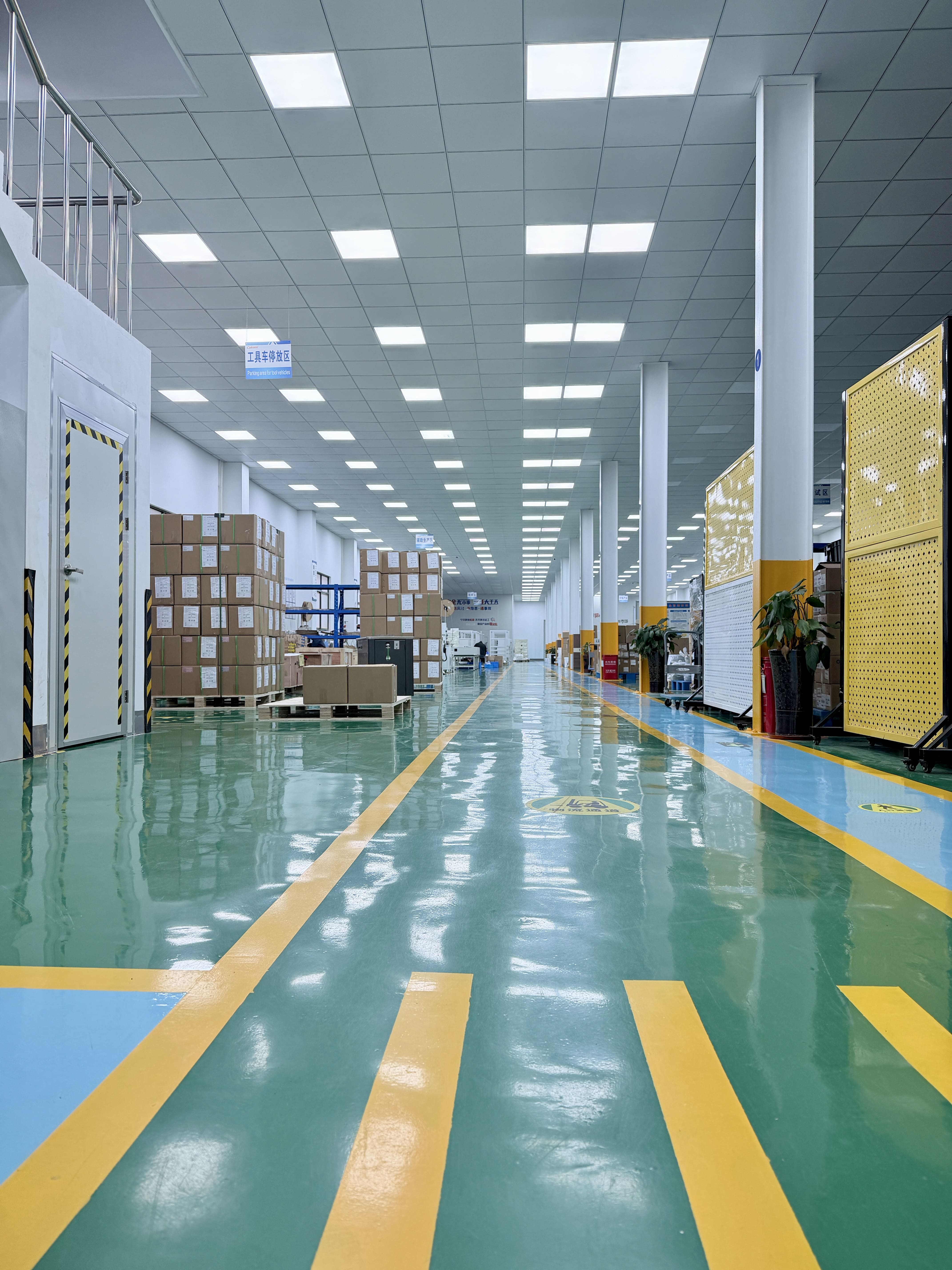
Control electronics for semiconductor equipment are built and tested at Cakeen in Wuxi, Jiangsu. Image: Cakeen factory.
Nitrogen lines in semiconductor thermal processing equipment are heated for two reasons: to keep the gas above its dew point so moisture and condensable species do not deposit on pipe walls, and to deliver gas to the chamber at a stable temperature so the process never sees a cold slug. Both objectives are control problems, and both are won or lost at the point where the pipeline heater, the PID controller, the I/O layer and the plant monitoring system meet.
This application guide is written for equipment engineers, process engineers and control cabinet builders who have already finished supplier screening and are now in evaluation and execution: they need to match a pipeline nitrogen heater to a controller, choose between DIN rail and panel mount form factors, expand switching I/O, and expose the loop to a central monitoring system. The reference hardware used throughout is the Cakeen HOT-GUN Pipeline Nitrogen Gas Heater, the KE-2104 and KE-48 PID temperature controllers, the KE-H10, H6625 and ASH heating-tape controllers, the K15DT-D I/O Expansion Module, the K42CE-D CMS Communication Module and the Industrial Device Central Monitoring System (CMS).
Problem Definition: Where N2 Pipeline Heating Loops Usually Fail
A nitrogen line that relies on a fixed power blanket, or on on/off control with wide hysteresis, tends to fail in three predictable ways: gas temperature at the chamber inlet drifts with flow rate and ambient conditions; condensable species form on cold sections downstream of the heated zone; and the operator sees nothing until the process is already disturbed. In semiconductor thermal processing, where chamber temperature uniformity is a direct yield variable, that is an expensive failure mode.
Four design risks sit behind the general problem:
- Power sizing. The HOT-GUN Pipeline Nitrogen Gas Heater is specified from 800 W to 1600 W at AC 220 V. The switching element that drives it, whether a built-in SSR or an external SSR, must be matched to the power band actually ordered, not to the lowest figure in the range.
- Accuracy stacking. The pipeline N2 heating controller is specified at ±1°C control accuracy over a 0–250°C range, while the Cakeen PID controller family is specified at ±0.1°C control accuracy. Treating the controller figure as the heater envelope is one of the most common specification errors in this loop.
- Signal and form-factor mismatch. A cabinet with limited DIN rail space, a retrofit that must keep the existing operator panel, and a new build running on 24 VDC control power each point to a different mounting and supply configuration.
- No digital path. A loop that cannot be polled remotely cannot be trended, alarmed or tuned from data. Retrofits that add RS485 devices often end up with more serial ports than the existing controller can host.
Industry Background: Why This Loop Gets More Attention Every Year
The global PID controller market was valued at USD 1.60 billion in 2024 and is projected to reach USD 2.24 billion by 2032 (SNS Insider). The industrial temperature controller segment is expected to grow at a CAGR of 7.1% from 2024 to 2030, with Industry 4.0 adoption cited as a driver (Strategic Market Research). The equipment class most sensitive to control quality is semiconductor: the global semiconductor temperature control equipment market was valued at USD 663 million in 2024 (Market Research Reports), and high-precision PID controllers can hold temperature stability within ±0.1°C, a requirement for lithography and etching (Grand View Research).
Regionally, Asia-Pacific held a 38.2% revenue share of the temperature controller market in 2023, with China as a key manufacturing hub (Dataintelo). Leading global manufacturers of PID and temperature controllers include Honeywell, Omron, Siemens, Eurotherm (Schneider Electric) and ABB (Mordor Intelligence). That list is useful for benchmarking form factors and documentation practices, but it does not replace evaluating a specific loop against specific parameters such as channel count, output stage rating, supply voltage and protocol behaviour.
Compliance expectations shape the specification as much as performance does. Industrial control panels, including PID controllers, must comply with UL 508A for North American safety listing and IEC 60947 for international markets (UL Solutions). For semiconductor manufacturing equipment specifically, SEMI S2 addresses electrical safety, mechanical safety and hazard mitigation. Cakeen's K42CE-D CMS Communication Module is certified to SEMI S2-0821 (certificate number 220252, issued by SAFES) and holds CE certification for electromagnetic compatibility under EN 55032:2015+A11:2020 and EN 55035:2017+A11:2020 (certificate number CEJS22011335967, issued by GTS).
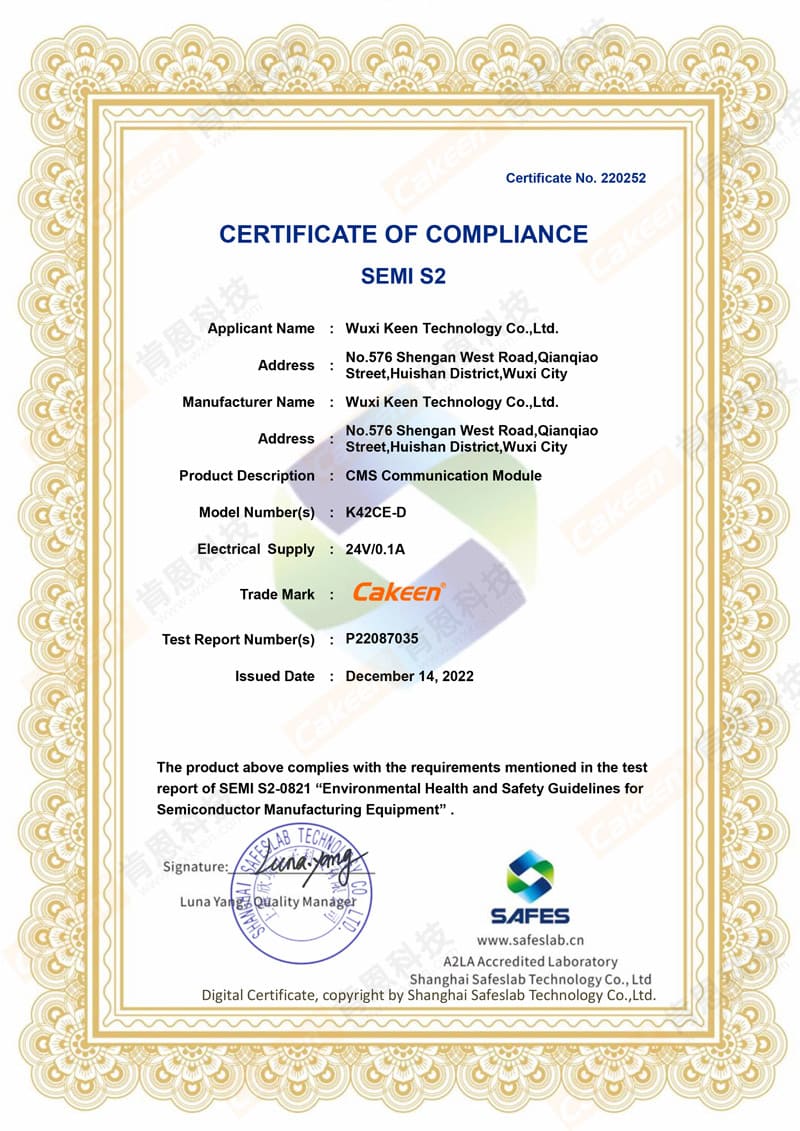
SEMI S2-0821 certification covers the K42CE-D CMS Communication Module used to aggregate PID controllers on a nitrogen heating loop.
System Architecture: Four Layers from Gas Line to Plant Dashboard
A production-grade N2 pipeline heating loop is easier to specify when it is treated as four layers rather than as a heater plus a controller:
- Thermal layer. The HOT-GUN Pipeline Nitrogen Gas Heater, a pipeline N2 heating controller for anti-condensation service in semiconductor thermal processing equipment. Published parameters: temperature range 0–250°C, control accuracy ±1°C, working voltage AC 220 V, heating power 800 W–1600 W, construction in stainless steel or high-temperature alloy.
- Control layer. One or more PID temperature controllers. Single-channel options include KE-H10 (built-in SSR, MAX 6 A), H6625 (mini, built-in SSR, MAX 3 A), ASH (pipe and vessel insulation and heating, built-in SSR, MAX 3 A) and KE-48 (48×48 mm panel mount). Multi-zone work uses the KE-2104, a DIN rail 4-channel controller with external SSR output.
- I/O layer. The K15DT-D I/O Expansion Module, providing 5 inputs and 5 NPN outputs over Modbus RTU for switching control and remote I/O expansion.
- Communication and supervision layer. The K42CE-D CMS Communication Module (6 RS485 ports, 1 Ethernet port, Modbus TCP/RTU, 2× NPN I/O) feeding the Industrial Device Central Monitoring System software.
Each layer can be specified and procured independently, which is what makes the architecture practical for both new equipment and retrofits. A single-zone nitrogen line can stop at layer two. A multi-chamber tool adds layers three and four without replacing the heater or the controllers already in the cabinet.
Detailed Solution: Matching HOT-GUN Parameters to the Right PID Controller
Start from the four fixed parameters of the heater
The HOT-GUN specification contains four values that determine almost everything downstream. The 0–250°C range sets the sensor type and the calibration span; the ±1°C figure defines the process envelope the loop must hold; AC 220 V defines the switching circuit; and 800 W–1600 W defines the current the output stage must carry. The stainless steel and high-temperature alloy construction primarily affects thermal mass and therefore PID tuning response, not the controller electronics.
Match the output stage to the power band
The Cakeen controller family covers the range with different output stages. KE-H10 provides a built-in SSR output rated MAX 6 A; the H6625 and ASH controllers provide a built-in SSR rated MAX 3 A; the KE-2104 uses an external SSR; and the KE-48 offers SSR, 0-20 mA, 4-20 mA or 0-10 V output. The analog options matter when the heater is driven by an SCR power controller or a proportional valve rather than by contact switching, because they allow continuous power modulation instead of time-proportioned switching.
Choose the form factor from the cabinet, not the catalogue
The KE-2104 mounts on DIN35 rail, runs on 12–24 VDC and controls four channels at ±0.1°C control accuracy with external SSR output. The KE-48 is a 48×48 mm panel-mount single-channel controller running on 100–265 V AC with one RS485 port. In practice, the choice is driven by panel real estate and by how many zones the tool has. One semiconductor equipment OEM has used the KE-48 and KE-2104 embedded in CVD, etching and diffusion furnace equipment at more than 50 units per year over a period of more than four years; the KE-48 fits the OEM panel design, while the KE-2104 reduces cabinet space in multi-zone builds.
Expand switching I/O with the K15DT-D module
Controllers regulate temperature; they do not necessarily provide enough discrete points for valves, alarm beacons, pressure interlocks and cabinet-level switching. The K15DT-D I/O Expansion Module adds 5 inputs and 5 NPN outputs over Modbus RTU, runs on 12–24 VDC and mounts on DIN35 rail. In the Cakeen product line it is described as a K42CE-D expansion module, so the discrete layer and the communication layer come from the same family and share the same wiring conventions. It holds CE certification for electromagnetic compatibility under EN 55032:2015+A11:2020 and EN 55035:2017+A11:2020 (certificate number CEJS22011335968, issued by GTS).
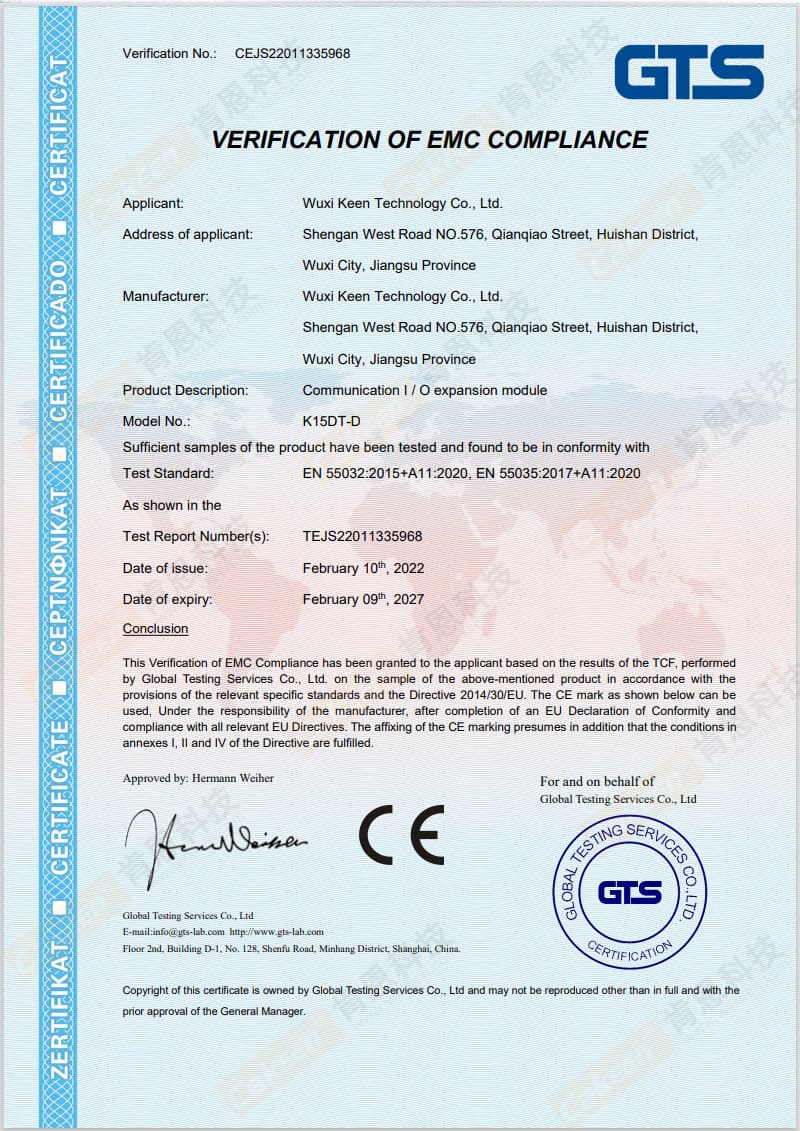
CE EMC certification for the K15DT-D I/O Expansion Module, used for switching control and remote I/O expansion.
Expose the loop with the K42CE-D module and CMS
The K42CE-D CMS Communication Module carries 6 RS485 ports, 1 Ethernet port, 2 NPN I/O points, Modbus TCP/RTU protocol support, 12–24 VDC power and DIN35 rail mounting. Its published applications are multi-485 device low-latency parameter setting, data acquisition and forwarding, and PLC replacement. The third application is the one that changes retrofit economics: six RS485 controllers can be polled and re-parameterised through a single module with one Ethernet uplink, without adding a PLC to the cabinet.
On the software side, the Industrial Device Central Monitoring System supports 10,000 or more Modbus TCP devices with a 10-second real-time polling interval, monitors PV and SV temperature values, AL1 and AL2 alarm thresholds and TC BK sensors, and retains 365-day time-series history in InfluxDB. That data model maps directly onto an N2 heating loop: each zone reports its measured value, setpoint and alarm state, and the historical record supports both process traceability and tuning decisions.
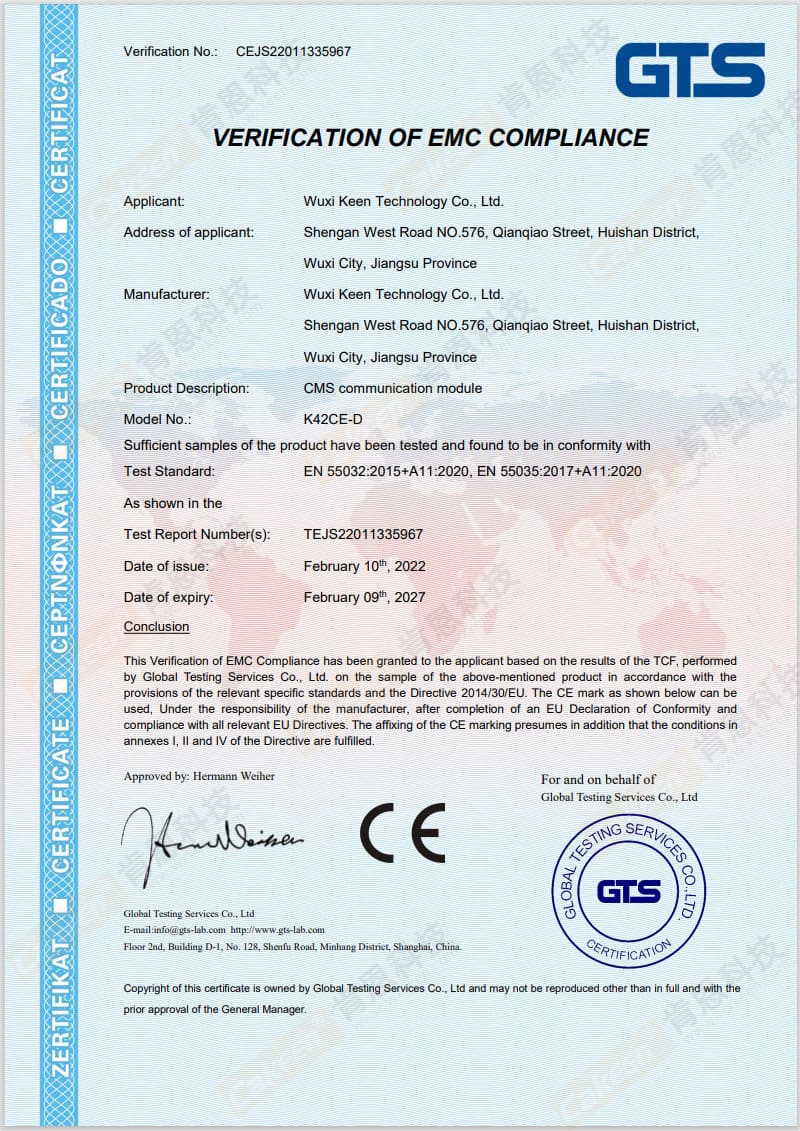
CE EMC certification for the K42CE-D CMS Communication Module, the aggregation point between PID controllers and CMS monitoring.
Step-by-Step: Specifying and Commissioning the Loop
- Define the process window and the margin. Record the required nitrogen delivery temperature, the dew point it must stay above, and the allowable deviation at the chamber inlet. This single step decides whether the ±1°C envelope of the HOT-GUN heater is sufficient or whether additional close-coupled heating is needed.
- Fix the heater power and construction. Select within the 800 W–1600 W band and confirm that the stainless steel or high-temperature alloy construction suits the gas and the operating environment.
- Select the sensor type. The controller family accepts PT, K, J, R, S, T, B, E, N and L inputs. Match the sensor to the 0–250°C range and to the physical mounting point on the pipeline.
- Choose channel count and form factor. Use a single-channel controller for one heated line (KE-H10, H6625, ASH or KE-48), or the four-channel KE-2104 on DIN35 rail when several zones share a cabinet.
- Verify the output stage against the power band. Confirm the built-in SSR rating (MAX 6 A on KE-H10, MAX 3 A on H6625 and ASH) or plan an external SSR as required by the KE-2104. Where continuous power modulation is preferred, use the KE-48 analog outputs at 0-20 mA, 4-20 mA or 0-10 V.
- Add discrete I/O where the process needs it. The K15DT-D provides 5 inputs and 5 NPN outputs over Modbus RTU for valve, alarm and interlock switching.
- Aggregate serial devices and publish data. Route the controllers' RS485 links into the K42CE-D (6 RS485 ports, 1 Ethernet port), then configure the CMS polling interval at 10 seconds and set the AL1 and AL2 alarm thresholds per zone.
- Commission against records. Confirm the supplier's 100% pre-shipment test records, verify alarm behaviour in CMS, and file the electrical documentation. Cakeen's Electrical Drawing Design Service delivers DWG, PDF and a BOM in Excel to IEC and UL508A standards, in Chinese or English, typically within 2 to 4 weeks.
Use Cases
Semiconductor equipment OEM, embedded temperature control. A semiconductor equipment OEM has used the KE-48 panel-mount controller and the KE-2104 DIN rail controller inside CVD, etching and diffusion furnace equipment at more than 50 units per year over more than four years. The reported outcomes were improved equipment uptime and consistent process temperature across all chambers. The KE-48 fits the OEM's 48×48 mm panel design, while the KE-2104 reduces cabinet space in multi-channel builds.
Equipment integrators and control cabinet builders. A domestic equipment integrator has taken more than 100 cabinet sets per year over more than five years for factory automation and equipment retrofit projects, reporting a 40% shortening of the customer delivery cycle. The cabinet range covers multi-PLC-brand support (Siemens, Mitsubishi, Omron), IP40–IP65 protection and quick customization. The European Standard Electrical Cabinet is CE-certified by TÜV Rheinland with ABB, Siemens and Schneider components at 380/400 V three-phase; the Japanese Standard Electrical Cabinet is JIS-compliant with Mitsubishi, Omron and Schneider components at 200/400 V. For an N2 heating retrofit, these cabinets provide the enclosure and power distribution layer around the same controller and module family.
Industrial IoT system integrators. An Industrial IoT system integrator project combined custom IoT gateway hardware with edge computing software for factory data acquisition and AI-based predictive maintenance over more than one year. The reported result was real-time data collection from more than 1,000 sensors, with AI anomaly detection reducing unplanned downtime by 25%. The same data path, from field device to CMS to analytics, is what makes a nitrogen heating loop observable rather than simply controlled.
Chemical delivery and pipe insulation. The ASH PID controller is specified for pipe and vessel insulation and heating control at ±0.1°C control accuracy, with built-in SSR output rated MAX 3 A, RS485/Modbus RTU communication and a 100–265 V AC supply. It is the appropriate companion where heated nitrogen lines run alongside insulated chemical delivery lines in the same sub-fab corridor.
These projects were implemented in China, Taiwan, Singapore, Malaysia and the United States.
Comparison Table: Controllers and Modules for an N2 Heating Loop
The table below compares only published parameters from the Cakeen product line. It is intended as a specification aid, not as a substitute for validating a specific loop.
| Model | Role in the loop | Channels / I/O | Control accuracy | Output | Communication | Power supply | Mounting |
|---|---|---|---|---|---|---|---|
| HOT-GUN | Pipeline N2 heater, anti-condensation | — | ±1°C | — | — | AC 220 V (800 W–1600 W) | Inline on pipeline |
| KE-2104 | Multi-zone PID control | 4 channels | ±0.1°C | External SSR | Not specified in published parameters | 12–24 VDC | DIN35 rail |
| KE-48 | Panel-mount single-zone PID control | 1 channel | ±0.1°C | SSR / 0-20 mA / 4-20 mA / 0-10 V | 1× RS485 | 100–265 V AC | Panel mount 48×48 mm |
| KE-H10 | Heating tape PID control, higher current | 1 channel | ±0.1°C | Built-in SSR, MAX 6 A | RS485 / Modbus RTU | 100–265 V AC | — |
| H6625 | Mini heating tape PID control | 1 channel | ±0.1°C | Built-in SSR, MAX 3 A | RS485 / Modbus RTU | 100–265 V AC | — |
| ASH | Pipe and vessel insulation and heating | 1 channel | ±0.1°C | Built-in SSR, MAX 3 A | RS485 / Modbus RTU | 100–265 V AC | — |
| K15DT-D | I/O expansion for switching control | 5 inputs / 5 NPN outputs | — | — | Modbus RTU | 12–24 VDC | DIN35 rail |
| K42CE-D | CMS communication and device aggregation | 2× NPN I/O | — | — | 6× RS485 + 1× Ethernet, Modbus TCP/RTU | 12–24 VDC | DIN35 rail |
Input types across the PID controller family are PT, K, J, R, S, T, B, E, N and L. Sensor range, cable routing and grounding practice should be confirmed against the specific process before commissioning.
Frequently Asked Questions
1. Does the Cakeen control hardware for N2 pipeline heating meet compliance requirements for semiconductor equipment?
Yes for the modules that carry published certifications. The K42CE-D CMS Communication Module is certified to SEMI S2-0821 (certificate number 220252, issued by SAFES), covering electrical safety, mechanical safety and hazard mitigation for semiconductor manufacturing equipment, and holds CE EMC certification under EN 55032:2015+A11:2020 and EN 55035:2017+A11:2020 (certificate number CEJS22011335967). The K15DT-D I/O Expansion Module holds CE EMC certification under the same standards (certificate number CEJS22011335968). The HOT N2 MFC Gas Flow Controller holds CE certification number TRCN-22262WCT01 against EN 60204-1:2018, EN IEC 61000-6-3:2021 and EN IEC 61000-6-1:2019, valid to 2027-09-18. At company level, Wuxi Cakeen Technology Co., Ltd. holds ISO 9001 (50325Q3891R0S), ISO 14001 (50325E3892R0S) and ISO 45001 (50325S3893R0S) certificates issued on 2025-12-12 and valid to 2028-12-11, alongside UL, SEMI S2, CE and RoHS certifications.
2. Can one controller platform cover both a single N2 pipeline heater and a multi-zone heated line?
Yes, within the published parameter set. Single-zone loops use the KE-H10 (built-in SSR, MAX 6 A), the H6625 or ASH (built-in SSR, MAX 3 A), or the KE-48 48×48 mm panel-mount controller with one RS485 port and output options of SSR, 0-20 mA, 4-20 mA or 0-10 V. Multi-zone loops use the KE-2104 DIN rail controller with four channels, ±0.1°C control accuracy, external SSR output and a 12–24 VDC supply. Discrete switching is added with the K15DT-D module (5 inputs / 5 NPN outputs, Modbus RTU), and serial aggregation with the K42CE-D module (6 RS485 ports, 1 Ethernet port, Modbus TCP/RTU), which also supports multi-485 device parameter setting and PLC replacement.
3. What drives the cost of a nitrogen pipeline heating control package?
The main cost drivers are configuration choices rather than brand premiums: the number of control channels (single-channel versus the four-channel KE-2104), the output stage (built-in SSR versus external SSR), the output current rating (MAX 3 A versus MAX 6 A), whether I/O expansion and communication modules are added for remote supervision, and the degree of customization, since all parameters, logos and appearance functions support customization under the OEM and ODM production service. Engineering scope also affects total cost: electrical drawing design to IEC and UL508A standards with DWG, PDF and BOM Excel deliverables typically takes 2 to 4 weeks. Procurement terms for the controller range are listed as FOB, CIF or EXW delivery with a 30% payment term and 100% pre-shipment testing.
4. How can engineers validate the configuration before committing to volume production?
Validation typically runs through a sample order. The minimum order quantity is 5 units, every unit is subject to 100% test before shipment, and remote after-sales support is provided after delivery. Because all parameters, logos and appearance functions support customization under the OEM and ODM service, a sample can be produced to the target specification rather than selected from a fixed catalogue. Engineers evaluating a nitrogen heating loop can therefore validate sensor type, output stage, channel count and communication behaviour on their own pipeline before scaling. To start a sample or quotation request, contact the Cakeen team at jwy@wxkeen.com or via WhatsApp at +86 18921139517.
5. What are the lead time and production capacity for this controller and module range?
Lead time is 30 to 45 days. Monthly production capacity for the control electronics range is 40,000 units, and products are exported to Spain, Southeast Asia, the European Union and the USA. Delivery methods are FOB, CIF or EXW. For projects that combine controllers with cabinets and engineering services, the electrical drawing service runs on a typical 2 to 4 week design cycle, so drawing release and hardware production can be planned in parallel.
Conclusion: A Loop You Can Specify, Document and Monitor
PID temperature control for semiconductor N2 pipeline heating is decided by four matching decisions: the heater power band against the switching element, the sensor type against the 0–250°C range, the form factor against the cabinet, and the communication path against how much visibility the process requires. Get those right and the loop is stable, documented and repeatable. Get any one of them wrong and the symptom usually appears as condensation, drift or an unplanned stop rather than as an obvious wiring fault.
Cakeen supplies the full chain for this application: the HOT-GUN Pipeline Nitrogen Gas Heater, the KE-2104, KE-48, KE-H10, H6625 and ASH PID controllers, the K15DT-D I/O Expansion Module and the K42CE-D CMS Communication Module, together with CMS monitoring, PLC program design, electrical drawing design and embedded software development services. Wuxi Cakeen Technology Co., Ltd. was established in 2011 in Huishan District, Wuxi, Jiangsu Province, employs 50 people including a 20-engineer R&D team in a 2,019 m² facility, and operates under ISO 9001, ISO 14001, ISO 45001, UL, SEMI S2, CE and RoHS certifications.
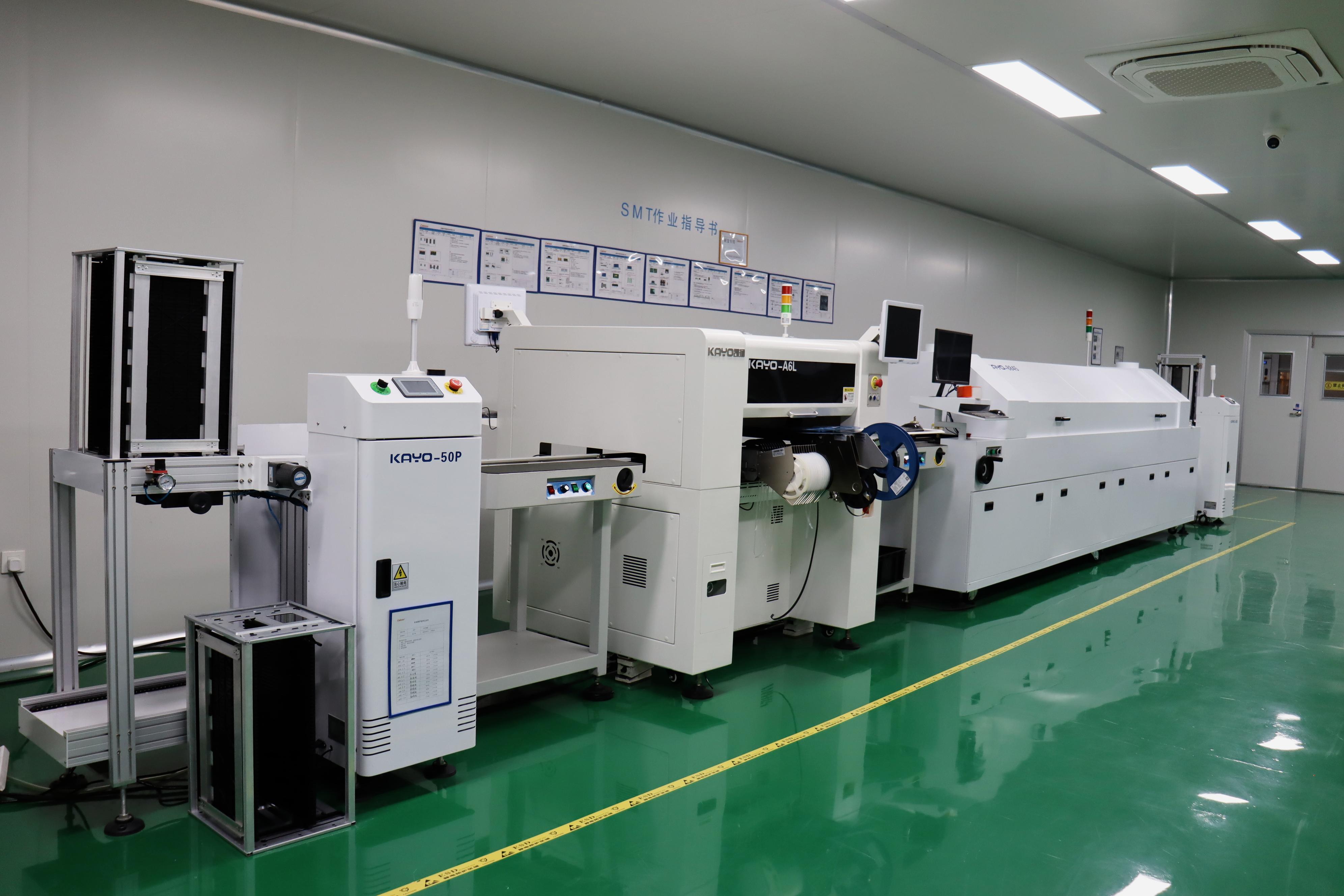
Sample validation and OEM configuration are handled in-house at Cakeen before volume production.
Next step. If you are specifying a nitrogen pipeline heating loop, send your process window, heater power band, channel count and communication requirements to the Cakeen team. Sample orders start from a minimum order quantity of 5 units, with 100% pre-shipment testing and remote after-sales support.
Email: jwy@wxkeen.com | Tel: +86-0510-85161878 / +86-18921139517 | WhatsApp: +86 18921139517 | Website: www.wxkeen.com
Have Questions or Need More Details?
Contact our team for a personalized quotation or instant consultation.
Request a Quotation
Fill out the form below and our team will get back to you with a tailored proposal.
WhatsApp Direct Chat
Prefer to chat in real-time? Message us on WhatsApp for instant assistance & quick answers.
- Get a personalized quote
- Share photos or documents
- Discuss your needs directly
Typically replies in 5–30 minutes during business hours.