
The Basics of Closed-Loop Temperature Control: A Buyer's Primer
The Basics of Closed-Loop Temperature Control: A Buyer's Primer
Closed-loop temperature control is a method in which a system measures the actual process temperature, compares it with the temperature you asked for, and automatically adjusts heating power to reduce the difference. The loop is “closed” because the measured result feeds back into the decision. In industrial equipment that loop is normally built from four working parts: a temperature sensor, a PID temperature controller, an actuator such as a solid-state relay (SSR) or analog output, and the process being heated — a pipe, a vessel, a heating jacket, a nitrogen line, or a process chamber.
Two supporting component families complete a practical loop. I/O expansion modules add the extra digital inputs and outputs needed for switches, alarms, and interlocks, while communication modules link multiple controllers to a host system or plant monitoring layer. This primer is written for procurement staff, sourcing managers, and engineers who are new to thermal control and need to buy parts of a loop without overspecifying it. It explains what closed-loop control is, how the market treats it, where a PID controller fits, what expansion and communication modules actually do, and how to specify a first loop step by step.
Problem Definition: What Goes Wrong When Heating Runs Without Feedback
Open-loop heating is simple: a fixed power level is applied to a heater and left there. The difficulty is that the process rarely stays where it was left. Ambient temperature, gas flow, material load, and line speed all pull the real temperature away from the target. With no measurement and no correction path, someone has to watch a gauge and turn power up or down by hand.
In production, the symptoms usually appear as quality problems rather than as controller failures. Temperature overshoot at start-up pushes the first parts of a batch outside the tolerance window. Slow recovery after a load change stretches cycle time. Gradual drift across a long shift creates variation that is hard to trace back to a single cause. Heating jackets, heating mantles, and traced process lines all behave the same way when the loop is open: the operator becomes the control system.
For buyers, open-loop thinking also creates procurement problems. Three mistakes are common when a controller is purchased for the first time:
- Buying a controller without defining the sensor. A controller can only work with the temperature signal it is built to read. Thermocouple and RTD inputs are not interchangeable at the ordering stage.
- Undercounting the zones. A machine that heats three lines separately needs three control channels, or one multi-channel unit. Discovering this after the panel is wired is expensive.
- Leaving communication out of the first quote. If temperature data has to reach a SCADA system or a monitoring platform later, the communication layer should be part of the original loop design, not a retrofit.
The definition of the problem is therefore narrow and useful: closed-loop control exists to replace manual correction with automatic correction, and the buying decision exists to make sure every part of that correction path is specified together.
Industry Background: A Stable, Expanding Procurement Category
Temperature control is not a niche accessory market. SNS Insider valued the global PID controller market at USD 1.60 billion in 2024 and projected it to reach USD 2.24 billion by 2032. Strategic Market Research expects the industrial temperature controller market to grow at a CAGR of 7.1% from 2024 to 2030, with Industry 4.0 adoption cited as a driver. Dataintelo reported that Asia-Pacific held a 38.2% revenue share of the temperature controller market in 2023, with China as a key manufacturing hub. SNS Insider also found that the oil & gas sector held the largest end-user share of PID controllers in 2024 at approximately 31.4%, which shows how widely the same loop architecture is reused across industries.
Semiconductor work sits at the precision end of the same market. Market Research Reports valued the global semiconductor temperature control equipment market at USD 663 million in 2024, reflecting the role of thermal precision in wafer fabrication. Grand View Research notes that high-precision PID controllers can hold temperature stability within ±0.1°C, a level that matters in lithography and etching. Mordor Intelligence lists Honeywell, Omron, Siemens, Eurotherm (Schneider Electric), and ABB among the established global manufacturers of PID and temperature controllers, alongside a long tail of specialist suppliers that serve machine builders and process integrators.
Panels and components are also shaped by standards. UL Solutions states that industrial control panels, including PID controllers, must comply with UL 508A for North American safety listing and IEC 60947 for international markets. For a buyer, that means the compliance target of the finished panel — not only of the controller — belongs in the specification from day one.
Wuxi Cakeen Technology Co., Ltd. is one of the specialist suppliers in this category. Founded in 2011 and headquartered in Huishan District, Wuxi, Jiangsu Province, Cakeen works on semiconductor industrial control electronics, electrical cabinet systems, AI system software, and AI embedded systems. The company operates a 2019 m² facility with approximately 50 employees, including an R&D team of 20 engineers, and reports that export business accounts for about 40% of total sales, with main markets in Spain, Southeast Asia, the European Union, and the USA. Its quality and safety management follows international standards, with ISO 9001, ISO 14001, ISO 45001, UL, SEMI S2, CE, and RoHS certifications stated for its product applications.
Anatomy of a Closed Loop: Four Layers That Must Match
A closed loop can be described in four layers, and mismatches between layers are the most common cause of a loop that technically runs but never holds temperature well.
| Loop layer | What it does | Buyer question |
|---|---|---|
| Sensor | Measures the real temperature and sends it to the controller | Thermocouple type or RTD? What range? |
| Controller | Compares measured value with setpoint and calculates the correction | How many channels? What accuracy? |
| Actuator | Delivers the corrected power to the heater | SSR, built-in SSR, or analog signal? |
| Support modules | Add digital I/O and connect controllers to a host or SCADA layer | What has to be switched, logged, or monitored? |
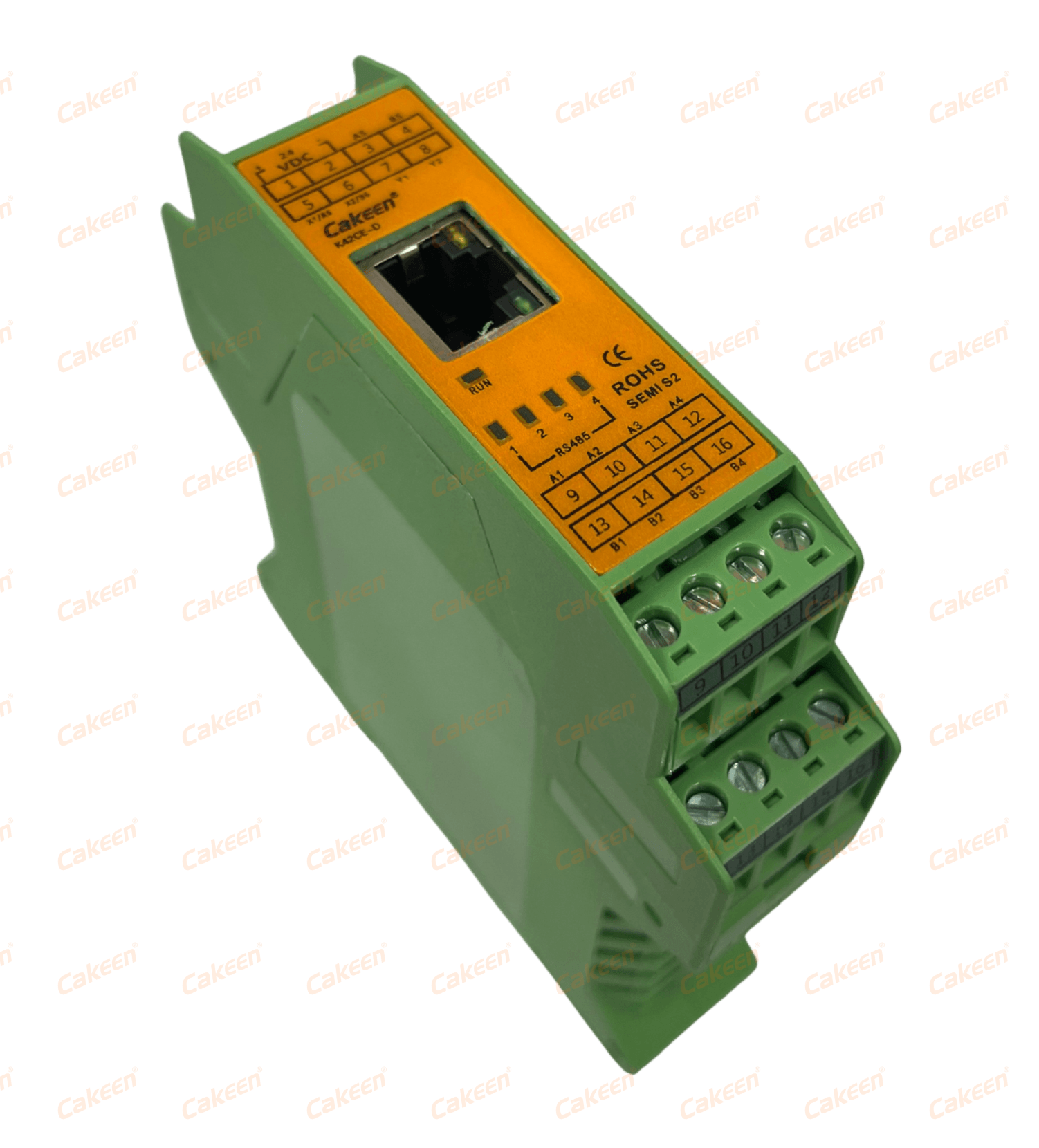
CMS Communication Module K42CE-D — the network layer of a closed loop, with 6 RS485 ports and 1 Ethernet port.
The important structural point is that the loop is only as accurate as its weakest layer. A controller rated to ±0.1°C cannot correct for a sensor mounted in the wrong place, and an oversized heater with a slow relay will overshoot no matter how well the controller is chosen.
Where PID Fits In: What the Controller Actually Decides
A PID temperature controller is the decision-making layer of the loop. It reads the measured process value (PV), compares it with the setpoint (SV), and calculates how much output to send to the heater. The three terms in the name describe how that correction is shaped: the proportional term reacts to the present gap, the integral term removes the small remaining offset over time, and the derivative term dampens the speed of change so the process settles instead of oscillating.
In procurement language, the controller is where three specifications become concrete:
- Input compatibility. Cakeen PID controllers accept PT/K/J/R/S/T/B/E/N/L inputs, covering the RTD and thermocouple types most industrial loops use.
- Output form. A controller may drive an external SSR, as the DIN rail mount KE-2104 does, or provide a built-in SSR output, as the ASH, H6625, and KE-H10 heating tape controllers do. The panel mount KE-48 offers SSR as well as 0-20 mA, 4-20 mA, and 0-10 V analog outputs.
- Channel count. A single-channel industrial temperature controller serves one zone; a multi-channel PID controller consolidates several zones in one device. The KE-2104 controls 4 channels at ±0.1°C control accuracy from a 12-24 VDC supply on a DIN35 rail.
Precision is where the choice becomes commercially meaningful. The ±0.1°C control accuracy available across the Cakeen controller range matches the stability level that Grand View Research identifies as critical for semiconductor lithography and etching, which is why the same controller family appears in both general industrial panels and semiconductor thermal systems.
Support Modules: How I/O Expansion and Communication Complete the Loop
Support modules are the part of the loop that new buyers most often overlook. They do not control temperature directly, but they determine whether the loop can talk to the rest of the machine and to the plant.
| Module | Function in the loop | Key specifications |
|---|---|---|
| I/O Expansion Module K15DT-D | Adds digital switching and signal acquisition for interlocks, alarms, and remote I/O expansion | 5 NPN inputs / 5 NPN outputs; Modbus RTU; 12-24 VDC; DIN35 rail |
| CMS Communication Module K42CE-D | Networks multiple RS485 devices, forwards data to a host, and can replace lightweight PLC tasks | 6 RS485 ports; 1 Ethernet port; 2 NPN I/O; Modbus TCP/RTU; 12-24 VDC; DIN35 rail |
| Industrial Device Central Monitoring System (CMS) | Monitors and alarms the whole loop population, with history for trend analysis | 10,000+ Modbus TCP devices; 10-second polling; PV/SV, AL1/AL2, TC BK values; 365-day time-series history (InfluxDB) |
In practice, the I/O expansion module answers the question “what else has to be switched?”, while the communication module answers “how does this data reach the system that needs it?” Where several controllers are installed on one machine, the K42CE-D allows many RS485 devices to be addressed from a single host connection with low-latency parameter setting and data forwarding, which keeps the control cabinet wiring simpler than a point-to-point approach.
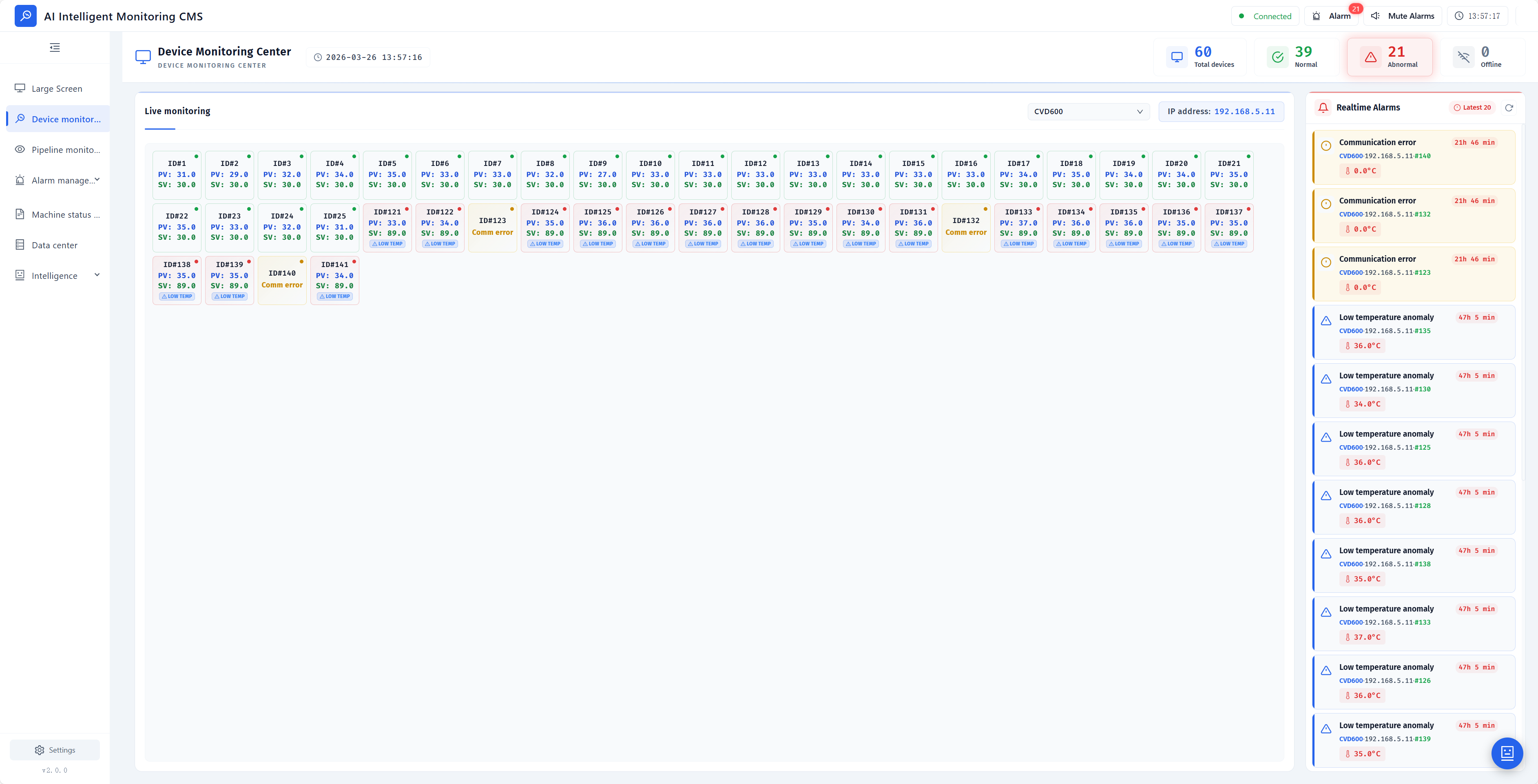
Industrial Device Central Monitoring System (CMS) — the monitoring layer above the loop, built on Modbus TCP.
Step-by-Step: Specifying a First Closed Loop Without Overbuying
The sequence below is written for a buyer assembling a specification, not for a control engineer tuning a loop. Each step produces one line in the purchase request.
- Fix the setpoint and the acceptable band. Write down the target temperature and how far the process may move before the product is affected. This single number decides whether a standard industrial temperature controller is sufficient or whether a high precision PID temperature controller is required.
- Match the sensor to the temperature range. Select the thermocouple or RTD type first, then confirm the controller accepts it. Cakeen controllers support PT/K/J/R/S/T/B/E/N/L inputs, which covers most industrial and semiconductor loop requirements.
- Match the output to the actuator. Low-power heating tapes are often driven by a controller with a built-in SSR output, such as the ASH (max 3A), the mini H6625 (max 3A), or the KE-H10 (max 6A). Higher-power loads usually use a controller with external SSR output, such as the KE-2104, or an analog output where a power controller is already installed.
- Count the zones honestly. Decide whether each heater is an independent zone. One 4-channel unit such as the KE-2104 can replace four single-channel devices and simplifies cabinet space, wiring, and spare-part stocking.
- Choose the form factor and supply. DIN35 rail mounting suits cabinet builds and multi-channel layouts, while a 48×48 mm panel mount unit such as the KE-48 suits a machine fascia with a local display. Note that supply requirements differ: the KE-2104 runs on 12-24 VDC, whereas the KE-48, ASH, H6625, and KE-H10 run on 100-265 VAC.
- Plan the digital signals. List every switch, alarm, and interlock that must be read or driven. If the controller cannot host them, add an I/O expansion module such as the K15DT-D rather than changing the controller.
- Plan the data layer. If temperature values must be logged, alarmed, or pushed to a SCADA system, specify Modbus RTU/TCP capability from the start and add a communication module or the CMS platform at the design stage.
- Confirm the compliance target of the finished panel. UL 508A and IEC 60947 apply at panel level, so the controller, modules, and cabinet should be specified against the same target market.
- Pilot one loop before scaling. Validate the sensor, output, and communication path on a single representative loop, then replicate the approved configuration across the machine or the production line.
Use Cases: Where Closed-Loop Control Shows Up in Practice
Vessel and pipe heating. Heating jackets, heating mantles, and traced pipework follow the same logic: the sensor reads surface or media temperature and the controller modulates power to the heater. Cakeen heating tape PID temperature controllers — the ASH for pipe and vessel insulation and heating, the mini H6625 for space-limited installations, and the KE-H10 with a higher 6A built-in SSR output — are designed for exactly this loop, with RS485/Modbus RTU communication and ±0.1°C control accuracy.
Heated nitrogen lines in semiconductor processes. Pipeline nitrogen heating prevents condensation on pipe walls and keeps a stable hot N2 environment. The HOT-GUN Pipeline N2 Heating Controller holds ±1°C across a 0–250°C range at AC 220 V, with 800 W–1600 W heating power. Where heated nitrogen is also part of a gas delivery loop, the HOT N2 MFC gas flow controller provides ±1% F.S. flow accuracy over a 1–100 SLM range for semiconductor process gas delivery.
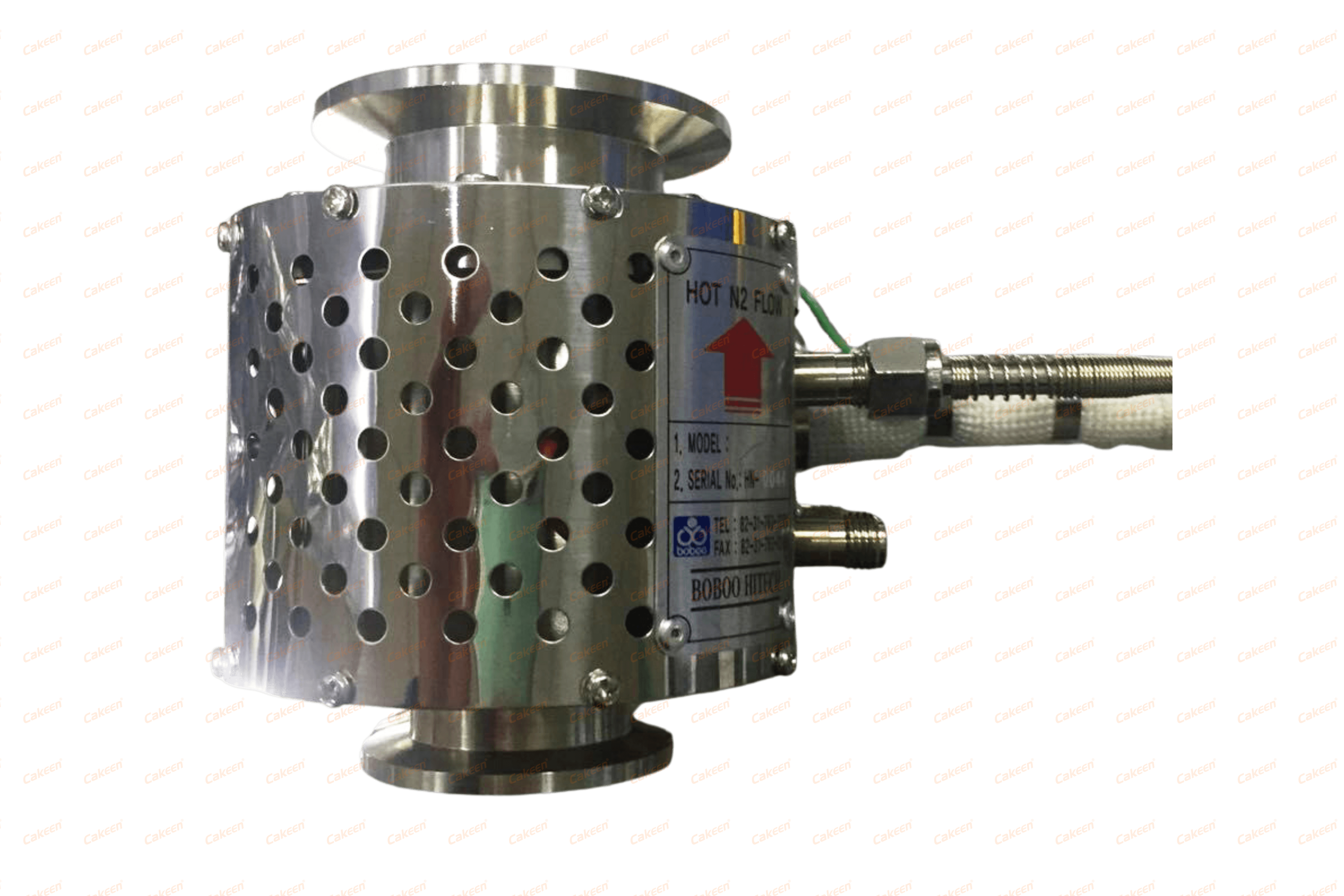
MFC Gas Flow Controller HOT N2 — flow accuracy ±1% F.S., flow range 1–100 SLM.
Multi-point plants. Once closed loops are deployed across a production area, the operating question changes from control to visibility. The Industrial Device Central Monitoring System supports 10,000+ Modbus TCP devices with a 10-second polling interval, monitoring PV/SV temperature, AL1/AL2 thresholds, and TC BK sensors, and retaining 365 days of time-series history for trend analysis.
Machine and cabinet builds. Where the loop is delivered as part of a system rather than a component, the surrounding hardware matters too. Cakeen supplies general purpose electrical control cabinets with IP40–IP65 protection, European Standard cabinets with CE and IEC certification and IP54/IP65 protection, and JIS-compliant precision cabinets for precision machinery and robotic systems, alongside electrical drawing design and PLC programming services for projects that need engineering deliverables.
Comparison Table: Matching a Controller to the Loop
The table below compares the Cakeen PID temperature controllers most often specified for a closed loop. All specifications are as published for each model.
| Model | Form factor | Channels | Output | Communication | Power supply | Control accuracy |
|---|---|---|---|---|---|---|
| KE-2104 | DIN35 rail | 4 | External SSR | Not specified for this model | 12-24 VDC | ±0.1°C |
| KE-48 | Panel mount 48×48 mm | 1 | SSR / 0-20 mA / 4-20 mA / 0-10 V | 1× RS485 | 100-265 VAC | ±0.1°C |
| ASH | Heating tape controller (pipe / vessel) | 1 | Built-in SSR, max 3A | RS485 / Modbus RTU | 100-265 VAC | ±0.1°C |
| H6625 | Mini heating tape controller | 1 | Built-in SSR, max 3A | RS485 / Modbus RTU | 100-265 VAC | ±0.1°C |
| KE-H10 | Heating tape controller (pipe / vessel) | 1 | Built-in SSR, max 6A | RS485 / Modbus RTU | 100-265 VAC | ±0.1°C |
All five models accept PT/K/J/R/S/T/B/E/N/L input types, so the choice between them comes down to channel count, mounting, output current, and how the loop will be connected to the rest of the system.
FAQ: Closed-Loop Temperature Control Questions Buyers Ask First
Do closed-loop temperature controllers need UL or CE certification for industrial panels?
Panel-level compliance is the deciding factor. UL Solutions states that industrial control panels, including PID controllers, must comply with UL 508A for North American safety listing and IEC 60947 for international markets. Component-level marks are separate from that panel listing. Cakeen's quality and safety management follows international standards, with ISO 9001, ISO 14001, ISO 45001, UL, SEMI S2, CE, and RoHS certifications stated for its product applications; European Standard electrical cabinets carry CE and IEC certification with TÜV Rheinland certification, and UL is available as an option on general purpose and Japanese Standard cabinets. Buyers should confirm which mark applies at panel level and which applies at component level before ordering.
Can one closed-loop controller manage more than one temperature zone?
Yes. The Cakeen KE-2104 is a DIN rail mount 4-channel PID controller with ±0.1°C control accuracy, PT/K/J/R/S/T/B/E/N/L input types, external SSR output, and a 12-24 VDC supply on a DIN35 rail, which makes it suitable for multi-zone temperature control and process monitoring. Where zones are spread across a machine, the CMS Communication Module K42CE-D provides 6 RS485 ports and 1 Ethernet port with Modbus TCP/RTU over a 12-24 VDC supply on DIN35 rail, allowing many controllers to be addressed from one host. If the loop also needs digital switching, the K15DT-D I/O expansion module adds 5 NPN inputs and 5 NPN outputs over Modbus RTU.
What drives the cost of a closed-loop temperature control setup?
Cost is driven by architecture decisions rather than by the controller alone. The main variables are the number of control channels, the sensor type and quantity, the output form (built-in SSR versus external SSR versus 0-20 mA, 4-20 mA, or 0-10 V analog), the communication and monitoring requirement, the need for I/O expansion modules, the cabinet and protection level, and the certification target for the destination market. Because these choices are interdependent, the lowest total cost usually comes from specifying accuracy, channel count, and communication once at the design stage, rather than upgrading a working loop afterwards.
Can we validate a controller on a pilot loop before committing to volume?
Pilot validation is a normal step for a first closed loop. It usually means building one representative loop, confirming the sensor type matches the controller input, verifying that the setpoint holds at the real operating temperature, and checking that temperature data reaches the host system. Controllers and modules such as the KE-48, KE-2104, ASH, H6625, KE-H10, K15DT-D, and K42CE-D are supplied as standard models, so a pilot configuration can be reviewed before production planning begins. Sample and pilot requests can be sent to jwy@wxkeen.com.
How should buyers plan the timeline for a closed-loop control project?
Engineering deliverables can be scheduled with precision: the Cakeen Electrical Drawing Design Service for semiconductor equipment is compliant with IEC and UL508A, delivered in DWG, PDF, and BOM Excel formats, and runs on a 2-4 week design cycle with Chinese and English language support. Hardware lead time depends on the configuration, channel count, and whether the controller is delivered as a component or as part of a cabinet build, so the practical rule is to freeze the loop specification and the compliance target before requesting a delivery schedule. As a next step, send your loop parameters — setpoint range, sensor type, channel count, and communication requirement — to Cakeen for a quotation or sample discussion through www.wxkeen.com or jwy@wxkeen.com.
Conclusion: The Loop Is the Specification
Closed-loop temperature control is easier to buy once it is understood as a system rather than as a controller part number. The sensor defines what the loop can see, the PID controller decides how the correction is shaped, the actuator delivers it, and the expansion and communication modules decide how the loop connects to the machine and to the plant. When those four layers are specified together, specifications such as ±0.1°C control accuracy, 4-channel capacity in a single DIN35 rail unit, or 6 RS485 ports per communication module become design choices rather than surprises during commissioning.
Cakeen, the brand of Wuxi Cakeen Technology Co., Ltd., builds this loop from a single supplier base: PID temperature controllers for DIN rail, panel, heating tape, and multi-channel use; I/O expansion and CMS communication modules; pipeline nitrogen heating and MFC gas flow control for semiconductor processes; and the cabinets, electrical drawings, and PLC programs that surround them. For buyers at the research stage, the most efficient next step is a specification review of one representative loop.
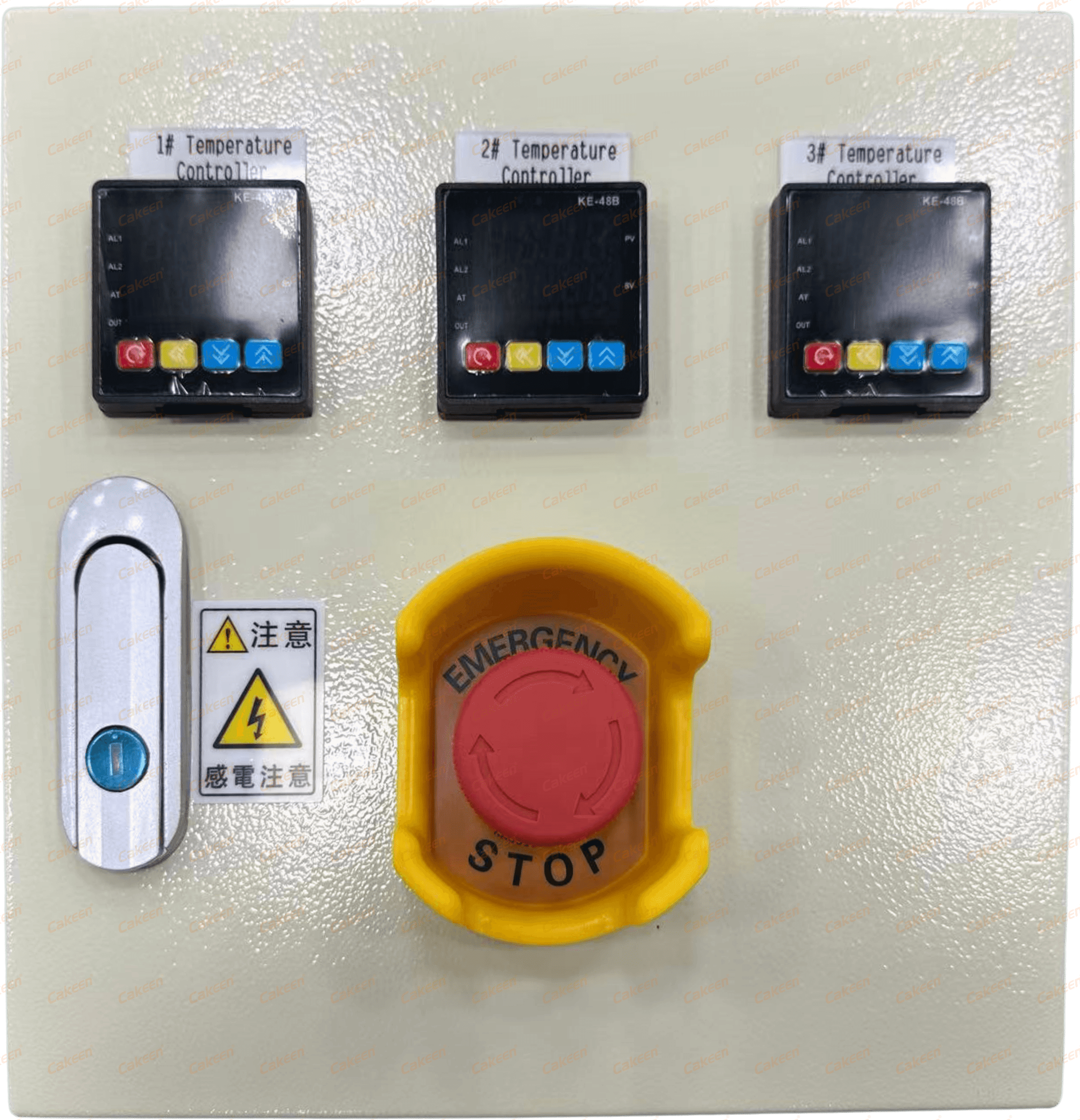
Loop components integrated into a control cabinet — request a sample, quotation, or cabinet configuration from Cakeen.
Talk to Cakeen about your loop.
Website: www.wxkeen.com | Blog: blog.wxkeen.com
Email: jwy@wxkeen.com | Tel: +86-0510-85161878 / +86-18921139517
WhatsApp: +86 18921139517 | Address: No.576 Shengan West Road, Qianqiao Street, Huishan District, Wuxi City, Jiangsu Province
Have Questions or Need More Details?
Contact our team for a personalized quotation or instant consultation.
Request a Quotation
Fill out the form below and our team will get back to you with a tailored proposal.
WhatsApp Direct Chat
Prefer to chat in real-time? Message us on WhatsApp for instant assistance & quick answers.
- Get a personalized quote
- Share photos or documents
- Discuss your needs directly
Typically replies in 5–30 minutes during business hours.