
Understanding I/O Expansion Modules: A Primer for PID Control System Designers
An I/O expansion module adds discrete input and output points to a control system that already regulates its process. In PID temperature control, the controller keeps reading the sensor, running the PID algorithm and driving the SSR — while the expansion module carries the switch signals around that loop over a fieldbus such as Modbus RTU.
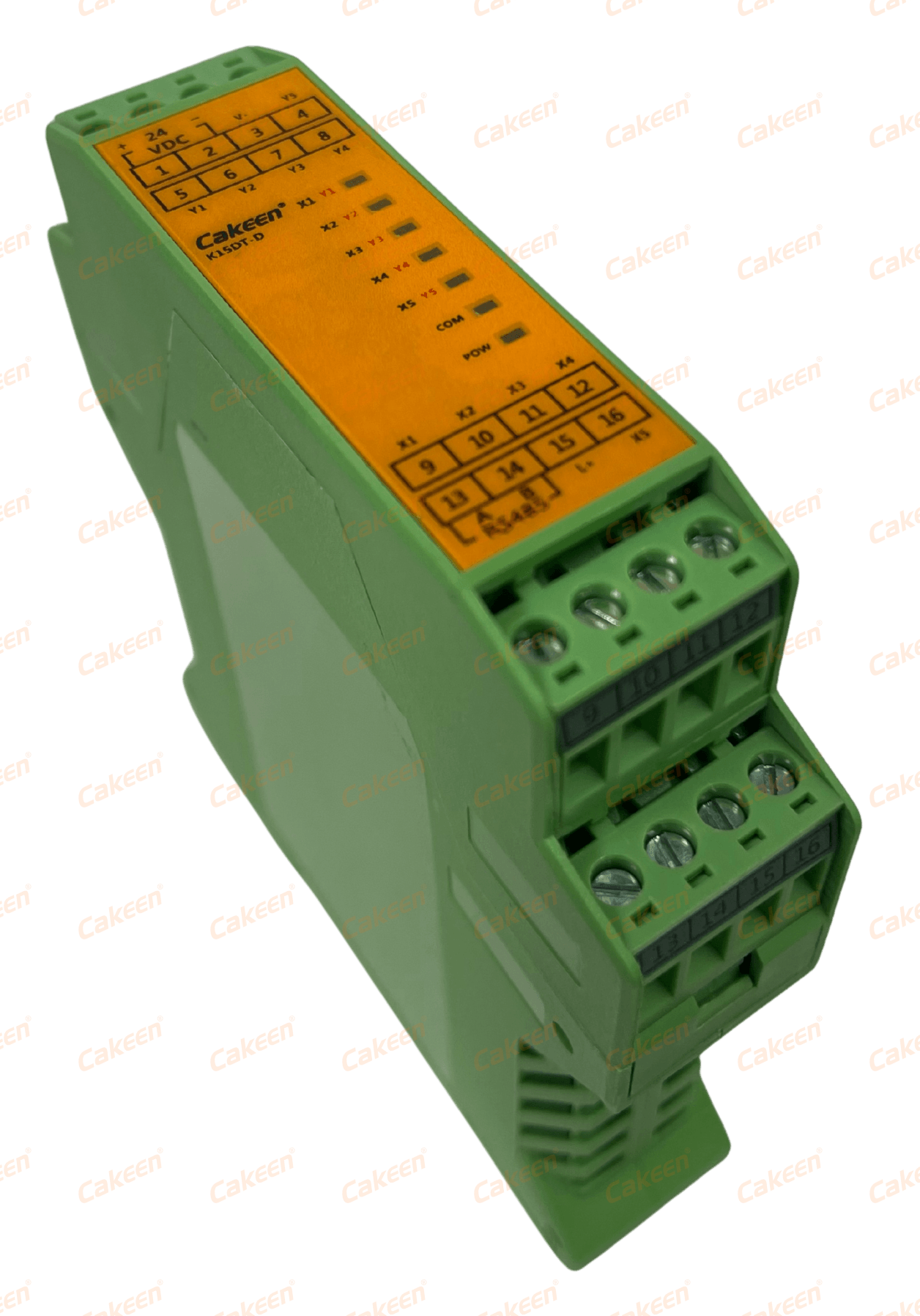
K15DT-D: a DIN35 rail-mounted I/O expansion module with Modbus RTU communication.
This primer is written for the people who lay out control cabinets — system designers, panel builders and integrators who already know how a PID loop works and now need to know how the discrete side of the panel gets built. It explains what an I/O expansion module does, what the Cakeen K15DT-D and K42CE-D provide in input/output counts, NPN configuration and Modbus RTU interface, and the design conditions under which expansion is the right answer rather than a larger controller or a PLC.
Cakeen is the brand of Wuxi Keen Technology Co.,Ltd., a manufacturer established in 2011 and based in Huishan District, Wuxi, Jiangsu Province. The company develops semiconductor industrial control electronics, electrical cabinet systems, AI system software and AI embedded systems, and supplies temperature controllers, DIN rail modules and control cabinets for semiconductor, electronic manufacturing and industrial control applications.
Problem Definition: Why a Working PID Loop Still Runs Out of Points
A PID controller regulates one variable well. It is not sized to switch everything that surrounds that variable. That gap — between a stable temperature loop and the discrete hardware a process actually needs — is the reason I/O expansion modules exist.
In a real heating installation, the analogue loop is the simple part. The discrete signals are what accumulate:
- Switching outputs for purge valves, cooling valves, dampers, alarm beacons and status lamps.
- Sequence and safety inputs from door switches, flow switches, pressure switches and remote run/stop stations.
- Distributed point groups, where heating tape circuits, ovens or gas lines sit far from the main panel and cannot be wired back economically.
- Parameter tasks that require setpoints or alarm thresholds to be written to a bank of devices instead of one unit at a time.
A single-channel controller carries exactly one control loop. The KE-48 is a 48×48mm panel-mount PID temperature controller with ±0.1°C control accuracy, SSR/0–20mA/4–20mA/0–10V output options, one RS485 port and a 100–265V AC power supply. It is a complete temperature loop — and its on-board I/O is sized for that loop, not for the plant hardware around it.
Density inside one controller helps but does not remove the problem. The KE-2104 is a DIN rail mount, multi-channel PID temperature controller with four control channels, ±0.1°C control accuracy, external SSR output and a 12–24VDC supply. Four loops in one housing reduce the controller count; they do not eliminate the discrete points.
When the point count exceeds the controller, three options are normally on the table: specify a larger or higher-density controller, add a PLC to own the discrete logic, or extend the existing architecture with an I/O expansion module on the same bus the controllers already use. Expansion is the least disruptive of the three because it leaves the validated temperature loop untouched.
Industry Background: More Zones, More Points, More Integration
The direction of the temperature control market explains why discrete point counts keep rising. The global PID controller market was valued at USD 1.60 billion in 2024 and is projected to reach USD 2.24 billion by 2032, according to SNS Insider. Strategic Market Research expects the industrial temperature controller market to grow at a CAGR of 7.1% from 2024 to 2030, driven by Industry 4.0 adoption. Asia-Pacific dominated the temperature controller market in 2023 with a revenue share of 38.2%, with China as a key manufacturing hub, per Dataintelo.
At the high-precision end, the global semiconductor temperature control equipment market was valued at USD 663 million in 2024, where wafer fabrication depends on tight thermal control (Market Research Reports). Grand View Research notes that high-precision PID controllers can hold temperature stability within ±0.1°C — a requirement for semiconductor lithography and etching. In process industries, the oil and gas sector held the largest end-user share for PID controllers in 2024 at approximately 31.4% (SNS Insider).
These figures describe spending, not I/O counts, and they should not be read as a direct measure of module demand. What they show is a pattern panel designers already experience: more controlled zones per installation, more monitored values per zone, and more equipment expected to report into a host system instead of sitting as an isolated loop.
Compliance expectations rise with that integration. Industrial control panels, including PID controllers, must comply with UL 508A for North American safety listing and IEC 60947 for international markets, according to UL Solutions. Any expansion module added to a panel therefore inherits the same documentation and certification review as the controllers beside it.
Cakeen's own product structure reflects that shift. The line includes panel-mount and DIN rail PID temperature controllers, heating tape controllers for pipe and vessel insulation, DIN rail I/O and communication modules, and control cabinets built around Siemens, Mitsubishi, Omron, Schneider or ABB components depending on the standard required.
What an I/O Expansion Module Adds to a Temperature Control System
Cakeen's DIN rail module line addresses two different jobs. One module type adds discrete points. The other adds connectivity and port count. Both are engineered for the same cabinet practice: 12–24VDC supply, DIN35 rail mounting and flame-retardant engineering plastic housings.
K15DT-D: five inputs and five NPN outputs over Modbus RTU
The K15DT-D is an I/O expansion module in the K42CE-D series, providing five inputs and five NPN outputs with an isolated input/output design for industrial automation signal acquisition and control. It communicates over Modbus RTU, runs on a 12–24VDC supply and mounts on DIN35 rail.
Its documented application focus is switching control and remote I/O expansion. In cabinet terms, that means the module takes the pilot devices — valves, lamps, relays, interlocks — that would otherwise crowd the controller terminals, and presents them as bus-addressable points. It is designed for 24/7 continuous operation alongside a main module, switch signal sources and actuators.
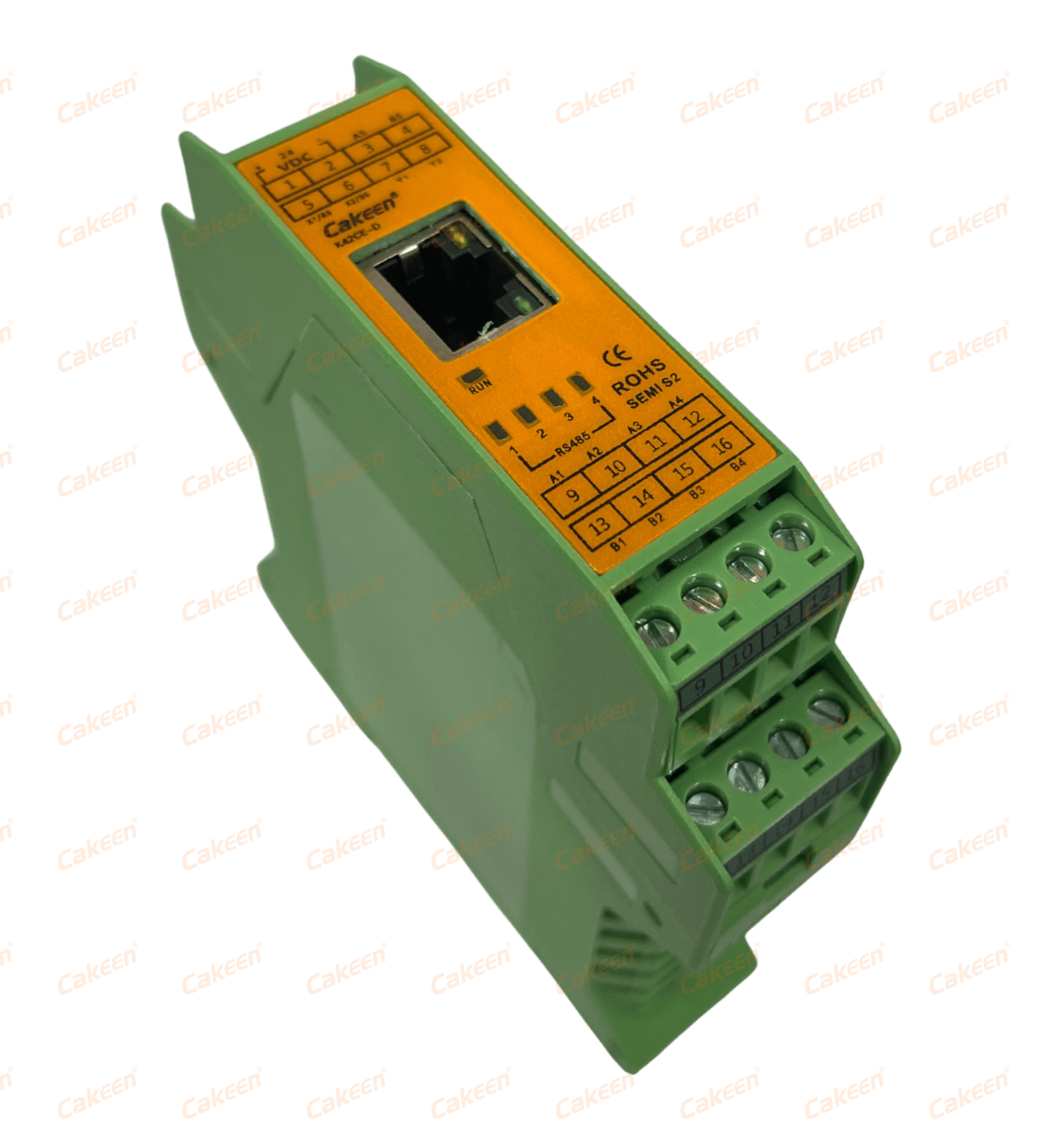
K42CE-D: a DIN35 rail module with 2x NPN I/O, six RS485 ports and one Ethernet port.
K42CE-D: discrete I/O plus six RS485 ports and Ethernet
The K42CE-D is a CMS communication module built around RS485 and Ethernet. It carries 2x NPN I/O, six RS485 ports and one Ethernet port, supports Modbus TCP and Modbus RTU, and is powered from 12–24VDC on DIN35 rail.
Its recorded applications are multi-485 device low-latency parameter setting, data acquisition and forwarding, and PLC replacement. That combination matters when a panel contains a bank of controllers that each need an individual setpoint: instead of walking the cabinet with a laptop, the module fans the bus out across six RS485 segments and forwards the data to a host. The matched equipment in that scenario is the RS485 device group, an Ethernet switch, and a host PC or SCADA system.
Where these modules sit relative to Cakeen PID controllers
Expansion modules are companions to the control loop, not replacements for it. A representative combination for a heating installation looks like this:
- KE-2104 — DIN rail mount, four-channel PID temperature controller, ±0.1°C control accuracy, PT/K/J/R/S/T/B/E/N/L input types, external SSR output, 12–24VDC, DIN35 rail.
- KE-48 — 48×48mm panel-mount controller, single channel, ±0.1°C control accuracy, SSR/0–20mA/4–20mA/0–10V output, one RS485 port, 100–265V AC.
- ASH, H6625, KE-H10 — heating tape controllers for pipe and vessel insulation, built-in SSR output at MAX 3A (ASH, H6625) or MAX 6A (KE-H10), RS485/Modbus RTU, 100–265V AC, ±0.1°C control accuracy. The H6625 is the mini-size version for space-constrained installations; the KE-H10 is the higher-current unit used in semiconductor equipment pipeline heating and chemical delivery insulation.
- K15DT-D / K42CE-D — the discrete point layer and the connectivity layer described above.
- CMS — Industrial Device Central Monitoring System, a Temperature Monitoring & Alarm Management Software package supporting 10,000+ Modbus TCP devices with a 10-second polling interval, monitoring PV/SV temperature, AL1/AL2 thresholds and TC BK sensors, and retaining 365 days of time-series history in InfluxDB.
The connecting thread is the bus. Controllers, I/O module and communication module all mount on DIN35 rail and speak Modbus — RTU where devices are daisy-chained on a segment, TCP where the data has to reach a host, a SCADA layer or the CMS platform.
Step-by-Step Breakdown: Specifying Expansion in Seven Steps
- Count the discrete points per zone. List every pilot device, every status lamp and every interlock as an input or an output before choosing hardware. A point list, not a product preference, should drive the module count.
- Split local from remote points. Points inside the main cabinet can stay hardwired near the controller terminals. Points at the far end of an oven, a gas line or a distributed heating circuit are candidates for a remote drop.
- Decide whether you need density or connectivity first. The K15DT-D answers density: five inputs and five NPN outputs on Modbus RTU. The K42CE-D answers connectivity: 2x NPN I/O with six RS485 ports and one Ethernet port on Modbus TCP/RTU.
- Confirm the NPN configuration against your devices. Both modules specify NPN I/O. Check the polarity and sink/source behaviour of the sensors, switches and relay coils you intend to connect, and record the result in the panel drawing.
- Fix the protocol and assign addresses. The I/O module runs Modbus RTU; the communication module handles Modbus TCP and Modbus RTU. Reserve slave addresses and document the mapping before wiring, not after commissioning.
- Budget power and rail space. Both modules accept 12–24VDC and mount on DIN35 rail, which allows them to sit on the same rail as the controllers and share the panel's DC distribution.
- Check compliance and observability. Panels including PID controllers must comply with UL 508A for North America and IEC 60947 internationally (UL Solutions), so the module belongs in the same drawing set and BOM. Pair the build with a monitoring layer such as the CMS so the extra points remain visible after commissioning.
A useful sanity check before release: if a module is added only to avoid wiring, the point list is probably still local. If a module is added because points are physically remote, need independent addressing, or must be reported to a host, the expansion architecture is doing real work.
Use Cases: When Expansion Beats a Bigger Controller
1. Switching control inside a heating cabinet
Purge valves, cooling valves, alarm beacons and run lamps are wired to the K15DT-D instead of being routed to controller terminals. The temperature loop keeps its inputs and outputs clean, and the switching logic becomes a bus-addressable block that can be reviewed as a unit.
2. Remote I/O expansion on distributed heating circuits
Heating tape circuits on long pipe runs or vessel walls often sit far from the main panel. A remote drop built on an I/O expansion module shortens the analogue sensor runs and concentrates the discrete wiring at the point of use.
3. Multi-device parameter setting across an RS485 bank
Where a cabinet contains many RS485 temperature controllers, the K42CE-D's six RS485 ports allow parameter changes to be pushed to devices with low latency rather than performed device by device. This is one of its documented applications.
4. Lightweight architectures that would otherwise need a PLC
The K42CE-D is recorded as PLC-replacement capable, covering data acquisition and forwarding. For temperature-centric systems with limited logic complexity, a controller plus communication module plus host software can replace a full PLC layer.
5. Data acquisition and forwarding into a monitoring platform
Discrete points are only useful if someone can see them. The CMS platform supports 10,000+ Modbus TCP devices with a 10-second polling interval and retains 365 days of time-series history, which turns the expanded point set into trend data rather than a set of indicator lamps.
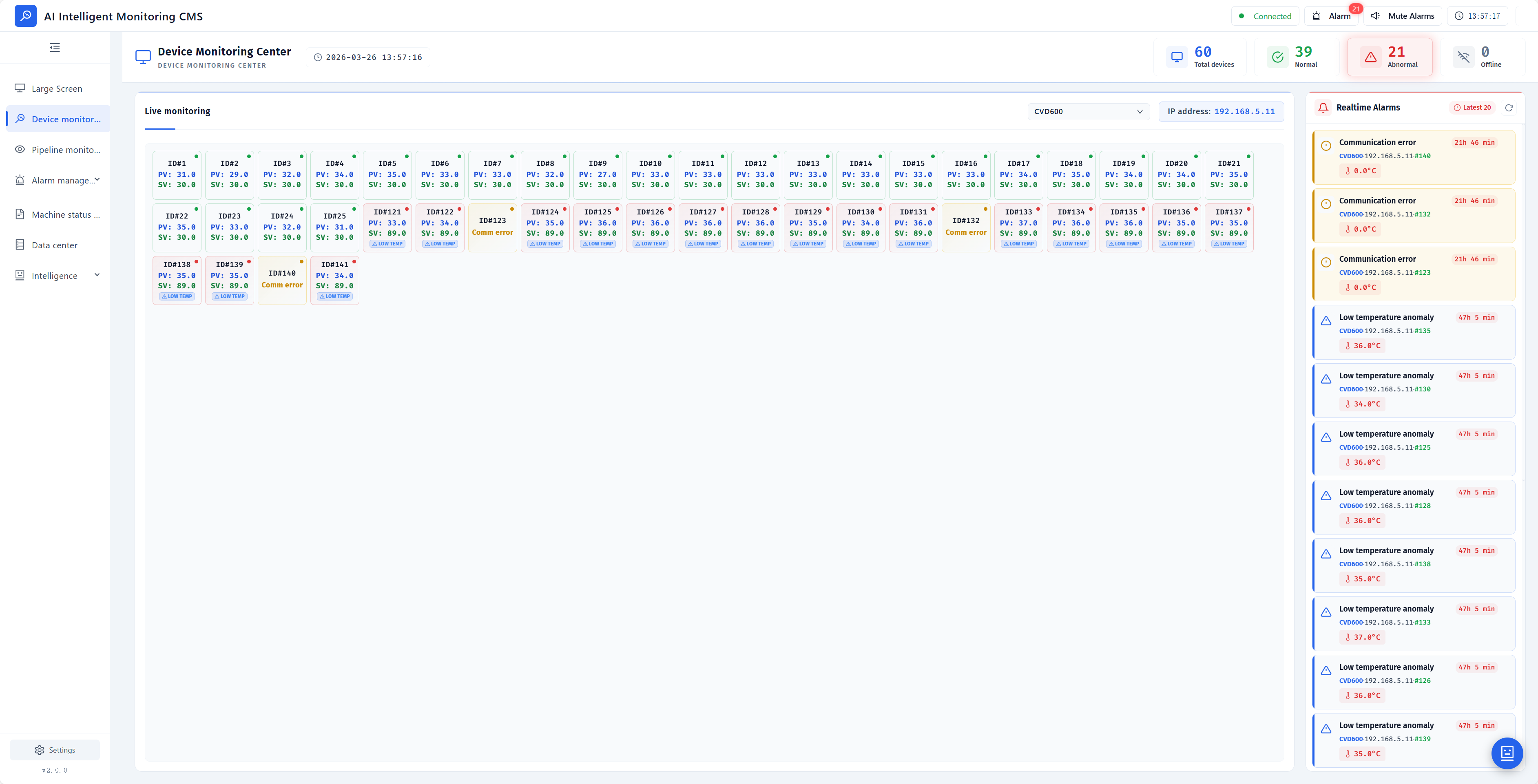
CMS: temperature monitoring and alarm management software for Modbus TCP device networks.
6. Semiconductor nitrogen pipeline heating
In semiconductor thermal processing, pipeline nitrogen heating is used to prevent condensation on pipe walls. The HOT-GUN pipeline N2 heating controller holds ±1°C control accuracy across a 0–250°C range with AC 220V working voltage and 800W–1600W heating power. Heating tape controllers such as the KE-H10, H6625 and ASH cover the related pipe and vessel insulation duty. In these builds the discrete layer handles interlocks and status, while the PID layer holds the thermal setpoint.
Comparison Table: K15DT-D vs K42CE-D
| Specification | K15DT-D | K42CE-D |
|---|---|---|
| Product type | I/O expansion module (K42CE-D series) | CMS communication module (RS485/Ethernet) |
| Digital I/O | 5 inputs and 5 NPN outputs, isolated I/O design | 2x NPN I/O |
| Serial ports | Modbus RTU interface | 6x RS485 |
| Ethernet | — | 1 port |
| Protocol | Modbus RTU | Modbus TCP / Modbus RTU |
| Power supply | 12–24VDC | 12–24VDC |
| Mounting | DIN35 rail | DIN35 rail |
| Housing material | Flame-retardant engineering plastic | Flame-retardant engineering plastic |
| Documented application focus | Switching control; remote I/O expansion | Multi-485 device low-latency parameter setting; data acquisition & forwarding; PLC replacement |
Selection is straightforward once the point list exists. If the requirement is more discrete points on an existing Modbus RTU segment, the K15DT-D fits. If the requirement is to concentrate several RS485 segments, push parameters at low latency, or forward data to a host without a PLC, the K42CE-D fits. Many installations use both: the I/O module at the point of control, and the communication module as the bridge to the monitoring layer.
Frequently Asked Questions
Do panels that include I/O expansion modules have to meet UL 508A or IEC 60947?
Yes. Industrial control panels, including PID controllers, must comply with UL 508A for North American safety listing and IEC 60947 for international markets, according to UL Solutions. An expansion module added to that panel falls inside the same scope, so it should be included in the panel drawing set, the BOM and the certification review. Cakeen operates under ISO9001, ISO14001 and ISO45001 management systems and holds UL, SEMI S2, CE and ROHS certifications for its products; its European Standard Electrical Cabinet is CE-certified with TÜV Rheinland.
How many extra points does a module add, and does it need a PLC?
The K15DT-D adds five inputs and five NPN outputs over Modbus RTU. The K42CE-D carries 2x NPN I/O together with six RS485 ports and one Ethernet port on Modbus TCP/Modbus RTU. Neither requires a PLC to function: the K42CE-D is documented as PLC-replacement capable for data acquisition and forwarding, and both modules mount on DIN35 rail with a 12–24VDC supply, so they can run alongside existing PID temperature controllers on the same bus.
What drives the cost of an I/O expansion setup?
Cost is driven by architecture rather than by the module alone. The main variables are the number of point blocks required; whether connectivity is handled by the controller's own RS485 port or by a dedicated communication module with six RS485 ports and Ethernet; the DC supply and rail provision inside the cabinet; the enclosure protection level required (Cakeen cabinet types are specified from IP40 to IP65); and whether certification beyond the standard build is needed — UL is optional on the General Purpose and Japanese Standard cabinets, while the European Standard cabinet line is CE-certified. Where the panel drawing does not yet exist, an electrical drawing design service adds a documented 2–4 week design cycle with DWG, PDF and BOM Excel deliverables.
Can I test a module before committing to a panel design?
Bench validation is the normal first step: confirm the point count, check NPN polarity against the actual switches and relay coils, and verify Modbus RTU addressing on the intended segment. Cakeen supports evaluation samples — send the point list, the controller models already specified and the bus layout to jwy@wxkeen.com or WhatsApp +86 18921139517, and the module configuration can be matched to the design.
How early should design input start, and what lead time applies to documentation?
Design input should start as soon as the point list is stable, because addressing, power distribution and rail space all depend on it. Where panel documentation is part of the scope, Cakeen's electrical drawing design service follows IEC and UL508A design standards and is documented with a 2–4 week design cycle, delivering DWG, PDF and BOM Excel files in Chinese or English. Freezing the point list before that window starts is what keeps the schedule predictable. For a quote on modules, controllers or a complete cabinet, contact the team through the details below.
Conclusion
An I/O expansion module is a sizing decision, not a spare part. It exists because a PID loop and the discrete hardware around it scale at different rates: the thermal loop stays stable while valves, interlocks, lamps and remote point groups keep growing.
For most temperature-centric cabinets the practical rule is simple. Count the points, split local from remote, then choose between density and connectivity — five inputs and five NPN outputs on Modbus RTU with the K15DT-D, or 2x NPN I/O with six RS485 ports and Ethernet on Modbus TCP/RTU with the K42CE-D. Keep the choice inside the same panel documentation that covers UL 508A or IEC 60947 compliance, and connect the result to a monitoring layer so the added points stay visible.
Cakeen (Wuxi Keen Technology Co.,Ltd.) manufactures PID temperature controllers, DIN rail I/O and communication modules, control cabinets and monitoring software from its facility in Huishan District, Wuxi. Approximately 40% of the company's products are exported, with major markets including Spain, Southeast Asia, the European Union and the USA.
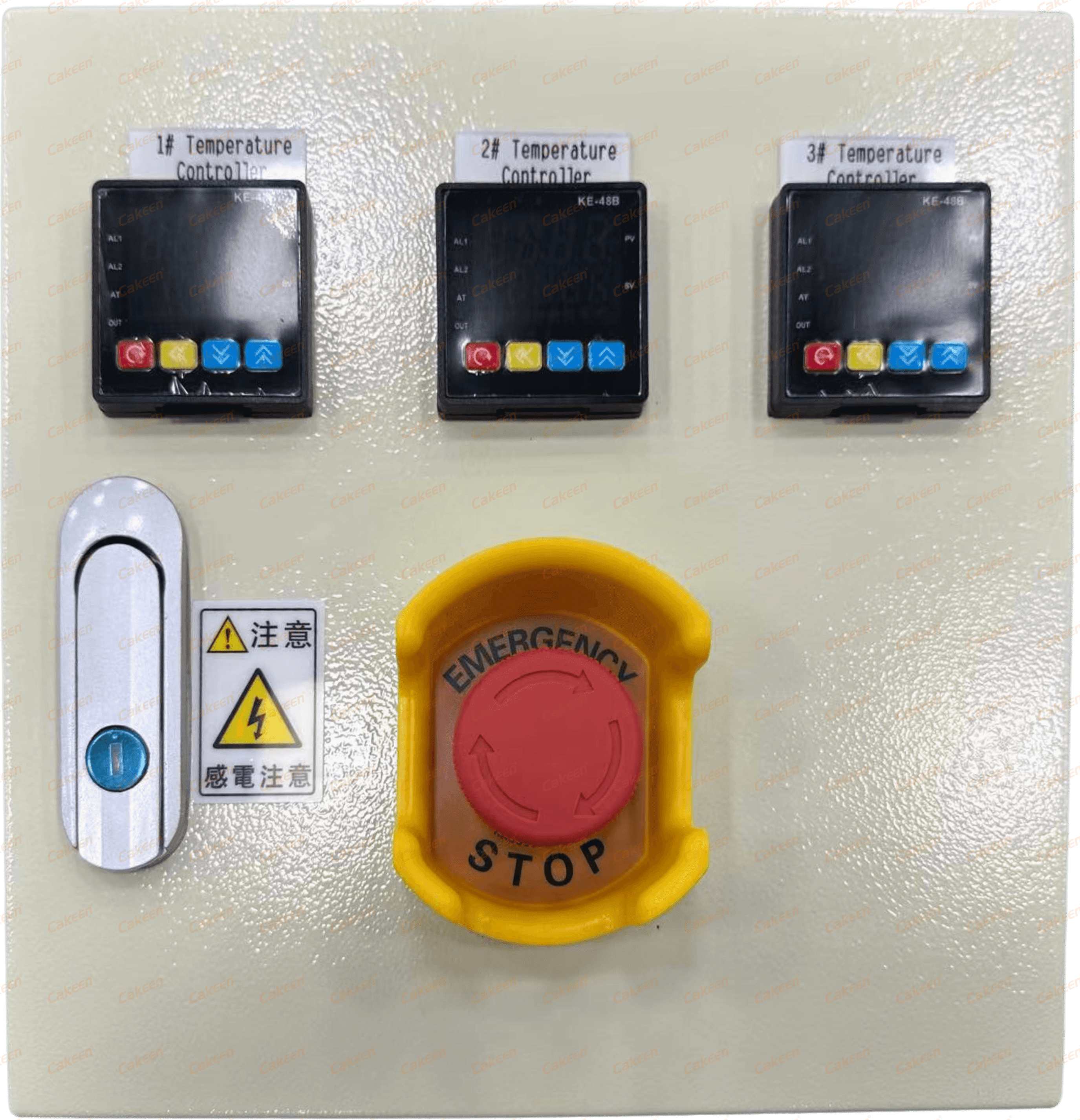
Cabinet-level integration: PID controllers, DIN rail modules and monitoring software in one build.
Next Step: Match the Module to Your Point List
Send your point count, the controller models already specified and the bus layout, and Cakeen will confirm the right module configuration — or provide a sample for bench validation.
Email: jwy@wxkeen.com
Tel: +86-0510-85161878 / +86-18921139517
WhatsApp: +86 18921139517
Website: www.wxkeen.com
Have Questions or Need More Details?
Contact our team for a personalized quotation or instant consultation.
Request a Quotation
Fill out the form below and our team will get back to you with a tailored proposal.
WhatsApp Direct Chat
Prefer to chat in real-time? Message us on WhatsApp for instant assistance & quick answers.
- Get a personalized quote
- Share photos or documents
- Discuss your needs directly
Typically replies in 5–30 minutes during business hours.