
Solving Temperature Control Problems in IoT-Connected Industrial Systems
Temperature control in an IoT-connected industrial system usually fails at the seam between the control loop and the network, not inside the PID algorithm. A controller that holds ±0.1 °C on a test bench can still deliver unusable results on a connected line when its data cannot reach a gateway, when the gateway cannot poll every device in time, or when the cabinet has no room left for the hardware the network requires.
Cakeen — the product brand of Wuxi Keen Technology Co., Ltd., a Wuxi, Jiangsu-based developer and manufacturer established in 2011 that works in semiconductor industrial control electronics, electrical cabinet systems and AI embedded systems — builds on both sides of that seam. Its portfolio combines PID temperature controllers with RS485/Modbus RTU communication, CMS communication modules that concentrate up to six RS485 channels and one Ethernet port, and an embedded software service covering IoT connectivity, edge computing and AI intelligent analysis.
This article is written for the people who have to make that combination work: OEM engineers embedding thermal control into semiconductor equipment, system integrators connecting mixed control cabinets to a plant data layer, and procurement teams evaluating a PID temperature controller manufacturer on integration capability rather than catalogue accuracy alone.
Where Temperature Control Actually Breaks in a Connected System
Four failure patterns account for most of the integration work in connected thermal systems. Each one is a boundary problem: the control decision itself is sound, but the device, the bus or the data layer around it is not.
1. The control loop is asked to do network work
Thermal control is deterministic and local. A heated gas line, a jacketed vessel or a process chamber cannot wait for a cloud round trip to correct a deviation. In practice this means the PID loop has to close inside the cabinet or at the equipment edge, while the connected layer consumes the same values for monitoring, trending and analysis. Architectures that blur those two jobs produce either unstable control or unmanageable data.
2. Protocol fragmentation across a single machine
A semiconductor tool or a process skid rarely uses one bus. Temperature controllers, gas flow devices, I/O and legacy equipment frequently sit on separate RS485 segments, and the integration burden lands on whoever has to make them visible to a single system. Cakeen's PID temperature controllers use RS485/Modbus RTU, and the CMS Communication Module K42CE-D concentrates six RS485 ports plus one Ethernet port. The practical answer is rarely one universal device; it is a concentration point that terminates many segments and republishes them once.
3. Channel density versus cabinet space
Multi-zone heating is where cabinet space disappears. A tool with several heated chambers, gas lines or transfer lines can need four, six or more independent loops, and each loop historically meant another panel instrument. Cakeen's DIN rail KE-2104 provides four PID channels on a DIN35 rail at 12–24 V DC, while the panel-mount KE-48 keeps a 48×48 mm footprint for machine front panels where operators need direct visibility.
4. Monitoring without traceability
A live temperature reading is not the same as a record. Semiconductor and process environments increasingly expect historical temperature data tied to alarm events and sensor channels. Cakeen's CMS software supports 10,000+ Modbus TCP devices with a 10-second polling interval, monitors PV/SV temperature, AL1/AL2 thresholds and TC BK sensors, and retains 365 days of time-series history.
Precision expectation. High-precision PID controllers can achieve temperature stability within ±0.1 °C, a level described as critical for semiconductor lithography and etching (Grand View Research). Cakeen's published controller parameters specify ±0.1 °C control accuracy across the KE-H10, H6625, ASH, KE-48 and KE-2104 — which is why the communication and cabinet layers must not degrade what the loop already achieves.
Industry Background: Why Connected Thermal Control Is Being Rebuilt
The direction of the market explains why integration capability became a selection criterion in the first place. The global PID controller market was valued at USD 1.60 billion in 2024 and is projected to reach USD 2.24 billion by 2032 (SNS Insider). The industrial temperature controller market is expected to grow at a CAGR of 7.1% from 2024 to 2030, a trajectory attributed to Industry 4.0 adoption (Strategic Market Research).
Demand is geographically concentrated. Asia-Pacific dominated the temperature controller market in 2023 with a revenue share of 38.2%, with China as a key manufacturing hub (Dataintelo). Within that, semiconductor thermal control has its own scale: the global semiconductor temperature control equipment market was valued at USD 663 million in 2024, a figure tied directly to wafer fabrication precision (Market Research Reports). Process industries remain a major volume base, with the oil and gas sector holding the largest end-user share for PID controllers in 2024 at approximately 31.4% (SNS Insider).
Competitively, the category includes established global names: Honeywell, Omron, Siemens, Eurotherm (Schneider Electric) and ABB are identified as leading manufacturers of PID and temperature controllers (Mordor Intelligence). Cakeen competes along a different axis — not catalogue breadth, but the depth of the engineering layers around the controller, including cabinet design, communication modules, embedded software and documentation. Those are precisely the layers where connected projects stall.
Compliance sets another boundary. Industrial control panels, including PID controllers, must comply with UL 508A for North American safety listing and IEC 60947 for international markets (UL Solutions). A connected architecture therefore has to be documented and certified as a system, not treated as a loose set of parts.
The Solution: Four Layers That Make Temperature Control Network-Ready
A connected thermal architecture can be assembled from four functional layers. Cakeen's portfolio covers all four, which allows one supplier to remain accountable for the loop, the bus, the data and the documentation.
Layer 1 — Thermal control at the edge
This layer closes the loop. KE-H10 is a heating tape PID temperature controller with a built-in SSR output rated to MAX 6 A and ±0.1 °C accuracy, suited to semiconductor equipment pipeline heating and chemical delivery insulation. H6625 is the mini version of the same concept at MAX 3 A, and ASH is configured for pipe and vessel insulation and heating control. All three share the same input range (PT/K/J/R/S/T/B/E/N/L), RS485/Modbus RTU communication and a 100–265 V AC supply. KE-48 adds analog output options (SSR, 0–20 mA, 4–20 mA, 0–10 V) with a single RS485 port in a 48×48 mm panel-mount body, and KE-2104 delivers four channels with external SSR switching on a DIN35 rail.
For jacketed vessels, heating mantles and heated gas lines, the selection logic stays the same: match the input sensor type, confirm the switching current against the heater load, and confirm that the required control accuracy is available at the point where the loop actually closes.
Layer 2 — Communication and concentration
Most connected projects are won or lost here. The CMS Communication Module K42CE-D carries two NPN I/O points, six RS485 ports and one Ethernet port, speaks Modbus TCP and Modbus RTU, runs on 12–24 V DC and mounts on a DIN35 rail. Its intended uses are telling: low-latency parameter setting across multiple RS485 devices, data acquisition and forwarding, and PLC replacement. In a temperature architecture it becomes the node that polls controllers locally and publishes one coherent stream upward.
The I/O Expansion Module K15DT-D adds five NPN channels to the K42CE-D over Modbus RTU, so switching tasks and remote I/O can grow without changing the upstream interface.
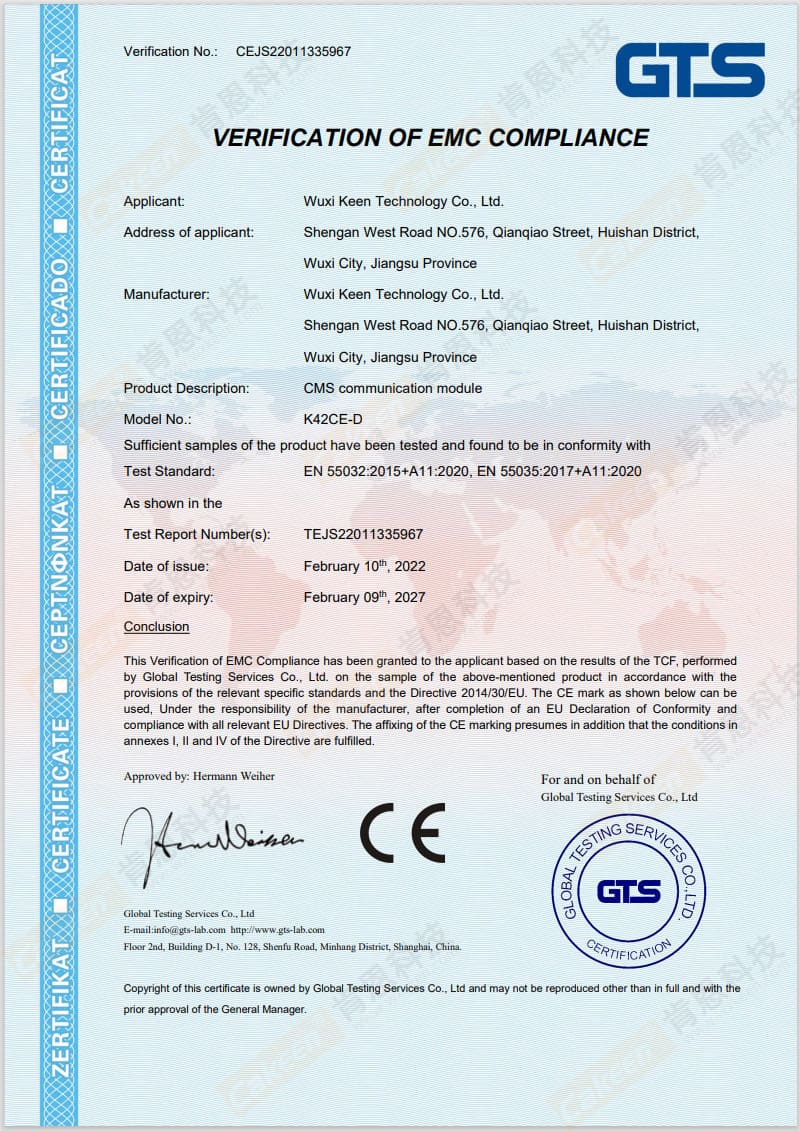
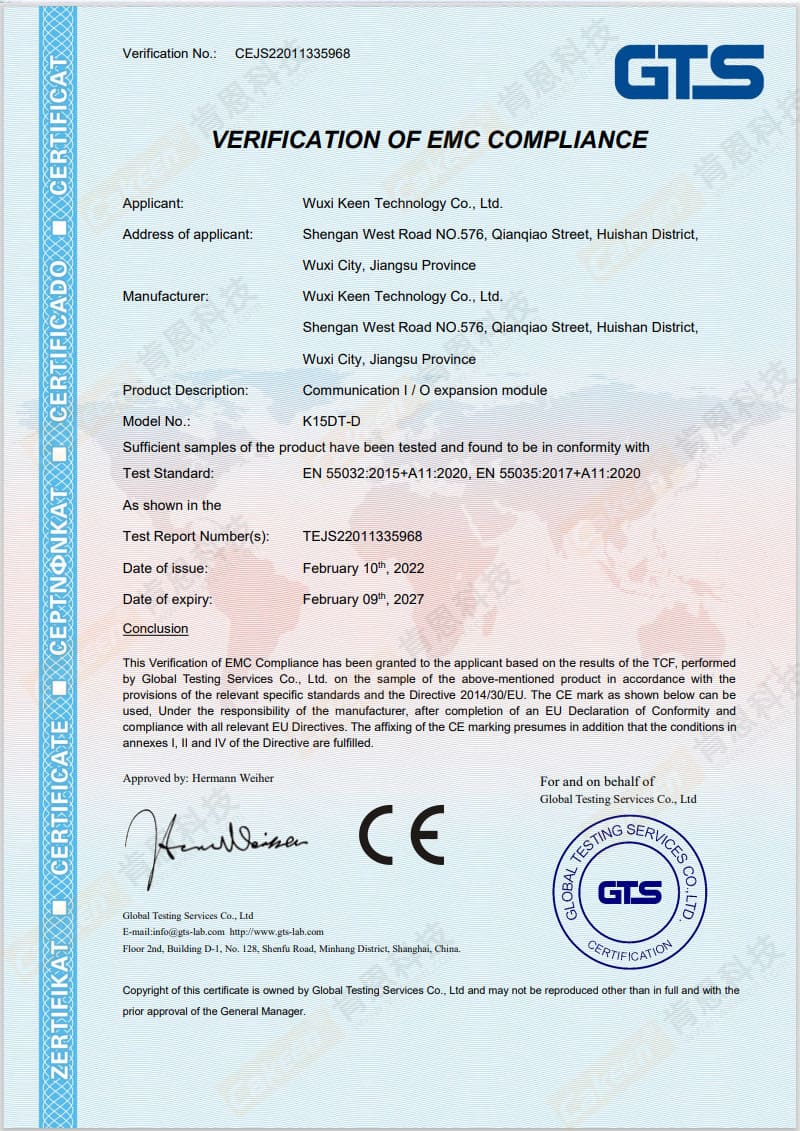
Because these modules sit inside industrial and semiconductor environments, their compliance record is part of the capability. The K42CE-D is covered by SEMI S2 certificate 220252 issued by SAFES against SEMI S2-0821, which addresses electrical safety, mechanical safety and hazard mitigation for semiconductor manufacturing equipment. Both the K42CE-D and the K15DT-D hold CE certification for electromagnetic compatibility against EN 55032:2015+A11:2020 and EN 55035:2017+A11:2020 (certificates CEJS22011335967 and CEJS22011335968).
Layer 3 — Software, edge computing and analysis
Above the bus, Cakeen's CMS software turns raw Modbus traffic into an operational picture: 10,000+ Modbus TCP devices supported, a 10-second polling interval, monitoring of PV/SV temperature, AL1/AL2 thresholds and TC BK sensors, and 365 days of time-series history. Where the plant requires more than monitoring, the Embedded System Software Development Service covers IoT connectivity, edge computing and AI intelligent analysis as a full-stack engagement from hardware to application layer.
Layer 4 — Engineering, cabinets and documentation
Connected systems still have to be built and certified. Cakeen's service layer includes electrical drawing design compliant with IEC and UL508A and delivered as DWG, PDF and BOM Excel with a 2–4 week design cycle in Chinese or English; PLC control program development covering Siemens S7-1200/1500, Mitsubishi Q/L and Omron NJ/NX with Modbus TCP and Modbus RTU; and PCB design where UL and EMC certification is a stated deliverable objective. Cabinet builds range from the CE-certified European Standard Electrical Cabinet (ABB, Siemens, Schneider components, IP54/IP65, 380/400 V three-phase) to the JIS-compliant Japanese Standard Electrical Cabinet (Mitsubishi, Omron, Schneider components, IP54/IP65, 200/400 V) and the configurable General Purpose Electrical Control Cabinet with IP40–IP65 protection.
At company level, Wuxi Keen Technology Co., Ltd. holds ISO 9001 (certificate 50325Q3891R0S), ISO 14001 (certificate 50325E3892R0S) and ISO 45001 (certificate 50325S3893R0S) registrations issued on 12 December 2025, covering the development and manufacturing of automation instruments and meters including temperature controllers and communication controllers.
Step-by-Step Breakdown: Specifying a Connected Temperature System
The following sequence keeps the control layer and the data layer from distorting each other. It is written for OEM and integrator teams that are in evaluation or early execution.
- Define the control points before the network. List every heated zone with its sensor type and required accuracy. Cakeen controllers accept PT/K/J/R/S/T/B/E/N/L inputs, and the ±0.1 °C class devices suit zones where drift is process-critical, while pipeline nitrogen heating is handled by the HOT-GUN controller with ±1 °C accuracy across a 0–250 °C range.
- Choose the form factor by physical reality. Panel-mount KE-48 for operator-facing panels with a 48×48 mm cutout; DIN rail KE-2104 for multi-zone cabinets where four channels share one rail at 12–24 V DC.
- Count the buses, not the devices. If the machine has several RS485 segments, plan a concentration point rather than running each segment to the plant network. K42CE-D terminates six RS485 ports and exposes one Ethernet port.
- Decide what stays local. Control and alarm logic stay in the cabinet; monitoring, trending and analysis travel. This is the split that embedded edge development formalises, with IoT connectivity and AI analysis running on the equipment side.
- Add I/O only where it is needed. K15DT-D adds five NPN channels over Modbus RTU to an existing K42CE-D node, keeping switching and remote I/O expansion incremental rather than architectural.
- Fix the documentation and acceptance path early. Electrical drawings under IEC/UL508A on a 2–4 week design cycle, 100% pre-shipment test as the acceptance criterion, and remote after-sales support after commissioning.
Use Cases: Three Integration Patterns in Practice
Embedded temperature control in semiconductor processing equipment
A semiconductor equipment OEM embeds temperature control directly into processing equipment for CVD, etching and diffusion furnaces. More than 50 units per year have been supplied across a relationship of 4+ years, with KE-48 used for compact front-panel control and KE-2104 used to save cabinet space through four channels on DIN rail. The reported outcome is improved equipment uptime and consistent process temperature across all chambers. The project footprint covers China, Taiwan, Singapore, Malaysia and the United States.
Factory data acquisition and AI-based predictive maintenance
An industrial IoT system integrator required custom IoT gateway hardware and edge computing software for factory data acquisition and AI-based predictive maintenance. The platform-level engagement has run for more than a year across China, Taiwan, Singapore, Malaysia, Mexico and the United States. The delivered architecture achieved real-time data collection from more than 1,000 sensors, and AI anomaly detection reduced unplanned downtime by 25%. The highlight of the build was full-stack delivery from PCB to cloud, with UL/EMC certified hardware and IoT, edge computing and AI analytics combined in one solution.
Control cabinets for equipment retrofit programmes
A domestic equipment integrator sources more than 100 cabinet sets per year for factory automation and equipment retrofit projects, across a relationship of more than five years. Multi-PLC brand support (Siemens, Mitsubishi, Omron), IP40–IP65 configurability and quick customization turnaround reportedly shortened the customer's delivery cycle by 40%, and the account shows a high repeat order rate.
Comparison Table: Hardware Options for a Connected Temperature Architecture
| Model | Role in a connected architecture | Channels / I/O | Control accuracy | Communication | Mounting & power |
|---|---|---|---|---|---|
| KE-H10 | Heating tape control at the edge | Single channel; built-in SSR output; MAX 6 A | ±0.1 °C | RS485 / Modbus RTU | — / 100–265 V AC |
| H6625 | Compact heating tape control | Single channel; built-in SSR; MAX 3 A | ±0.1 °C | RS485 / Modbus RTU | — / 100–265 V AC |
| ASH | Pipe and vessel insulation & heating control | Single channel; built-in SSR; MAX 3 A | ±0.1 °C | RS485 / Modbus RTU | — / 100–265 V AC |
| KE-48 | Panel-mount front-end control | Single channel; SSR / 0–20 mA / 4–20 mA / 0–10 V | ±0.1 °C | 1 × RS485 | Panel mount 48×48 mm / 100–265 V AC |
| KE-2104 | Multi-zone cabinet control | 4 channels; external SSR | ±0.1 °C | — | DIN35 rail / 12–24 V DC |
| K42CE-D | CMS communication module and bus concentration node | 2 × NPN; 6 × RS485; 1 × Ethernet | — | Modbus TCP / RTU | DIN35 rail / 12–24 V DC |
| K15DT-D | Remote I/O expansion for K42CE-D | 5 × NPN | — | Modbus RTU | DIN35 rail / 12–24 V DC |
| HOT-GUN | Pipeline nitrogen heating with anti-condensation control | — | ±1 °C | — | — / AC 220 V, 800–1600 W, 0–250 °C |
Compiled from Cakeen product parameters. A dash indicates the published parameter set does not list a value for that field.
FAQ
Does the CMS communication module carry third-party certification for semiconductor use?
Yes. The CMS Communication Module K42CE-D is covered by SEMI S2 certificate 220252 issued by SAFES against SEMI S2-0821, which sets safety requirements for semiconductor manufacturing equipment including electrical safety, mechanical safety and hazard mitigation. The same module also holds CE certification CEJS22011335967 for electromagnetic compatibility under EN 55032:2015+A11:2020 and EN 55035:2017+A11:2020, while the I/O Expansion Module K15DT-D holds CEJS22011335968 against the same standards. At company level, Wuxi Keen Technology Co., Ltd. holds ISO 9001 (50325Q3891R0S), ISO 14001 (50325E3892R0S) and ISO 45001 (50325S3893R0S) registrations issued by Beijing Zhong Ding Qian Yuan Certification Co., Ltd., covering the development and manufacturing of automation instruments and meters such as temperature controllers and communication controllers.
Can Cakeen PID controllers be customized for OEM integration?
Cakeen provides OEM and ODM production services, and all parameters, logos and appearance functions support customization. The company was established in 2011, operates a 2019 m² facility with 50 employees, employs a 20-engineer R&D team, and reports an annual output of 500,000 units with 100% test quality control. Export markets include Spain, Southeast Asia, the European Union and the USA, and products have been used by semiconductor equipment OEM clients, industrial IoT system integrators and domestic equipment integrators.
What are the purchasing terms and acceptance criteria?
Programs are quoted with a minimum order quantity of 500 units at a monthly capacity of 40,000 units, or with a minimum order quantity of 5 units for lower-volume builds. Delivery terms are FOB, CIF or EXW, acceptance criteria are based on 100% pre-shipment test, and payment terms are listed as 30. Lead time is 30–45 days.
Can a controller and module set be validated before a production commitment?
Yes. A minimum order quantity of 5 units makes sample-scale evaluation possible, and every unit passes 100% pre-shipment test before shipping. This is how most integration teams confirm that a controller holds its specified accuracy in their cabinet, on their bus, before scaling to volume.
How long does delivery take after an order is confirmed?
Lead time is 30–45 days, supported by a monthly capacity of 40,000 units for volume programs. Remote after-sales support is provided after commissioning. To start a sample or quotation request, contact Cakeen through www.wxkeen.com or email jwy@wxkeen.com with your zone count, sensor types and required accuracy.
Next step: validate the architecture on your own cabinet
Send the heated zones, sensor types, bus layout and accuracy targets, and the Cakeen team will map them against PID controller options, the K42CE-D concentration node and the CMS data layer. Samples, quotations and technical documentation are available on request.
Website: www.wxkeen.com | Email: jwy@wxkeen.com | Tel: +86-0510-85161878 | WhatsApp: +86 18921139517
Address: No.576 Shengan West Road, Qianqiao Street, Huishan District, Wuxi City, Jiangsu Province, China
Conclusion
Temperature control problems in IoT-connected industrial systems are integration problems. The loop has to close locally, the buses have to be concentrated rather than multiplied, the cabinet has to fit the channel count, and the data layer has to keep a record rather than only a reading. Cakeen addresses those four requirements with ±0.1 °C class PID controllers, the K42CE-D module that terminates six RS485 segments behind one Ethernet port, CMS software handling 10,000+ Modbus TCP devices with 365-day history, and an engineering layer that covers drawings, PLC programs, PCB design, cabinets and embedded edge development. For OEMs and integrators in evaluation or execution, that combination is what makes a controller suitable for a connected system rather than only for a bench.
Have Questions or Need More Details?
Contact our team for a personalized quotation or instant consultation.
Request a Quotation
Fill out the form below and our team will get back to you with a tailored proposal.
WhatsApp Direct Chat
Prefer to chat in real-time? Message us on WhatsApp for instant assistance & quick answers.
- Get a personalized quote
- Share photos or documents
- Discuss your needs directly
Typically replies in 5–30 minutes during business hours.