
DIN Rail vs Panel Mount PID Temperature Controller: A Head-to-Head Decision Guide
DIN Rail vs Panel Mount PID Temperature Controller: A Head-to-Head Decision Guide
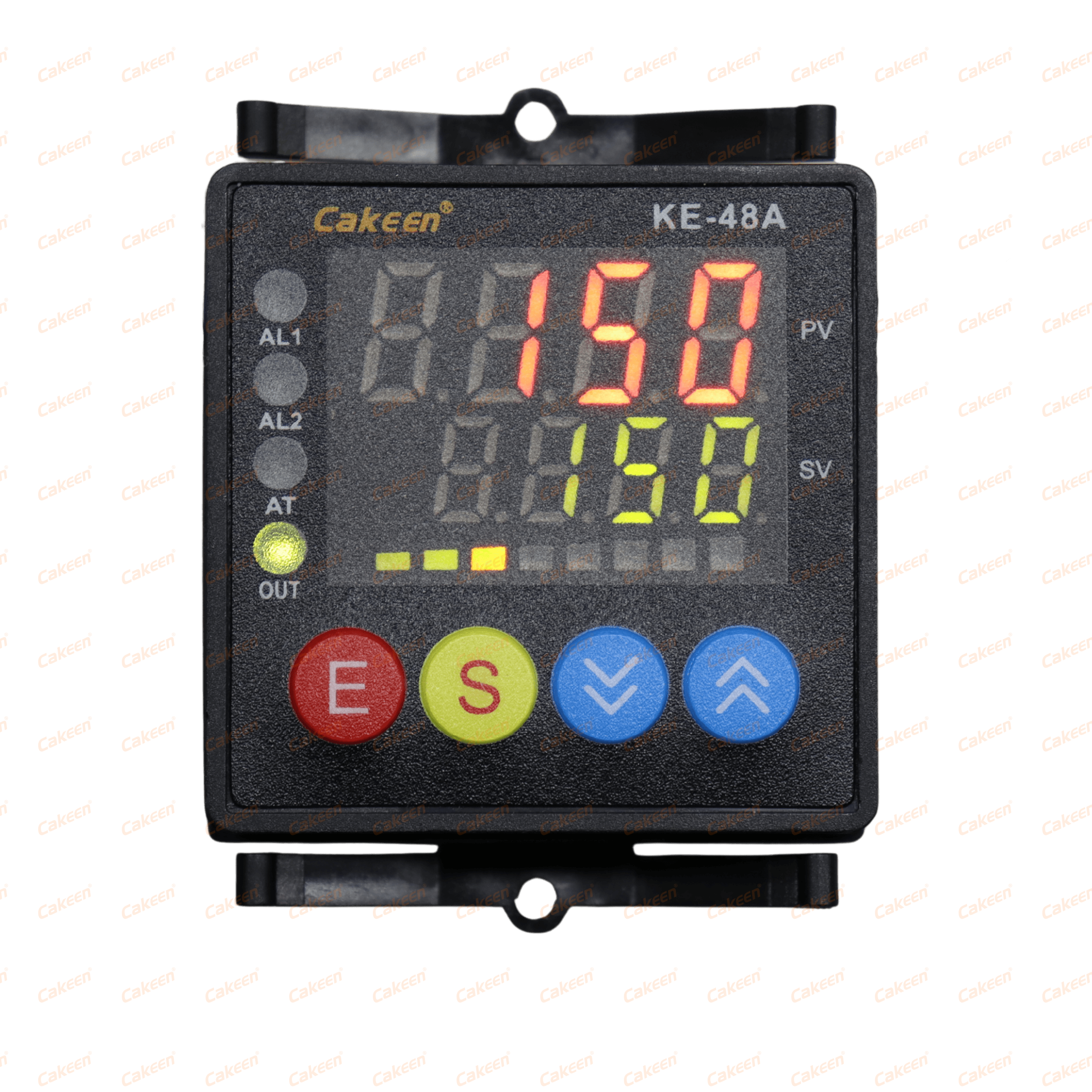
KE-48, a 48×48 mm panel mount PID temperature controller (single channel, ±0.1°C)
DIN rail and panel mount PID temperature controllers run the same control algorithm, but they force different decisions about cabinet layout, wiring routes, operator access and the path you will take when the machine needs more control points. That difference, not the control loop itself, is what makes the mounting format one of the first constraints a buyer has to lock down.
This head-to-head guide compares the two formats using two documented products from Cakeen: the KE-2104, a DIN35 rail-mounted 4-channel PID controller, and the KE-48, a 48×48 mm panel-mount single-channel controller. It then shows how each format behaves when it is extended with the K15DT-D I/O expansion module, the K42CE-D CMS communication module and the CMS central monitoring platform, and how the choice plays out in semiconductor thermal processing equipment.
Wuxi Keen Technology Co., Ltd. (brand: Cakeen) is a manufacturer established in 2011 and headquartered in Huishan District, Wuxi, Jiangsu Province, China. The company develops semiconductor industrial control electronics, electrical cabinet systems and AI embedded systems, and supplies PID temperature controllers and control modules under the Cakeen brand.
Problem Definition: Mounting Format Is a Constraint, Not a Cosmetic Choice
In procurement terms, the mounting format is a hard constraint that is fixed before the bill of materials is frozen. It determines how much front-plate area the controller consumes, whether a panel cutout has to be machined, how much field wiring has to run back to the rail, how many spare parts must be stocked, and how the control architecture can grow later. Changing format after the enclosure is built usually means re-machining a door or re-laying a rail.
The problem is that the decision is invisible if you only compare control specifications. Both formats in this comparison reach ±0.1°C control accuracy and accept the same PT/K/J/R/S/T/B/E/N/L input types, so a spec-sheet comparison alone will not separate them. The separating factors are physical and architectural.
Market context supports the direction of travel. The global PID controller market was valued at USD 1.60 billion in 2024 and is projected to reach USD 2.24 billion by 2032 (SNS Insider). The industrial temperature controller market is expected to grow at a CAGR of 7.1% from 2024 to 2030, driven by Industry 4.0 adoption (Strategic Market Research). Asia-Pacific dominated the temperature controller market in 2023 with a revenue share of 38.2%, with China as a key manufacturing hub (Dataintelo). More installed controllers generally means denser cabinets, which pushes the mounting decision forward in the engineering sequence.
Industry Background: Denser Cabinets, More Points, Higher Expectations
The global semiconductor temperature control equipment market was valued at USD 663 million in 2024 and is essential for wafer fabrication precision (Market Research Reports). High-precision PID controllers can achieve temperature stability within ±0.1°C, a critical requirement for semiconductor lithography and etching (Grand View Research).
The practical consequence for cabinet design is point count. A single piece of process equipment may need one control loop per thermal zone, per gas line or per chamber, and every one of those loops must be wired, commissioned, monitored and replaceable without stopping the line. That is the environment in which the DIN rail versus panel mount question is actually decided.
The Two Formats, Defined
DIN rail mount — Cakeen KE-2104
The KE-2104 is a DIN35 rail-mounted PID temperature controller with four control channels and ±0.1°C control accuracy. It accepts PT/K/J/R/S/T/B/E/N/L inputs, drives an external SSR, operates on a 12–24 VDC power supply, and is housed in flame-retardant engineering plastic. Its documented application scope is temperature control systems and process monitoring.
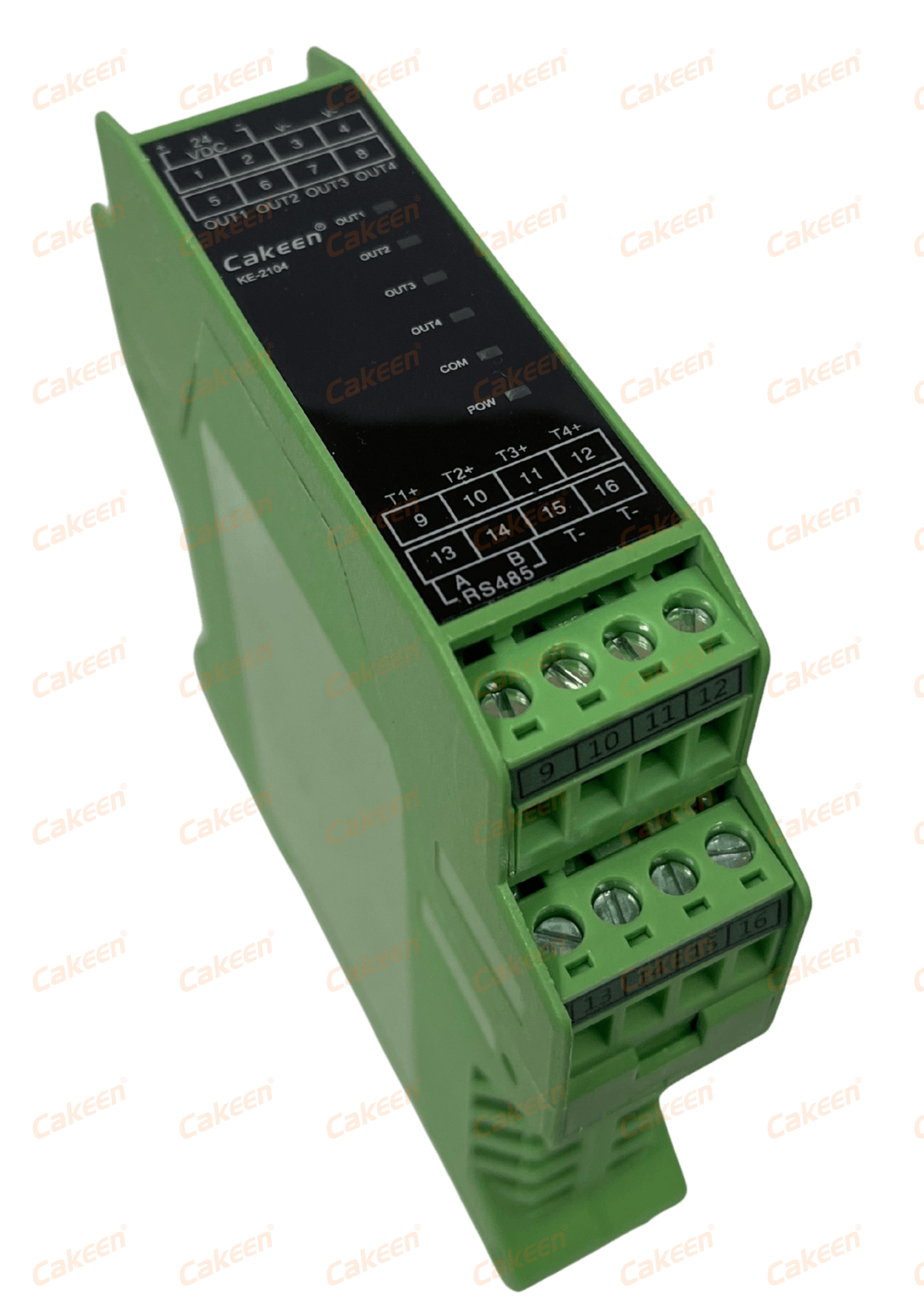
KE-2104, a DIN35 rail mount 4-channel PID controller with ±0.1°C accuracy and external SSR output
Panel mount — Cakeen KE-48
The KE-48 is a 48×48 mm standard panel-mount temperature controller with single-channel control and ±0.1°C control accuracy. It uses the same PT/K/J/R/S/T/B/E/N/L input list, and its output can be configured as SSR, 0–20 mA, 4–20 mA or 0–10 V. It includes one RS485 communication port, accepts 100–265 V AC, and installs through a 48×48 mm panel cutout.
Head-to-Head Comparison: KE-2104 (DIN Rail) vs KE-48 (Panel Mount)
| Decision dimension | KE-2104 — DIN rail mount | KE-48 — panel mount |
|---|---|---|
| Mounting interface | DIN35 rail | 48×48 mm panel cutout |
| Control channels | 4 channels | Single channel |
| Control accuracy | ±0.1°C | ±0.1°C |
| Input types | PT/K/J/R/S/T/B/E/N/L | PT/K/J/R/S/T/B/E/N/L |
| Output architecture | External SSR | SSR / 0–20 mA / 4–20 mA / 0–10 V |
| Power supply | 12–24 VDC | 100–265 V AC |
| Communication | Not listed in the published parameter set; networking is provided by modules such as K15DT-D and K42CE-D | 1× RS485 |
| Housing material | Flame-retardant engineering plastic | Flame-retardant engineering plastic |
| Documented application | Temperature control systems; process monitoring | Temperature control systems; process monitoring |
| Typical decision fit | Multi-zone and multi-loop cabinets, tool retrofits, rail-based expansion | Equipment-mounted local control with visible front-panel readout |
Installation Environment and Cabinet Space
A DIN rail controller lives entirely inside the enclosure. It needs rail length and interior depth, but no front-plate area and no cutout, and it can share the same DIN35 rail as the K15DT-D and K42CE-D modules. Because the KE-2104 carries four control channels in one rail-mounted body, the number of control points per unit of cabinet surface is higher than with single-loop faceplate devices.
A panel mount controller moves the visible interface to the front plate. The KE-48 requires a 48×48 mm cutout and reserves that area permanently, but it also puts the process value and setpoint in front of the operator without opening the door.
A practical rule for cabinet designers: if the front plate is already crowded with HMIs, pushbuttons, indicators and switches, the rail is the more flexible place to add control capacity. If the equipment needs a dedicated, always-visible reading for a specific process loop, a 48×48 mm faceplate device costs very little front-plate space.
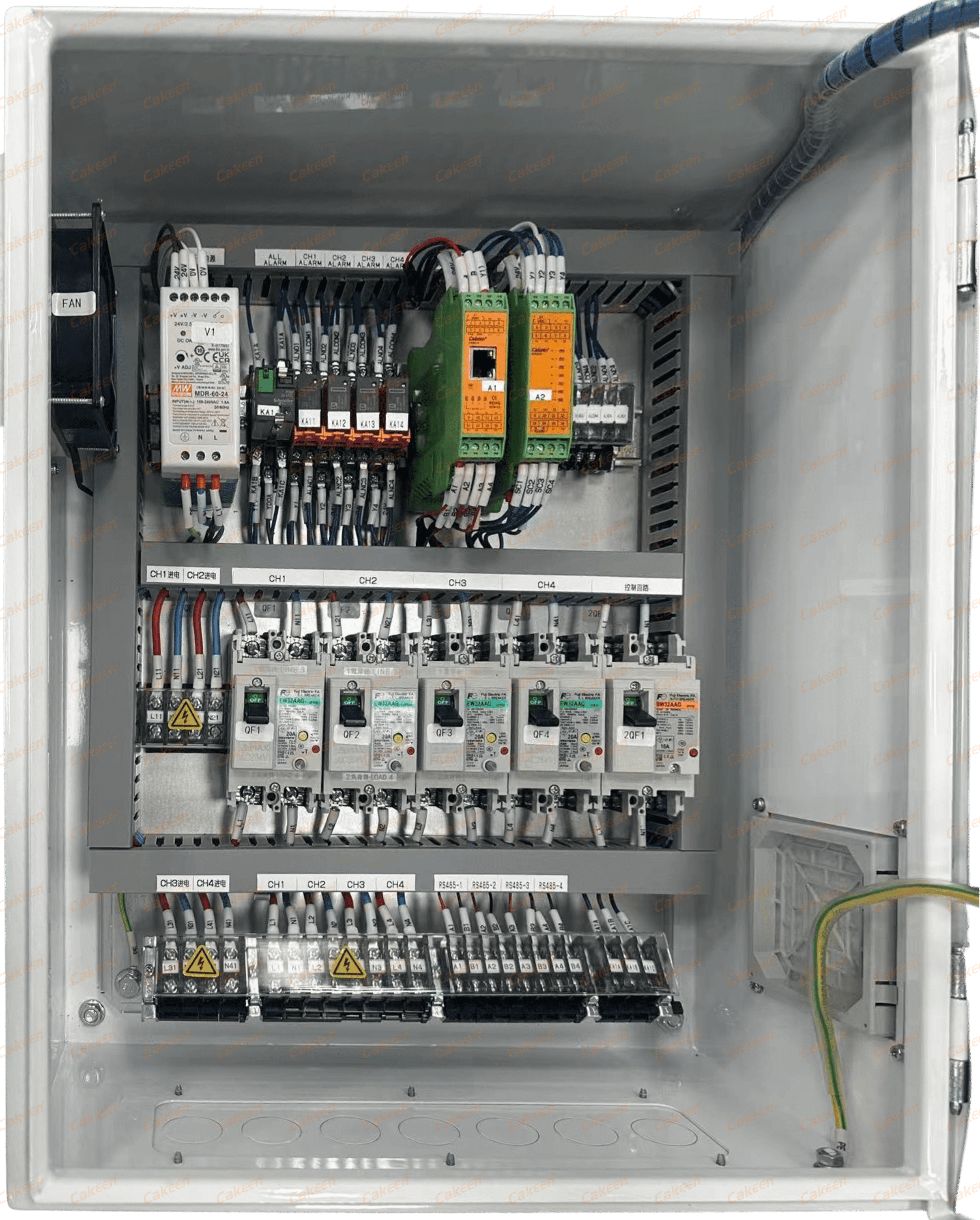
Cabinet layout is the deciding constraint: rail-based control inside the enclosure versus faceplate-mounted control on the front plate
Accessibility, Operator Interface and Serviceability
Panel mount wins on immediacy. The KE-48 shows process value and setpoint at the front plate, so an operator or process engineer can read and adjust the loop without opening the enclosure. The trade-off is that the device occupies the door, and any service work has to work around the panel.
DIN rail wins on cabinet cleanliness and on centralization. Nothing is exposed on the front plate, all control hardware sits behind the door, and adjustments are made with the door open, through an HMI, or remotely over the network. That last path is what makes the DIN rail format practical at scale: the KE-48 exposes one RS485 port, and the K42CE-D aggregates multiple RS485 segments so a rack of controllers can be parameterized from a single host.
Wiring, Power and Output Architecture
The two formats are powered differently, and this has direct consequences for the panel builder.
- KE-48 (panel mount): accepts 100–265 V AC, so it can be fed directly from the cabinet's AC distribution. Its output can be SSR drive or an analog signal (0–20 mA, 4–20 mA, 0–10 V), which allows direct connection to a valve, power controller or recorder without an intermediate conversion stage.
- KE-2104 (DIN rail): operates on 12–24 VDC and drives an external SSR. The cabinet must therefore include a 24 VDC supply and one SSR per controlled channel, but the load-switching components stay on the rail instead of behind the front plate.
For buyers evaluating total cost of ownership, the difference is not the controller alone. It is the combination of channel count per device, the number of SSRs, the amount of field wiring that runs back to the rail, and whether analog outputs are needed. A single-loop panel mount device and a four-channel rail device solve different wiring problems, so the comparison has to be made per cabinet, not per unit.
Extending Either Format: K15DT-D and K42CE-D
Mounting format stops being an isolated decision once I/O and communication modules enter the design, because both formats can be extended from the same module family.
The K15DT-D I/O Expansion Module provides 5 inputs and 5 NPN outputs over Modbus RTU, with a 12–24 VDC supply and DIN35 rail mounting in flame-retardant engineering plastic. It is documented for switching control and remote I/O expansion. It holds CE certification number CEJS22011335968, issued by GTS, complying with EN 55032:2015+A11:2020 and EN 55035:2017+A11:2020 for the EU market.
The K42CE-D CMS Communication Module provides 2 NPN I/O points, six RS485 ports and one Ethernet port, supporting Modbus TCP and Modbus RTU on a 12–24 VDC supply with DIN35 rail mounting. Its documented applications include multi-485 device low-latency parameter setting, data acquisition and forwarding, and PLC replacement scenarios. It holds SEMI S2 certification number 220252, issued by SAFES under the SEMI S2-0821 standard, and CE certification number CEJS22011335967 issued by GTS for the EU market.
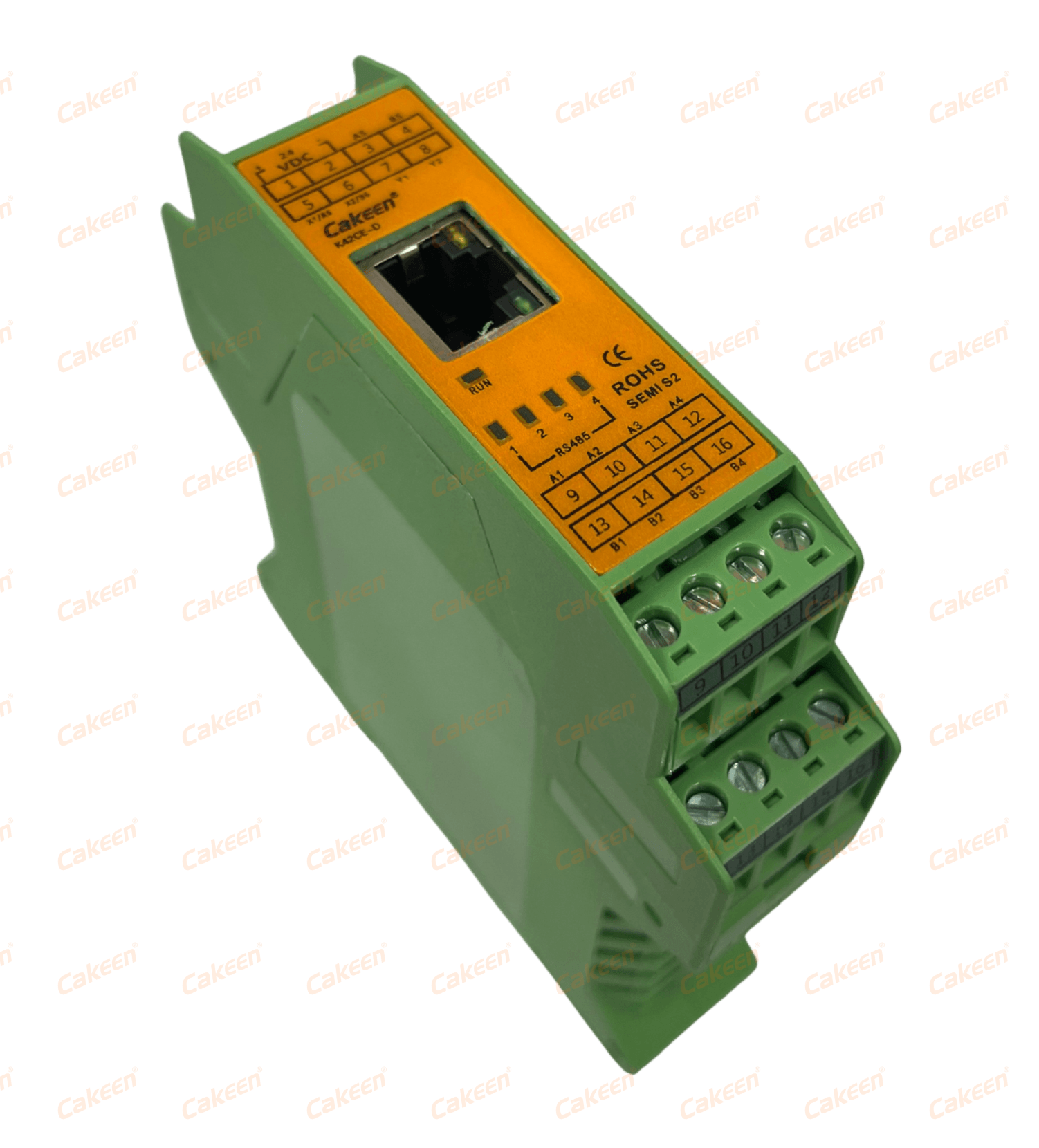
K42CE-D CMS Communication Module: 6× RS485, 1× Ethernet, 2× NPN I/O, Modbus TCP/RTU, DIN35 rail mount
Three integration conclusions follow. First, a DIN rail architecture is natively expandable, because the controllers and modules share the same DIN35 rail and the same 12–24 VDC domain. Second, a panel-mounted KE-48 is not isolated from that architecture: it exposes its own RS485 port, so it can join the same network through field wiring back to the rail. Third, the K42CE-D's six RS485 ports let one module concentrate several controllers, which matters most in cabinets that deliberately mix both mounting formats.
From Controller to Central Monitoring: CMS
Mounting style also determines how much work is required to reach a plant-level monitoring view. The Cakeen CMS (Industrial Device Central Monitoring System) supports 10,000+ Modbus TCP devices with a 10-second real-time polling interval, monitoring PV/SV temperature values, AL1/AL2 alarm thresholds and TC BK sensors, and retaining 365-day time-series history in InfluxDB. Its documented application industries include display and panel manufacturing, rail transportation, industrial temperature control and process manufacturing.
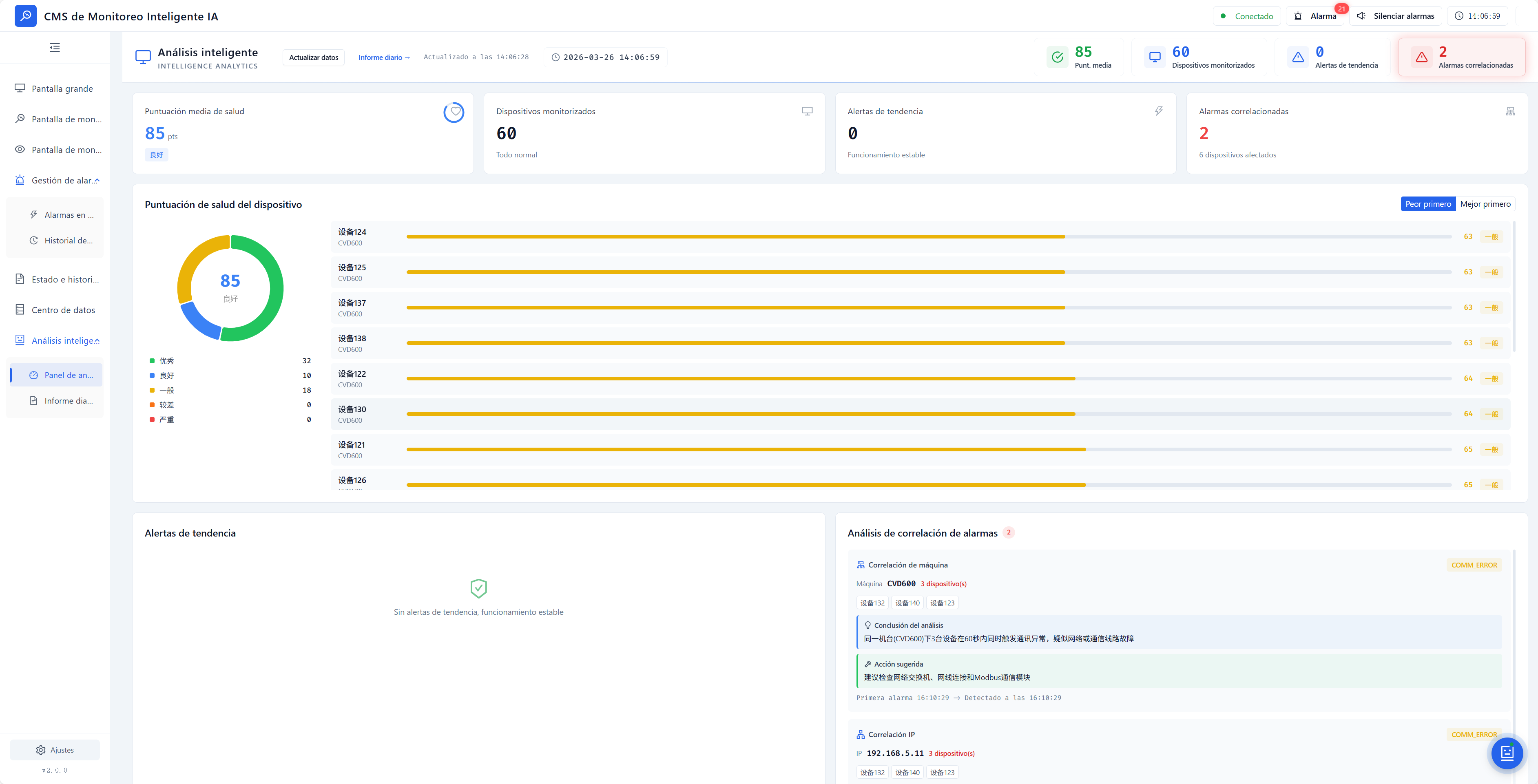
CMS central monitoring: 10,000+ Modbus TCP devices, 10-second polling, 365-day time-series history
Because the monitoring layer works over Modbus, the two mounting formats do not have to be standardized across a plant to produce a single monitoring view. What changes is the wiring effort and the aggregation point. A rail-based design converges on the K42CE-D inside the enclosure; a mixed design converges there too, but with additional field runs from the panel-mounted devices.
Matching Mounting Style to Semiconductor Thermal Processing
The clearest test of the decision framework is semiconductor equipment. A semiconductor equipment OEM that has used both Cakeen formats for more than four years, at more than 50 units per year, deploys them for embedded temperature control in semiconductor processing equipment including CVD, etching and diffusion furnaces. In that design the KE-48's compact 48×48 mm panel-mount body fits the original equipment design, while the KE-2104's four-channel DIN rail format saves cabinet space.
Adjacent thermal hardware follows the same logic. The HOT-GUN pipeline nitrogen gas heater operates with ±1°C control accuracy over a 0–250°C range at AC 220 V with 800–1600 W heating power, and is used in semiconductor thermal processing equipment to prevent condensation on pipe walls. Heating tape controllers such as the ASH, KE-H10 and H6625 are single-channel units with built-in SSR output, RS485/Modbus RTU communication, 100–265 V AC supply and ±0.1°C accuracy; they are physically installed along the pipe or vessel run rather than in the main control cabinet.
Rule of thumb for semiconductor and industrial cabinets: chamber-level or zone-level loops that an operator must see and adjust locally favour the panel mount format. Multiple parallel zones, gas lines or tool retrofits supervised from one place favour the DIN rail format, because four channels share one rail footprint and the enclosure face stays free.
Step-by-Step Decision Framework
- Count the control loops. Establish how many temperature points the cabinet must control now, and how many it will gain after the next retrofit. Four or more points in one enclosure immediately favours a 4-channel rail device.
- Decide who needs local access. If an operator must read the process value without opening the enclosure, a 48×48 mm panel device is the direct answer.
- Measure the physical budget. Compare available front-plate area against available DIN35 rail length and interior depth.
- Fix the power and switching architecture. AC-fed panel devices can drive an SSR or an analog output directly; a 12–24 VDC rail controller requires an external SSR per channel and a 24 VDC supply.
- Map the communication and expansion path. Confirm how the controllers reach the network and whether a K15DT-D or K42CE-D is needed for I/O and RS485 aggregation.
- Confirm the compliance scope for the exact models. Certificates map to specific products, not to a mounting style, so verify each model against the panel's target market.
- Validate before design freeze. Build one pilot cabinet with the chosen format and confirm the layout, wiring and monitoring path.
Use Cases: Where Each Format Fits
- OEM equipment embedding: a semiconductor equipment builder integrating a local loop into a chamber or process module uses the KE-48, keeping a visible setpoint in the machine's own front panel.
- Multi-zone cabinet retrofit: a factory upgrading an existing enclosure uses the KE-2104 to add four control channels without cutting new faceplate openings.
- Mixed cabinets: a line that already has faceplate instruments uses the K42CE-D's six RS485 ports to bring both the panel-mounted and rail-mounted controllers into one data stream.
- Distributed pipe and vessel heating: heating tape controllers with built-in SSR output, such as the ASH, KE-H10 and H6625, are mounted at the point of heating rather than on the main panel, with RS485/Modbus RTU back to the control room.
Compliance Considerations for Either Format
The mounting format does not change the certification requirement, but it changes the enclosure that must satisfy it. Industrial control panels, including PID controllers, must comply with UL 508A for North American safety listing and IEC 60947 for international markets (UL Solutions). That requirement attaches to the assembled panel, so the format decision affects what the panel builder has to demonstrate.
Cakeen holds ISO9001, ISO14001 and ISO45001 management system certifications, and the company's products have obtained UL, SEMI S2, CE and RoHS international certifications. Model-level mapping matters when a buyer assembles the panel BOM:
- SEMI S2 certification number 220252, issued by SAFES, applies to the CMS Communication Module (K42CE-D) under the SEMI S2-0821 standard for the EU market.
- CE certification number CEJS22011335968, issued by GTS, applies to the I/O Expansion Module (K15DT-D) under EN 55032:2015+A11:2020 and EN 55035:2017+A11:2020.
- CE certification number CEJS22011335967, issued by GTS, applies to the CMS Communication Module and covers Industrial Gas Burning Equipment and Communication Modules for the EU market.
- CE certification number TRCN-22262WCT01, issued by INTEGRA96, applies to the MFC Gas Flow Controller (HOT N2) under EN 60204-1:2018.
The decision implication is straightforward: if the modules that carry the certifications a project depends on are rail-mounted, the DIN35 rail becomes the natural place to standardize the control architecture.
What This Means for Supplier Selection
Because the mounting format is settled during the design phase, the supplier needs to support both variants of the same control platform. Cakeen operates on an OEM/ODM model in which all parameters support customization, along with logo and appearance functions. Documented capability terms include 100% testing, a stated monthly capacity of 40,000 units for the high-volume program, a lead time of 30–45 days, and MOQ thresholds defined per program. Export markets covered are ES, SEA, EU and USA, with remote after-sales support. The company operates a 2,019 m² facility with 50 employees, including 20 R&D engineers, and reports an export ratio of 40%.
FAQ
Do DIN rail and panel mount PID controllers require different certifications?
The certification scope follows the products and the assembled panel, not the mounting format itself. Industrial control panels, including PID controllers, must comply with UL 508A for North American safety listing and IEC 60947 for international markets. Cakeen holds ISO9001, ISO14001 and ISO45001 management system certifications, and its products have obtained UL, SEMI S2, CE and RoHS international certifications. Model-level mapping still matters: SEMI S2 certification number 220252 issued by SAFES covers the K42CE-D CMS Communication Module under SEMI S2-0821 for the EU market, while CE certification number CEJS22011335968 issued by GTS covers the K15DT-D I/O Expansion Module. Buyers should map each certificate to the exact model in the panel BOM rather than to a mounting style.
Can a DIN rail PID controller handle multi-channel semiconductor thermal control?
Within its documented specification, yes. The KE-2104 is a DIN35 rail-mounted controller with four control channels and ±0.1°C control accuracy, accepting PT/K/J/R/S/T/B/E/N/L inputs and driving external SSRs from a 12–24 VDC supply. For cabinets that need more points, the K15DT-D adds 5 inputs and 5 NPN outputs over Modbus RTU, and the K42CE-D provides six RS485 ports plus one Ethernet port with Modbus TCP/RTU, supporting multi-485 device parameter setting, data acquisition and forwarding. A semiconductor equipment OEM has used both the KE-2104 and the KE-48 for embedded temperature control in CVD, etching and diffusion furnaces, with the four-channel rail unit cited for saving cabinet space.
What drives the cost difference between the two mounting formats?
The cost drivers are structural rather than a single unit price. A panel mount KE-48 controls one channel per 48×48 mm cutout and accepts 100–265 V AC directly, and it can output SSR drive or an analog signal (0–20 mA, 4–20 mA, 0–10 V) to an actuator. A DIN rail KE-2104 controls four channels from one rail footprint but requires a 12–24 VDC supply and an external SSR per channel. That means the total cost of ownership depends on loop count per cabinet, the number of SSRs, the amount of field wiring running back to the rail, whether analog outputs are required, and the spare-parts policy. Comparing the two formats per unit rather than per cabinet will produce the wrong answer.
Can both formats be evaluated before the design is frozen?
Yes. The KE-2104 and the KE-48 are separate documented products, so a pilot cabinet can be built with one of each and the same sensor types (PT/K/J/R/S/T/B/E/N/L) on both, which keeps the validation focused on mounting, wiring and access rather than on sensor behaviour. Because the K15DT-D and K42CE-D modules use Modbus RTU, Modbus TCP and DIN35 rail mounting, the expansion and communication path can also be validated in the same pilot build. Validating both formats before freezing the enclosure design avoids re-machining a front plate or re-laying a rail later.
What lead time applies to custom DIN rail or panel mount controller orders?
Documented OEM/ODM terms list a lead time of 30–45 days, a stated monthly capacity of 40,000 units for the high-volume program, and MOQ thresholds defined per program, with published tiers of 500 units and 5 units. Quality control is 100% testing, export markets covered are ES, SEA, EU and USA, and after-sales is handled through remote support. Customization covers parameters, logo and appearance functions. To confirm which format fits your cabinet design and to request a sample or a quotation, contact Cakeen through www.wxkeen.com, by email at jwy@wxkeen.com, or by WhatsApp at +86 18921139517.
Conclusion: Decide on the Cabinet, Then Confirm on the Datasheet
The DIN rail versus panel mount decision is decided by the enclosure, not by accuracy figures. Both the KE-2104 and the KE-48 reach ±0.1°C and accept the same input types, so the differentiators are physical and architectural: four channels on a DIN35 rail with a 12–24 VDC supply and external SSR drive, versus one channel behind a 48×48 mm cutout on 100–265 V AC with SSR or analog output and an RS485 port.
Choose panel mount when a specific loop must be visible and adjustable at the front plate, when the loop count is low, and when an analog output is needed at the actuator. Choose DIN rail when loop density matters, when the front plate is already occupied, when the cabinet must expand along a rail with K15DT-D I/O and K42CE-D communication modules, and when the installation needs to feed a Modbus monitoring layer such as CMS. Where a plant already mixes both, the same module family and Modbus protocol keep the two formats in one control and monitoring architecture.
Next step: validate the format against your own cabinet
Send your loop count, cabinet layout constraints and target market, and Cakeen will confirm whether the KE-2104 DIN rail controller, the KE-48 panel mount controller, or a combination with the K15DT-D and K42CE-D modules fits your build.
Website: www.wxkeen.com | Email: jwy@wxkeen.com | Tel: +86-0510-85161878 | WhatsApp: +86 18921139517
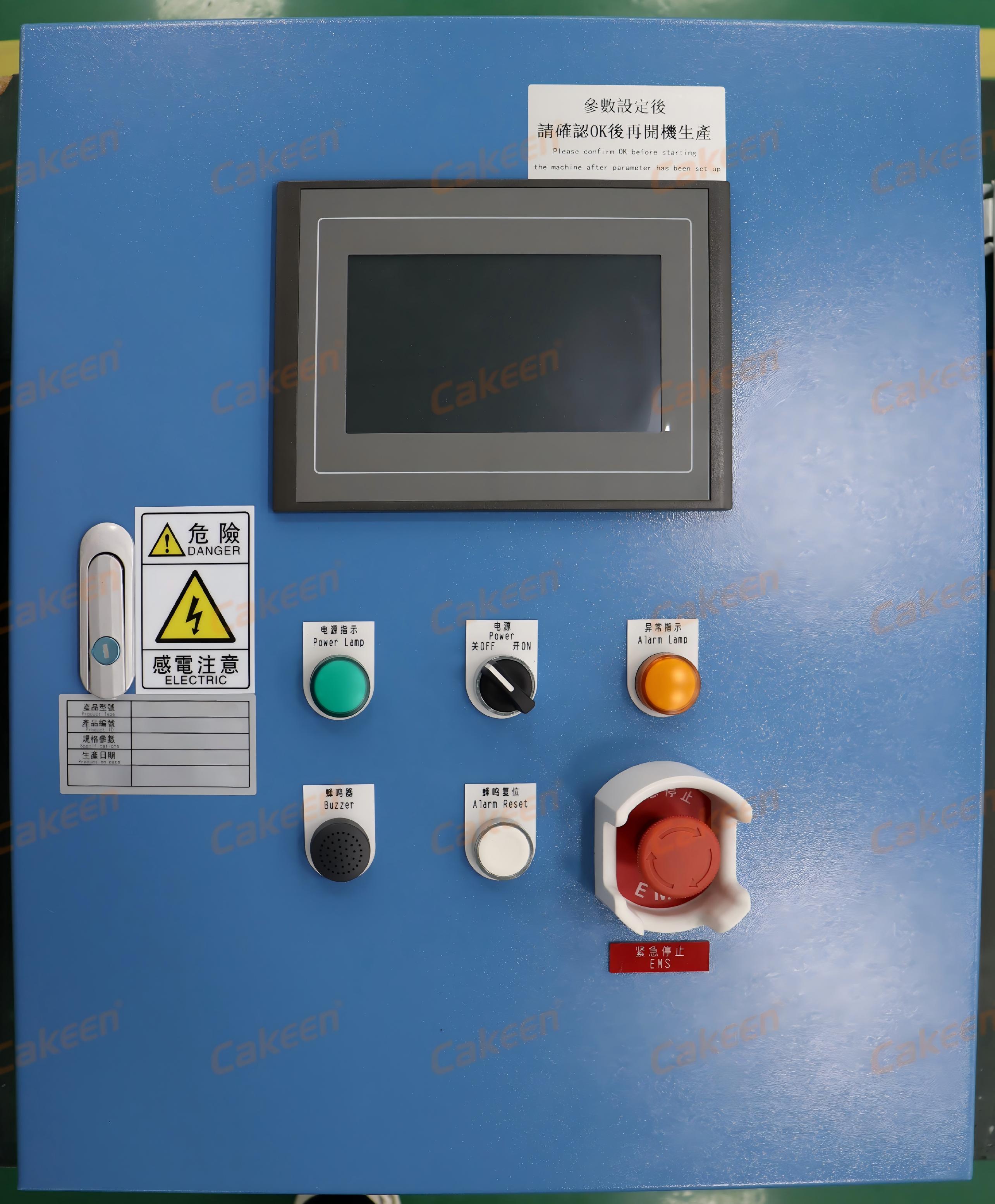
Electrical control cabinets are available in general purpose, Japanese standard and European standard configurations to host either mounting format
Have Questions or Need More Details?
Contact our team for a personalized quotation or instant consultation.
Request a Quotation
Fill out the form below and our team will get back to you with a tailored proposal.
WhatsApp Direct Chat
Prefer to chat in real-time? Message us on WhatsApp for instant assistance & quick answers.
- Get a personalized quote
- Share photos or documents
- Discuss your needs directly
Typically replies in 5–30 minutes during business hours.