
PID Controller Supplier or Full Control Partner? A Decision Framework for OEMs
PID Controller Supplier or Full Control Partner? A Decision Framework for OEMs
For an OEM building semiconductor process tools, analytical instruments or industrial thermal equipment, a PID temperature controller is a modest line item in the bill of materials and a disproportionately large share of the integration risk. The controller sets sensor compatibility, output behaviour, panel footprint, communication mapping and part of the compliance evidence file. Deciding who supplies it is therefore a system decision, not a catalogue decision.
OEM evaluation teams generally choose between two sourcing models. The first is a component-only PID temperature controller supplier: a vendor that manufactures to an agreed specification, ships units and stops at the box. The second is a full control partner: a manufacturer that also takes responsibility for the PCB, the electrical drawings, the PLC control program and the monitoring layer that surrounds the controller. Both models can be the right answer. They allocate integration risk very differently, and that allocation is what the framework below makes explicit.
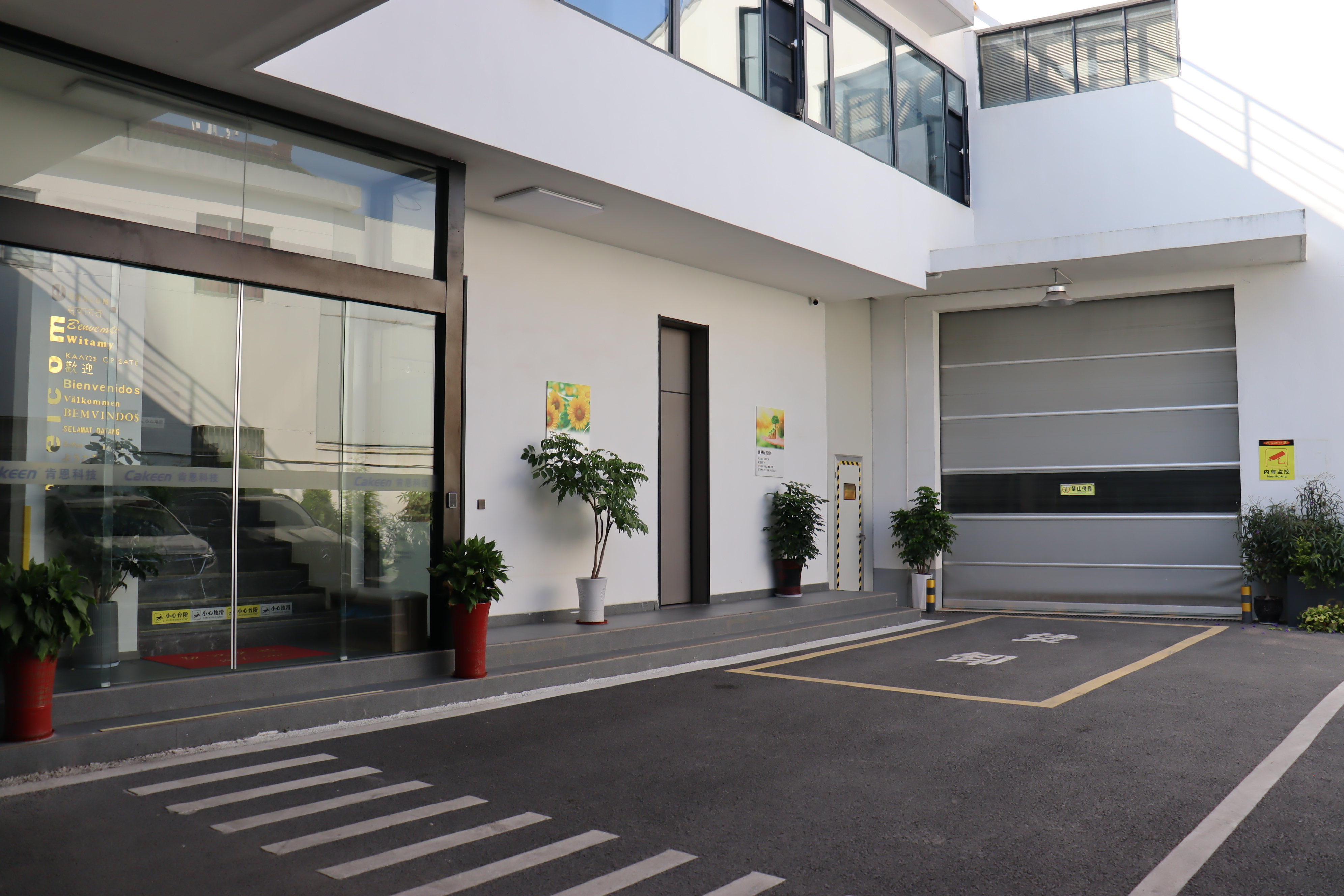
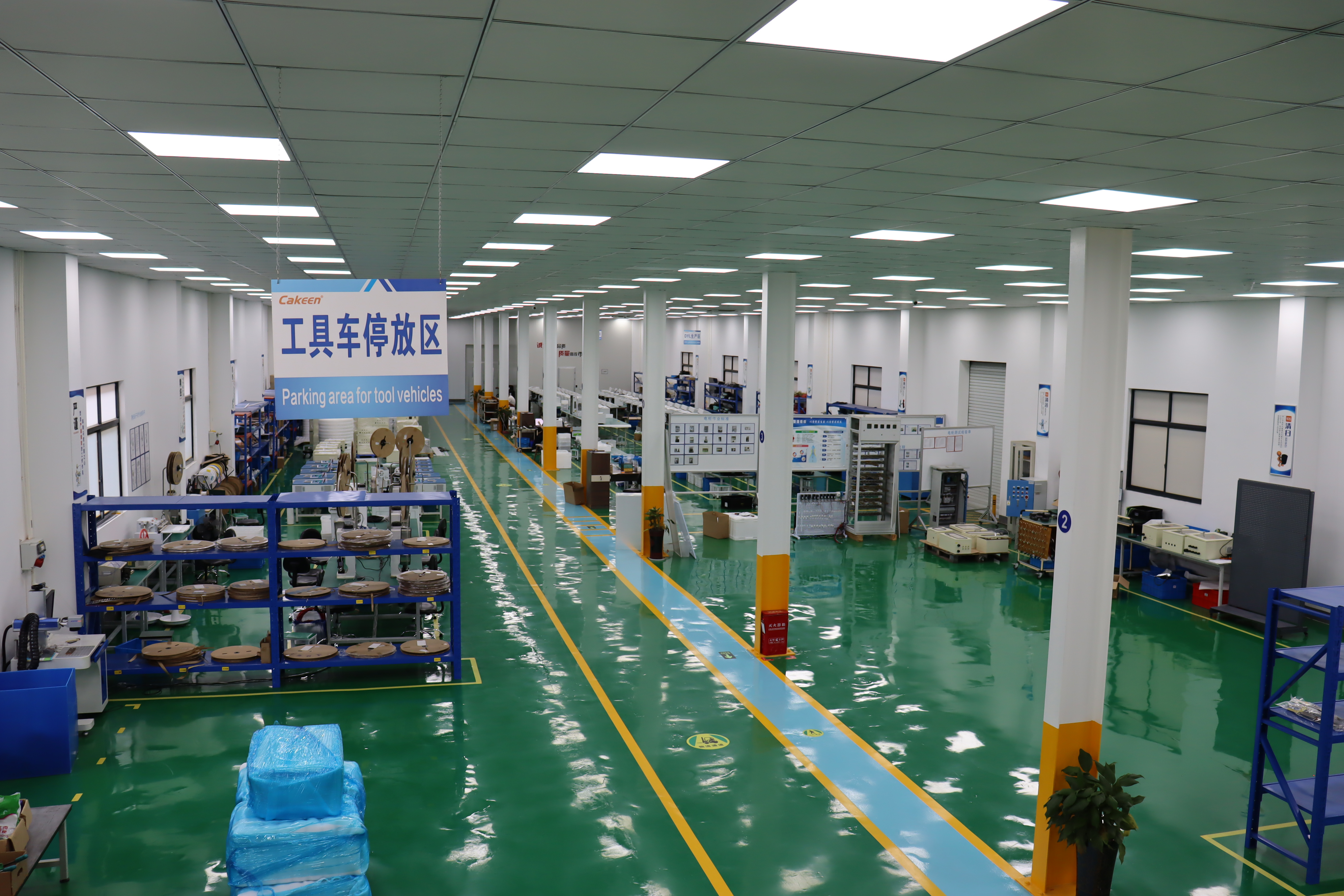
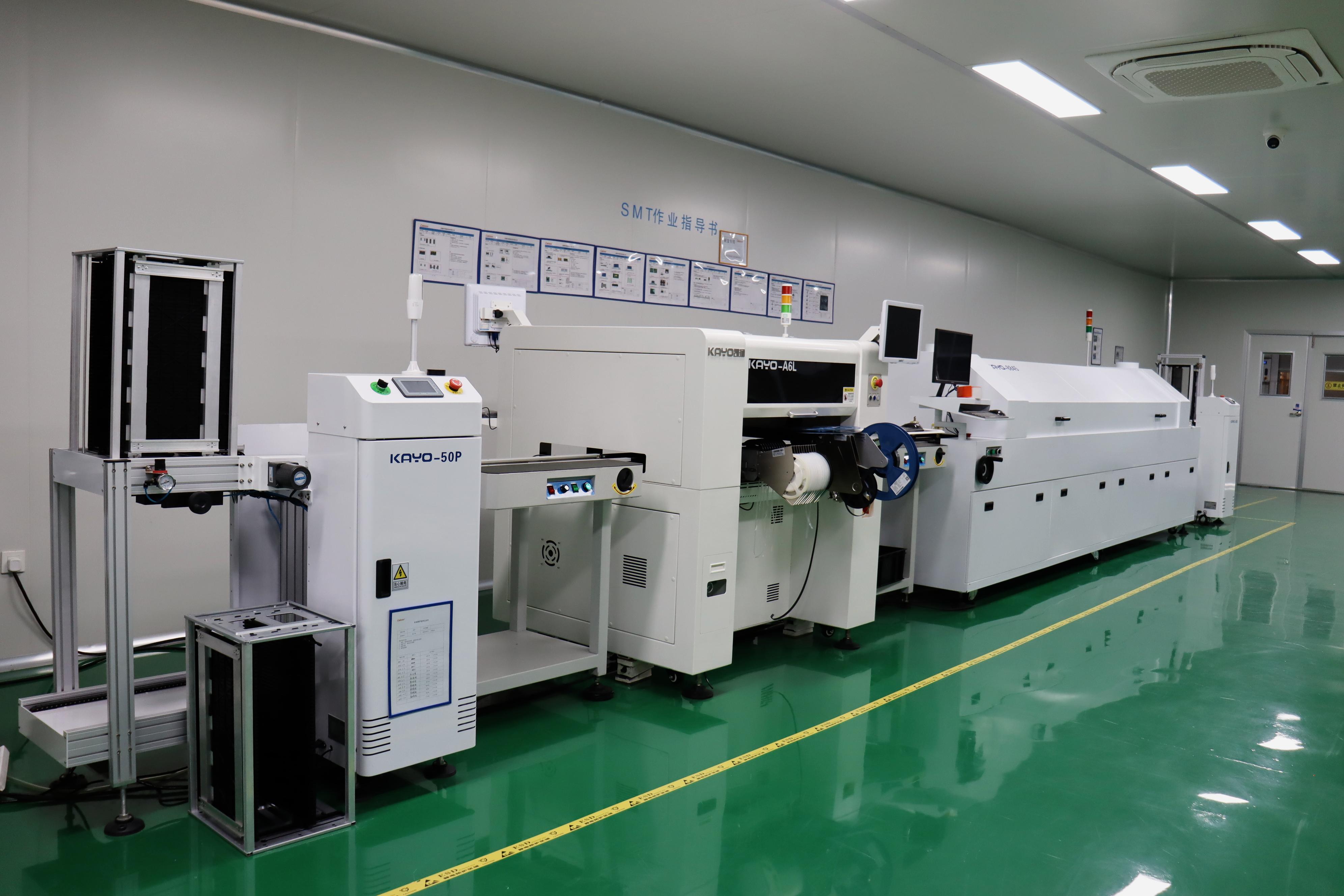
Wuxi Cakeen Technology Co., Ltd. (brand name Cakeen) is an industrial control manufacturer established in 2011 and headquartered in Huishan District, Wuxi, Jiangsu Province, China. The company works in semiconductor industrial control electronics, electrical cabinet systems and AI embedded systems, operates a 2,019 m² manufacturing facility with 50 employees and a 20-engineer R&D team, and exports approximately 40% of output to Spain, Southeast Asia, the EU and the USA. Its documented scope covers PID temperature controllers, communication modules, monitoring software, engineering design services and control cabinets, which makes it a practical reference point for comparing the component-only and full-partner models.
Problem Definition: The Interface Carries More Risk Than the Controller
The controller itself is rarely the failure point in a thermal system. The interfaces around it are. An OEM that buys a PID controller as a component inherits at least four interface surfaces:
- Mechanical: a 48 × 48 mm panel cut-out for a panel-mount industrial temperature controller such as the KE-48, or DIN35 rail space for a DIN rail unit such as the KE-2104. Both choices constrain cabinet layout, wiring routing and service access.
- Signal: whether the controller drives an SSR directly or provides 0–20 mA, 4–20 mA or 0–10 V analogue output, and whether the SSR is internal (KE-H10, H6625, ASH) or external (KE-2104).
- Data: how RS485/Modbus RTU values are mapped into the machine network, and whether that mapping reaches a supervisory layer through a module such as the K42CE-D, which provides six RS485 ports, one Ethernet port and Modbus TCP/RTU.
- Compliance: who holds the certificate that the finished machine will be asked to demonstrate.
When each of those surfaces is owned by a different supplier, the OEM owns the interface risk by default. That is not inherently wrong. It is a rational choice for an OEM with in-house electrical and control engineering capacity, a stable equipment platform and volumes that justify carrying the design internally. The risk appears when the OEM assumes it has that capacity but the program schedule does not.
Decision rule: if more than two of the four interface surfaces require new design work on the OEM side, the component-only model is being asked to carry risk it was never scoped to carry.
Industry Background: A Growing Market That Is Adding Layers
The commercial context supports a systems view of the sourcing decision. The global PID controller market was valued at USD 1.60 billion in 2024 and is projected by SNS Insider to reach USD 2.24 billion by 2032, while the industrial temperature controller market is expected to grow at a 7.1% CAGR from 2024 to 2030, driven in part by Industry 4.0 adoption (Strategic Market Research). Asia-Pacific accounted for a 38.2% revenue share of the temperature controller market in 2023, with China as a key manufacturing hub (Dataintelo). The semiconductor temperature control equipment segment alone was valued at USD 663 million in 2024 (Market Research Reports), and oil & gas remained the largest end-user vertical for PID controllers in 2024 at approximately 31.4% (SNS Insider).
Two technical facts shape how OEMs respond to that growth. High-precision PID controllers can hold temperature stability within ±0.1 °C, a requirement commonly associated with semiconductor lithography and etching (Grand View Research). Industrial control panels containing PID controllers must satisfy UL 508A for North American safety listing and IEC 60947 for international markets (UL Solutions). Both facts push the sourcing decision past the controller: ±0.1 °C stability depends on the sensor input chain, the output stage and the cabinet environment, while UL 508A compliance depends on the party that builds the panel.
Commonly listed manufacturers in the PID and temperature controller market include Honeywell, Omron, Siemens, Eurotherm (Schneider Electric) and ABB (Mordor Intelligence). For an OEM, the practical question is not which of those names appears on a controller, but how much of the surrounding control work the selected manufacturer is structured to absorb — whether the deliverable is a unit or a working sub-system. Chemical and laboratory equipment builders face the same question in a smaller frame: a heating jacket temperature controller or a heating mantle temperature controller used for vessel and pipe insulation sits inside the same control chain as the sensors, the SSR and the PLC that sequences the process.
The Two Sourcing Models, Defined
Model A — the component-only PID temperature controller supplier
Scope is the device: specification, manufacture, testing and delivery, with 100% unit testing where the supplier documents it. The OEM keeps the electrical drawings, the PCB, the PLC program, the cabinet build and the network mapping. This model suits OEMs with an in-house controls department, a platform that changes infrequently, and volumes that justify owning the design. Its advantage is clarity: the vendor is accountable for device performance against a published specification, and the OEM controls everything else.
Model B — the full control partner
Scope extends to the surrounding control layer. The partner co-designs the board that carries the control electronics, produces the electrical drawings, writes the PLC control program, and supplies the monitoring software and cabinet that the controller sits inside. The advantage is that interface risk moves to the party that can actually close it. The trade-off is a longer qualification cycle and a deeper dependency on a single supplier, which is why the decision should be made deliberately during evaluation rather than by default during commissioning.
What a documented full-stack scope contains
Cakeen's published capability set illustrates the second model in concrete terms. The documented scope includes:
- PID controller platforms: the KE-H10, ASH and compact H6625 heating tape controllers, each rated at ±0.1 °C with built-in SSR output, RS485/Modbus RTU communication and 100–265 V AC supply; the 48 × 48 mm panel-mount KE-48 with SSR, 0–20 mA, 4–20 mA or 0–10 V output and one RS485 port; and the multi-channel PID controller KE-2104, a DIN35 rail unit with four channels, ±0.1 °C accuracy, external SSR output and 12–24 V DC supply.
- Communication and I/O: the K42CE-D CMS communication module with six RS485 ports, one Ethernet port, Modbus TCP/RTU, 2 × NPN inputs and DIN35 mounting, extended by the K15DT-D I/O expansion module with five inputs and five NPN outputs over Modbus RTU.
- Monitoring software: the CMS central monitoring platform, documented for 10,000+ Modbus TCP devices at a 10-second polling interval, tracking PV/SV temperature, AL1/AL2 thresholds and TC BK sensors, with 365-day time-series data retention.
- Gas and thermal hardware: the HOT N2 MFC gas flow controller at ±1% F.S. over a 1–100 SLM range for semiconductor process gas delivery, and the HOT-GUN pipeline nitrogen heater for anti-condensation duty at 0–250 °C, ±1 °C, AC 220 V, 800–1600 W.
- Engineering services: Semi-PLC control program design for Siemens S7-1200/1500, Mitsubishi Q/L series and Omron NJ/NX controllers, with Modbus TCP and Modbus RTU support, Python programming, and documentation plus executable files as deliverables; electrical drawing design to IEC and UL508A, issued as DWG, PDF and BOM Excel on a 2–4 week design cycle with Chinese and English language support; PCB circuit board design from schematic to layout and routing with UL and EMC certification scope; and embedded system software development covering IoT connectivity, edge computing and AI analytics.
- Cabinet systems: CE-certified European standard electrical cabinets with TÜV Rheinland certification, ABB/Siemens/Schneider components, IP54/IP65 protection and 380/400 V three-phase supply; JIS-compliant Japanese standard cabinets with Mitsubishi/Omron/Schneider components at 200/400 V; and general-purpose cabinets configurable from IP40 to IP65.
The significance for an OEM is not the length of that list but the boundary it creates. If the controller, the board it sits on, the drawing that documents it, the program that sequences it and the cabinet that houses it come from one engineering team, the interfaces between them become internal interfaces — and internal interfaces are resolved with a conversation rather than a purchase order.
A Five-Step Decision Framework for OEMs
Step 1 — Draw the interface map
List every surface that crosses between your machine and the controller: panel cut-out or rail space, sensor type, output form, communication protocol, and the compliance file the end customer will request. The Cakeen PID controller family, for example, accepts PT/K/J/R/S/T/B/E/N/L inputs across the KE-H10, H6625, ASH, KE-48 and KE-2104 models, which simplifies sensor standardisation but still requires a documented mapping decision on the OEM side. Count how many of those surfaces your own team will design and maintain.
Step 2 — Score the supplier's design scope against your engineering capacity
Compare the map from Step 1 with what the supplier will accept. Electrical drawing design, PLC programming and PCB design are the three services that most often decide the model. If the supplier can absorb all three, the interface map shrinks to a data and mechanical handshake. If it can absorb none, the OEM absorbs all of them, and the schedule must be resourced accordingly.
Step 3 — Verify compliance ownership, not compliance claims
Ask who holds which certificate, for which product and under which standard. Certification that names the product, the standard, the certificate number and the issuing body is verifiable. A general statement of compliance is not. The verification method is identical whether you buy a component or a system — only the number of certificates to check changes.
Step 4 — Test the commercial model against your program phase
Customization and volume commitments should match the phase of the program. Cakeen documents OEM/ODM production in two order profiles: all parameters, logo and appearance functions are customizable, with a low-volume profile at a 5-unit MOQ and 80 units per month capacity, and a volume profile at a 500-unit MOQ and 40,000 units per month capacity. Both profiles run on a 30–45 day lead time with 100% testing and remote after-sales support.
Step 5 — Assign the failure-ownership question in advance
Write down, before purchase, who diagnoses a thermal oscillation, who owns the register map when the machine network changes, and who updates the drawing when the panel layout changes. The sourcing model that can answer all three without issuing a new purchase order is usually the one with the lower total cost of ownership, even when its unit price is higher.
Use Cases: How the Decision Plays Out in Real Projects
Semiconductor equipment OEM
A semiconductor equipment OEM has purchased 50+ units per year for more than four years for embedded temperature control in semiconductor processing equipment, including CVD, etching and diffusion furnaces. The KE-48 compact 48 × 48 mm panel-mount controller fit the OEM's own equipment design, and the four-channel KE-2104 DIN rail controller reduced cabinet space requirements. Reported results include improved equipment uptime and consistent process temperature across all chambers. For this buyer, the relevant capability was not a single controller but the ability to match form factor to equipment design while keeping the control chain consistent.
Industrial IoT system integrator
An integrator running a platform-level project across China, Taiwan, the United States, Mexico, Singapore and Malaysia required custom IoT gateway hardware and edge computing software for factory data acquisition and AI-based predictive maintenance. The delivery spanned PCB to cloud, with UL/EMC certified hardware and an integrated IoT, edge computing and AI analytics stack. Reported results include real-time data collection from more than 1,000 sensors and a 25% reduction in unplanned downtime through AI anomaly detection. This is the clearest illustration of the full-partner model: the integration risk sat with the party that designed the board, the firmware and the analytics layer.
Equipment integrator with cabinet demand
An equipment integrator building flexible control cabinets for factory automation and retrofit projects has ordered 100+ cabinet sets per year for more than five years. The cabinet range supports Siemens, Mitsubishi and Omron PLC brands with IP40–IP65 configurability and quick customization turnaround. The integrator reports a 40% shorter customer delivery cycle and a high repeat order rate. Here the sourcing decision was made at the cabinet level rather than the controller level — a reminder that the component-only versus full-partner question applies at every layer of the control stack.
Comparison: Component-Only Supplier vs Full Control Partner
The table below compares the two sourcing models by decision dimension. Neither column is universally better; the correct column is the one that matches your engineering capacity and program phase.
| Decision dimension | Component-only PID controller supplier | Full control partner |
|---|---|---|
| Scope of supply | The controller and its published specification | Controller, communication modules, monitoring software, engineering design services and cabinets |
| PCB design responsibility | OEM | Partner (schematic to layout and routing, UL and EMC certification scope) |
| Electrical drawing responsibility | OEM | Partner (IEC and UL508A; DWG, PDF, BOM Excel; 2–4 week design cycle; Chinese and English) |
| PLC control program | OEM | Partner (Siemens S7-1200/1500, Mitsubishi Q/L, Omron NJ/NX; Modbus TCP/RTU; Python; documentation and executable files) |
| Monitoring and data layer | OEM or a third-party software vendor | Partner (CMS platform: 10,000+ Modbus TCP devices, 10-second polling, 365-day history) |
| Cabinet build | Separate panel builder | Partner (European standard with TÜV Rheinland CE certification, Japanese standard, general purpose IP40–IP65) |
| Compliance documentation | Device-level certificates only | Device-level plus panel-level documentation; SEMI S2 for the K42CE-D CMS Communication Module; UL 508A / IEC 60947 relevance for panels |
| Documented order profile | Set by the vendor's own catalogue terms | OEM/ODM with all parameters, logo and appearance customizable; 5-unit MOQ profile (80 units/month) and 500-unit MOQ profile (40,000 units/month) |
| Lead time | Dependent on vendor terms | 30–45 days for OEM/ODM orders; 2–4 weeks for electrical drawing design packages |
| After-sales | Device support | Remote support across the supplied control scope |
| Risk profile | Interface risk stays with the OEM | Interface risk moves to the party that can close it |
| Best fit | OEMs with in-house controls engineering and a stable platform | OEMs in design, retrofit or scale-up phases with limited internal control engineering bandwidth |
The second table maps the documented specification envelope behind the full-partner column, so that OEMs can compare real parameters rather than categories:
| Documented item | Function | Key documented parameters |
|---|---|---|
| KE-H10 / H6625 / ASH | Heating tape PID controllers for pipeline and vessel insulation and chemical delivery insulation | Single channel; ±0.1 °C; PT/K/J/R/S/T/B/E/N/L inputs; built-in SSR; RS485/Modbus RTU; 100–265 V AC; max 6 A (KE-H10) or max 3 A (H6625, ASH) |
| KE-48 | 48 × 48 mm panel-mount temperature controller for OEM equipment front panels | Single channel; ±0.1 °C; SSR / 0–20 mA / 4–20 mA / 0–10 V output; 1 × RS485; 100–265 V AC |
| KE-2104 | DIN rail multi-channel PID controller for cabinet space saving | 4 channels; ±0.1 °C; external SSR; 12–24 V DC; DIN35 rail |
| K42CE-D | CMS communication module for multi-485 device parameter setting and data forwarding | 6 × RS485; 1 × Ethernet; Modbus TCP/RTU; 2 × NPN; 12–24 V DC; DIN35 rail |
| K15DT-D | I/O expansion module for switching control and remote I/O | 5 × NPN inputs and 5 × NPN outputs; Modbus RTU; 12–24 V DC; DIN35 rail |
| CMS | Central temperature monitoring and alarm management software | 10,000+ Modbus TCP devices; 10-second polling; PV/SV and AL1/AL2 monitoring; TC BK sensors; 365-day history |
| HOT N2 / HOT-GUN | Semiconductor process gas flow control and pipeline nitrogen heating | MFC: ±1% F.S., 1–100 SLM. N2 heater: ±1 °C, 0–250 °C, AC 220 V, 800–1600 W |
Frequently Asked Questions
What certifications should an OEM verify when the supplier also designs the control system?
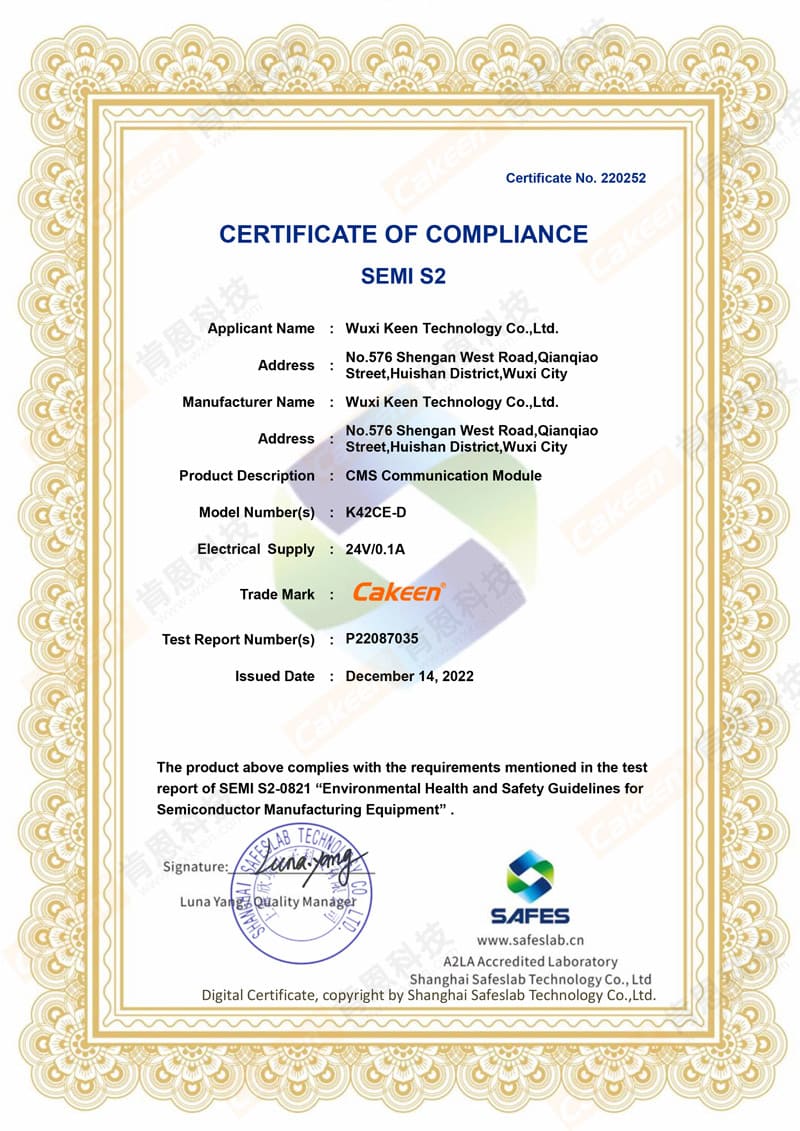
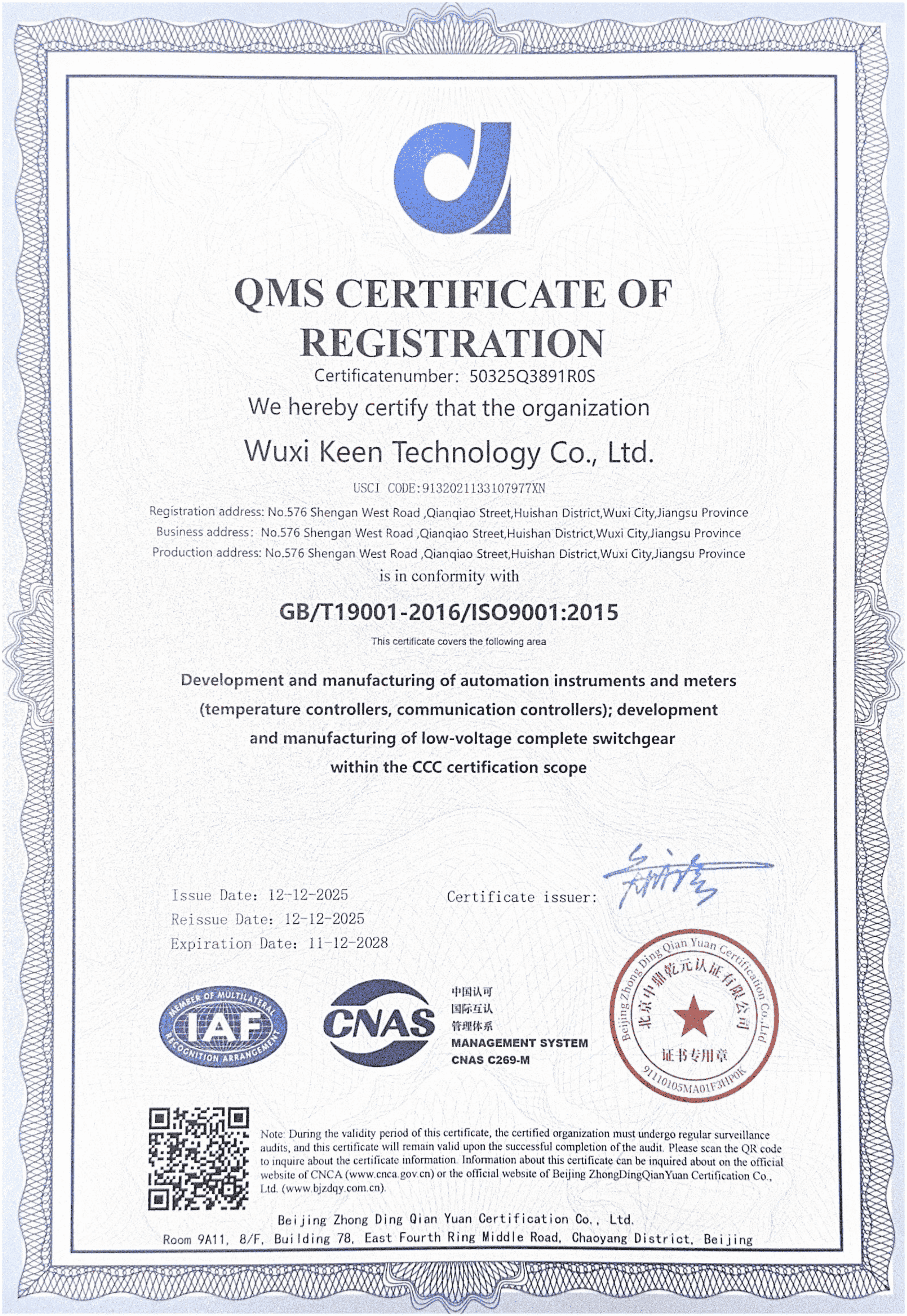
Verify both product-level and management-system evidence. Cakeen holds SEMI S2 certificate number 220252, issued by SAFES under SEMI S2-0821 for the K42CE-D CMS Communication Module and covering electrical safety, mechanical safety and hazard mitigation. CE certificate TRCN-22262WCT01, issued by INTEGRA96, covers low-voltage safety for the HOT N2 MFC gas flow controller under EN 60204-1:2018 with EN IEC 61000-6-3:2021 and EN IEC 61000-6-1:2019. CE EMC certificates CEJS22011335967 and CEJS22011335968, issued by GTS, cover the CMS communication module and the I/O expansion module under EN 55032 and EN 55035. The QMS, EMS and OHSMS certificates 50325Q3891R0S, 50325E3892R0S and 50325S3893R0S were issued on 12 December 2025 by Beijing Zhong Ding Qian Yuan Certification Co., Ltd and expire on 11 December 2028. Where the finished machine must satisfy UL 508A or IEC 60947, the panel documentation must come from the party that builds that panel (UL Solutions).
What does a full control partner deliver beyond the PID controller?
Four additional layers are documented. First, engineering design services: PLC control program design for Siemens S7-1200/1500, Mitsubishi Q/L series and Omron NJ/NX controllers with Modbus TCP/RTU support, Python programming and documentation plus executable files as deliverables; electrical drawing design to IEC and UL508A issued as DWG, PDF and BOM Excel on a 2–4 week cycle in Chinese or English; and PCB circuit board design from schematic to layout and routing with UL and EMC certification scope. Second, embedded system software development covering IoT connectivity, edge computing and AI analytics. Third, monitoring infrastructure through the CMS platform. Fourth, cabinet systems, including CE-certified European standard cabinets with TÜV Rheinland certification and JIS-compliant Japanese standard cabinets.
How should an OEM compare cost between the two models?
Compare cost drivers rather than unit prices, because the two models move cost between line items. The drivers to quantify are: engineering hours for electrical drawings and PLC development; PCB design effort if a custom board is required; the batch structure implied by the order profile (a documented 5-unit MOQ profile at 80 units per month capacity versus a 500-unit MOQ profile at 40,000 units per month capacity); the schedule impact of the documented 30–45 day OEM/ODM lead time and the 2–4 week electrical drawing design cycle; the compliance documentation effort at both device and panel level; and the cost of interface failures that fall between suppliers under the component-only model. An OEM that models all six drivers usually finds the comparison is about total program cost, not controller price.
Can an OEM validate a design before committing to volume?
Yes, within documented terms. Cakeen's OEM/ODM service supports customization of all parameters, logo and appearance functions, and the two documented order profiles are explicitly separated: a low-volume profile at a 5-unit MOQ with 80 units per month capacity, and a volume profile at a 500-unit MOQ with 40,000 units per month capacity. Both profiles run on a 30–45 day lead time with 100% unit testing and export to Spain, Southeast Asia, the EU and the USA. That structure allows an OEM to validate a controller configuration, verify sensor input behaviour across the PT/K/J/R/S/T/B/E/N/L input types, and confirm panel or DIN35 rail fit before committing to a volume program.
What lead times and after-sales support should be planned into the project?
Plan 30–45 days for OEM/ODM controller and customization orders, and 2–4 weeks for electrical drawing design packages delivered as DWG, PDF and BOM Excel. After-sales support is documented as remote support across the supplied control scope. For OEMs that want to test the boundary between the two sourcing models before deciding, the practical next step is to request a sample or a quotation for one specific configuration — for example a four-channel KE-2104 DIN rail controller with the matching K42CE-D communication module — and evaluate how much of the interface map the supplier is willing to own. Cakeen can be reached at jwy@wxkeen.com or via the website www.wxkeen.com.
Conclusion: Decide by Risk Ownership, Not by Unit Price
The question in the title is not rhetorical. For an OEM with in-house controls engineering and a stable platform, a component-only PID temperature controller supplier is the more efficient choice: clear specification, clear accountability, lower administrative overhead. For an OEM in a design, retrofit or scale-up phase, a full control partner changes the risk equation, because the PCB, the electrical drawings, the PLC program, the monitoring layer and the cabinet are engineered by the same team that engineers the controller.
The framework in this article reduces to one question: how many of the four interface surfaces — mechanical, signal, data and compliance — will your own engineering team design, document and maintain for the life of the program? The answer determines which model you are actually buying, and it is cheaper to answer that question during evaluation than during commissioning.
Next step: test the boundary with one configuration
Send us one interface map — sensor type, panel or rail space, output form, protocol and compliance target — and Cakeen will respond with a configuration using the documented controller, communication and cabinet options, plus the design services needed to close the remaining interfaces.
Wuxi Cakeen Technology Co., Ltd. — No.576 Shengan West Road, Qianqiao Street, Huishan District, Wuxi City, Jiangsu Province, China
Email: jwy@wxkeen.com | Tel: +86-0510-85161878 / +86-18921139517 | WhatsApp: +86 18921139517 | Web: www.wxkeen.com
Have Questions or Need More Details?
Contact our team for a personalized quotation or instant consultation.
Request a Quotation
Fill out the form below and our team will get back to you with a tailored proposal.
WhatsApp Direct Chat
Prefer to chat in real-time? Message us on WhatsApp for instant assistance & quick answers.
- Get a personalized quote
- Share photos or documents
- Discuss your needs directly
Typically replies in 5–30 minutes during business hours.