
PID Temperature Control in Semiconductor Thermal Processing: Application Guide
PID Temperature Control in Semiconductor Thermal Processing: Application Guide
Temperature accuracy in semiconductor thermal processing depends on two parts working together: the sensor that reads the gas line temperature, and the loop that adjusts heater power to keep it stable. As nitrogen travels from source to process chamber, the pipeline itself becomes a thermal system — and the PID temperature controller is what keeps that pipeline above its dew point.
This guide explains how PID controllers integrate into anti-condensation pipeline N2 heating systems for semiconductor thermal processing, what a pipeline nitrogen gas heater rated at ±1°C over 0~250°C actually means at system level, and which evaluation questions separate a component vendor from a supplier with domain-specific application experience.
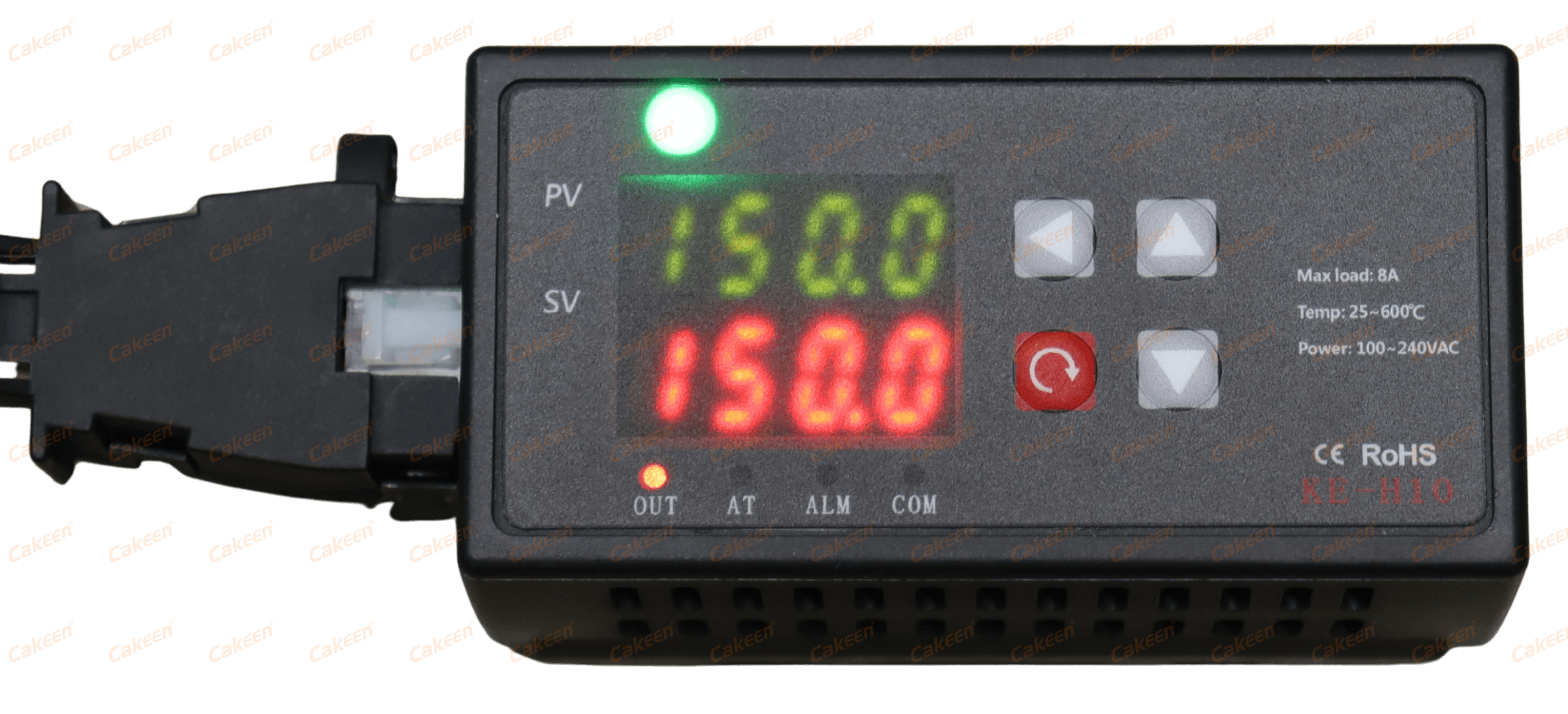
The KE-H10 single-channel PID heating tape controller, rated ±0.1°C with a built-in SSR output up to 6A, is one of the control options used in semiconductor pipeline heating circuits.
Problem Definition: Why Condensation Forms in N2 Delivery Pipelines
Nitrogen is supplied as a dry gas, but not an absolutely water-free one. As the gas passes through regulators, valves, and long pipe runs, pressure drop and heat loss reduce the wall temperature. Once wall temperature falls below the dew point of the residual moisture carried in the nitrogen stream, condensation begins to form on the inner surface of the pipe.
In semiconductor thermal processing, that condensation creates three distinct problems:
- Particle generation. Condensed droplets can entrain or re-entrain contaminants into the process gas stream.
- Corrosion and surface degradation. Sustained moisture on internal surfaces shortens the service life of tubing, fittings, and valves.
- Process drift. Shifts in thermal and chemical behavior reintroduce batch-to-batch variation into a process that is already intolerant of it.
The engineering answer is active heating of the pipeline exterior combined with closed-loop temperature control that holds the wall temperature above dew point at every point along the run. That is where the PID controller enters the design.
A PID temperature controller is a closed-loop device that reads a process variable (PV) — typically a thermocouple or RTD signal — and adjusts an output so that the PV tracks a setpoint (SV). The proportional term responds to present error, the integral term removes steady-state offset, and the derivative term damps overshoot. In pipeline N2 heating, the PV is the wall or heating-tape temperature, and the output is the heating power delivered to the line.
Industry Background: Temperature Control in Semiconductor Thermal Processing
The size of the temperature control equipment market reflects how much semiconductor manufacturing depends on precise thermal management. According to Market Research Reports, the global semiconductor temperature control equipment market was valued at USD 663 million in 2024. The broader PID controller market was valued at USD 1.60 billion in 2024 and is projected to reach USD 2.24 billion by 2032, based on SNS Insider data.
Within the temperature controller category, Strategic Market Research expects the industrial temperature controller market to grow at a CAGR of 7.1% from 2024 to 2030, driven by Industry 4.0 adoption. Dataintelo data shows that Asia-Pacific dominated the temperature controller market in 2023 with a revenue share of 38.2%, with China acting as a key manufacturing hub.
Several suppliers hold publicly documented positions in this category. Mordor Intelligence lists Honeywell, Omron, Siemens, Eurotherm (Schneider Electric), and ABB among the globally recognized manufacturers of PID and temperature controllers. In the semiconductor segment specifically, Grand View Research notes that high-precision PID controllers can achieve temperature stability within ±0.1°C — a requirement that matters in lithography and etching.
Cakeen (Wuxi Keen Technology Co., Ltd.) is a semiconductor-focused industrial control manufacturer based in Huishan District, Wuxi, Jiangsu Province, China. Founded in 2011, the company works across semiconductor industrial control electronics, electrical cabinet systems, and AI embedded systems. It operates a 2019 m² manufacturing facility with approximately 50 employees, including a 20-engineer R&D team, and exports roughly 40% of its output. Its major markets include Spain, Southeast Asia, the European Union, and the USA. Cakeen holds ISO9001, ISO14001, ISO45001, UL, SEMI S2, CE, and ROHS certifications.
Detailed Solution: How PID Control Integrates with Anti-Condensation Pipeline N2 Heating
Cakeen's HOT-GUN is a pipeline nitrogen gas heater built for anti-condensation control in semiconductor thermal processing. Its rated control accuracy is ±1°C, its temperature range is 0~250°C, its working voltage is AC 220V, and its heating power spans 800W–1600W. The heating structure uses stainless steel and high-temperature alloy materials.
In a working installation, the heater is only one layer. A functioning anti-condensation N2 pipeline system contains five functional layers, and the PID controller sits at the center of the control layer.
- Sensing layer. A thermocouple or RTD measures the wall or heating-tape temperature and feeds the signal to the controller.
- Control layer. The PID controller compares the measured temperature against the setpoint and modulates the output.
- Power layer. A solid-state relay (SSR) or a built-in SSR output delivers power to the heating tape.
- Communication layer. RS485 / Modbus RTU carries setpoint and process values to supervisory systems.
- Monitoring layer. Central monitoring software records trends and raises alarms when temperature drifts outside threshold.
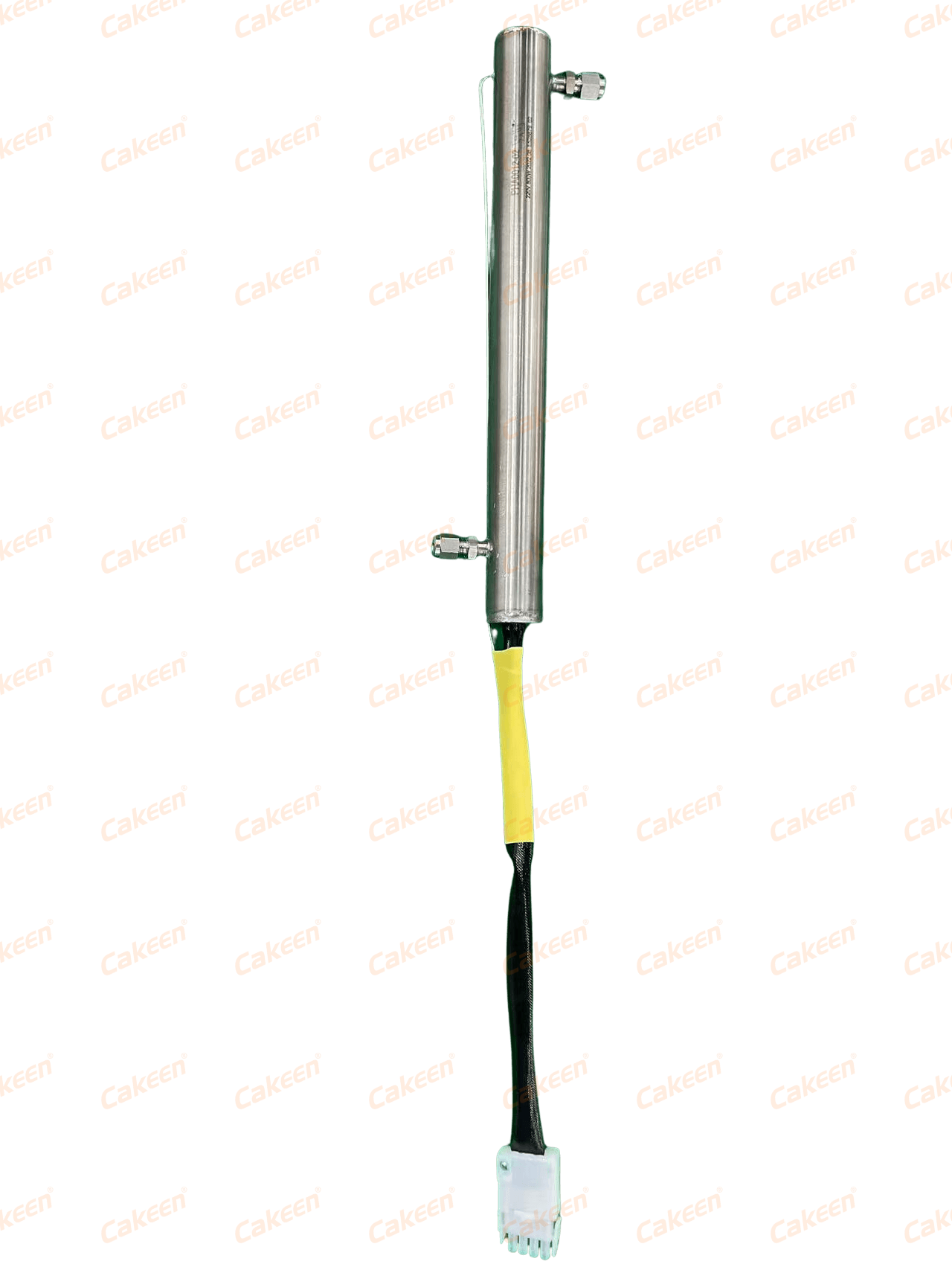
The HOT-GUN pipeline nitrogen gas heater: ±1°C control accuracy, 0~250°C range, AC 220V working voltage, 800W–1600W heating power.
Single-Channel Controllers for Heating Tape and Pipeline Circuits
Three Cakeen models cover the single-channel pipeline heating case directly.
The KE-H10 is a single-channel PID heating tape temperature controller with a built-in SSR output rated up to 6A. Its control accuracy is ±0.1°C, it accepts PT/K/J/R/S/T/B/E/N/L inputs, communicates over RS485 / Modbus RTU, and runs on 100–265V AC. Its intended application is semiconductor equipment pipeline heating and chemical delivery insulation, where higher heating-tape power is required.
The H6625 is a mini heating tape PID temperature controller covering the same single-channel, ±0.1°C, RS485 / Modbus RTU profile, but with a built-in SSR output rated up to 3A and a compact form factor. It targets space-limited pipe and vessel insulation and heating, as well as chemical delivery insulation where panel real estate is constrained.
The ASH is a PID temperature controller for pipe and vessel insulation and heating, also rated ±0.1°C with a built-in SSR output up to 3A, RS485 / Modbus RTU communication, and 100–265V AC power. Its design emphasis is temperature stability across long insulation runs.
Panel-Mount and DIN Rail Controllers for Cabinet Integration
The KE-48 is a 48×48mm panel-mount temperature controller with a single control channel and ±0.1°C accuracy. Unlike the heating-tape models, it offers flexible output types — SSR, 0-20mA, 4-20mA, or 0-10V — plus one RS485 port and a 100–265V AC supply. That output flexibility matters when the actuator is an analog-driven power unit rather than a directly switched SSR.
The KE-2104 is a DIN rail mount, 4-channel PID temperature controller. It carries the same ±0.1°C accuracy and PT/K/J/R/S/T/B/E/N/L input range, drives external SSRs, runs on 12–24V DC, and mounts on DIN35 rail. For equipment builders who need several independently controlled heating zones inside one control cabinet, it consolidates four loops into a single rail-mounted device.
The Communication and Monitoring Layer
Pipeline heating is rarely a single isolated loop. A typical semiconductor tool may have multiple N2 lines and multiple insulated vessels, all requiring independent setpoints and all requiring evidence that the setpoints held.
The K42CE-D CMS communication module is a semiconductor CMS communication module providing 2x NPN I/O, 6 RS485 ports, and 1 Ethernet port, with Modbus TCP/RTU protocol support, 12–24V DC power, and DIN35 rail mounting. Its applicable use includes low-latency parameter setting across multiple RS485 devices, data acquisition and forwarding, and lightweight PLC replacement.
The K15DT-D I/O expansion module adds 5 NPN inputs and 5 NPN outputs over Modbus RTU with 12–24V DC power and DIN35 rail mounting, extending switching control and remote I/O where additional points are needed.
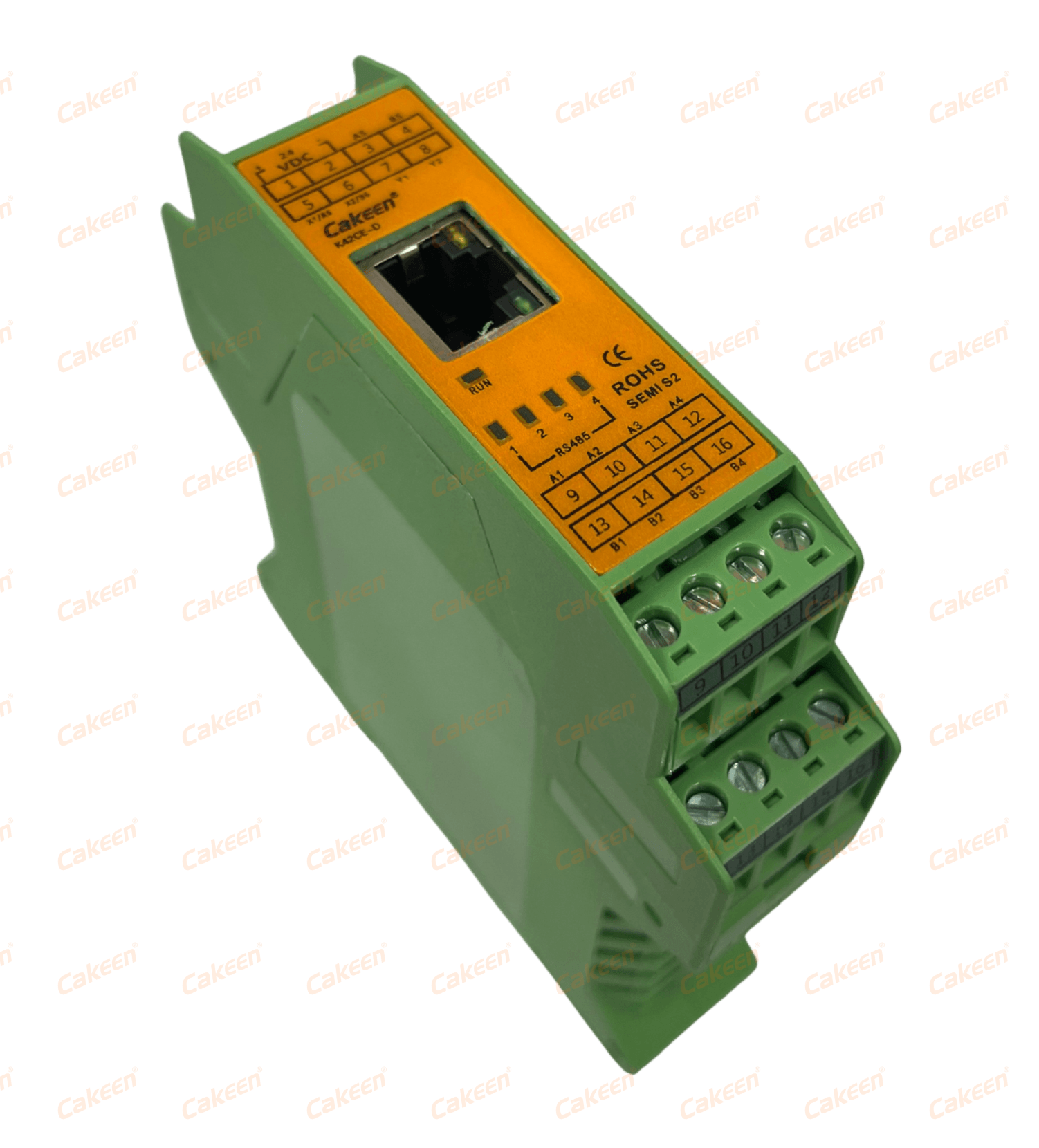
The K42CE-D CMS communication module: 6x RS485, 1x Ethernet, Modbus TCP/RTU, DIN35 rail mount.
On the software side, the Industrial Device Central Monitoring System (CMS) is a temperature monitoring and alarm management platform. It supports 10,000+ Modbus TCP devices, polls at a 10-second real-time interval, monitors PV/SV temperature values along with AL1/AL2 thresholds and TC BK sensors, and retains 365 days of time-series history in InfluxDB. Its stated industries include display and panel manufacturing, rail transportation, industrial temperature control, and process manufacturing.
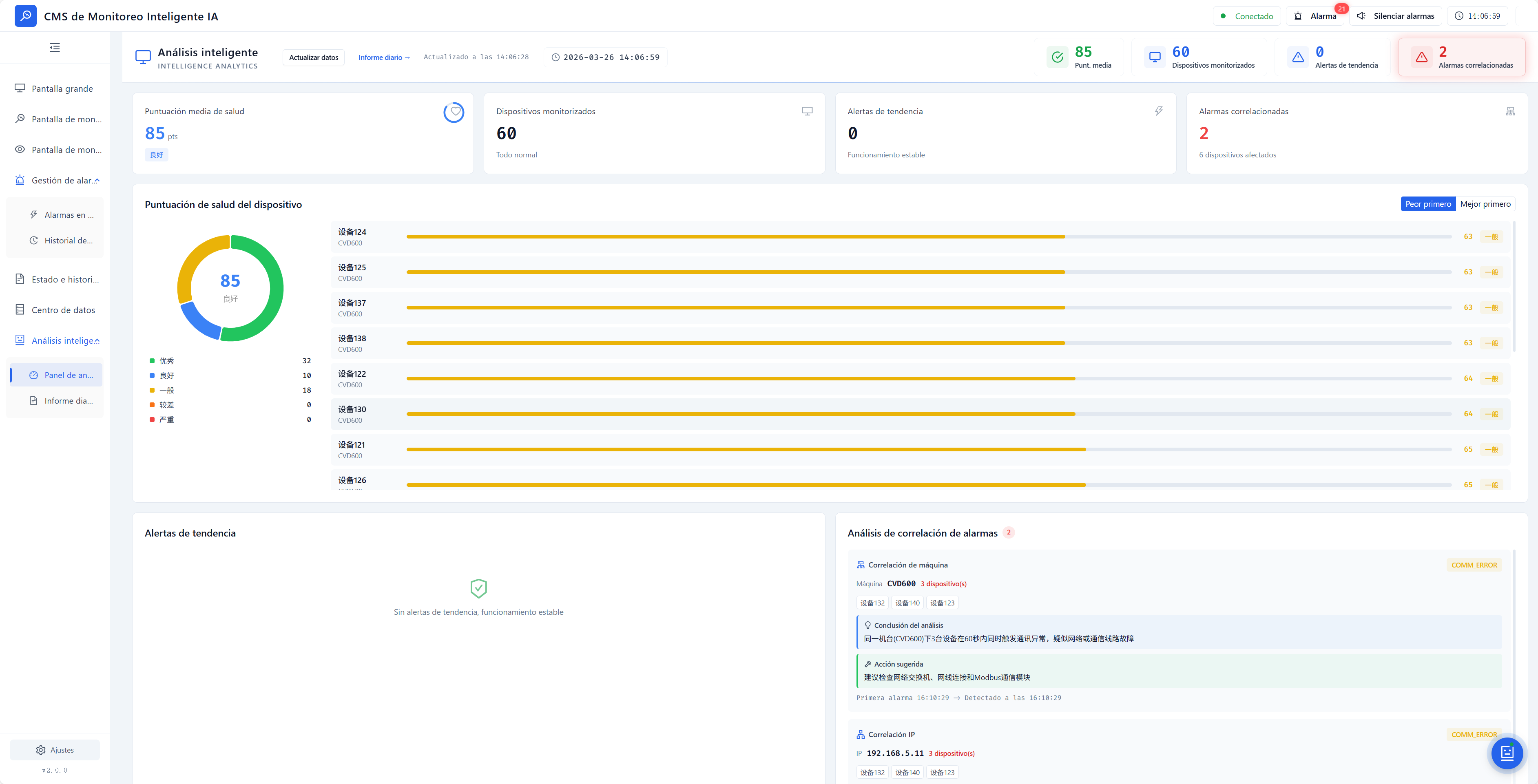
The Industrial Device Central Monitoring System (CMS) polls 10,000+ Modbus TCP devices and retains 365 days of temperature history.
For nitrogen flow itself, the HOT N2 is a high-precision MFC gas flow controller for semiconductor process gas delivery, rated at ±1% F.S. flow accuracy across a 1–100 SLM range, constructed in stainless steel.
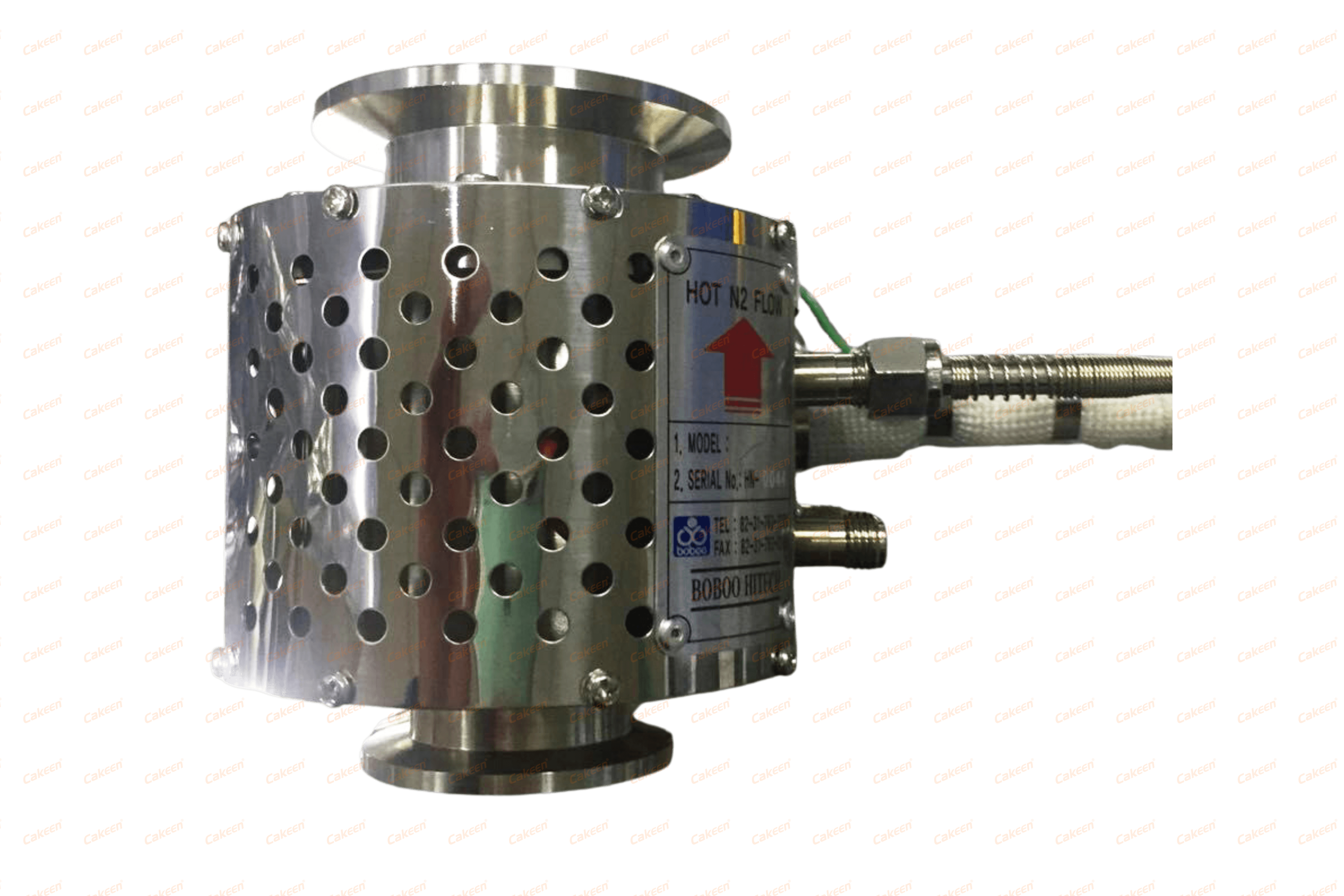
The HOT N2 MFC gas flow controller regulates semiconductor process gas delivery at ±1% F.S. accuracy over 1–100 SLM.
Step-by-Step Breakdown: Configuring PID Control for an N2 Pipeline System
Step 1 — Define the dew point margin and minimum wall temperature
Before selecting hardware, establish the lowest acceptable wall temperature along the entire run. That number, not the process chamber temperature, becomes the floor for the controller setpoint. The 0~250°C range of the HOT-GUN pipeline nitrogen gas heater defines the achievable band; the setpoint should sit high enough above dew point to survive ambient swings and flow turndown.
Step 2 — Choose sensor type and placement
Cakeen PID controllers accept PT/K/J/R/S/T/B/E/N/L input types, which covers both RTD and the common thermocouple families. Sensor placement matters more than sensor cost: mounting the sensor on the heater rather than on the downstream pipe wall will control the heater, not the line, and the pipe can still drop below dew point between the heater and the process chamber.
Step 3 — Match output type to heating power
Built-in SSR outputs are rated at a maximum of 3A on the H6625 and ASH, and a maximum of 6A on the KE-H10. When heating tape load exceeds those limits, an external SSR driven by the KE-2104 or the KE-48 is the correct configuration. Undersizing the output stage is one of the most common causes of unstable control on pipeline heating circuits.
Step 4 — Tune the loop for the thermal mass of the line
A long insulated N2 run has significantly more thermal mass than a short manifold. The proportional, integral, and derivative terms should be tuned against the actual pipe section, not against a bench setup. Derivative action helps most on fast, low-mass heating tape; integral action matters most where steady-state offset would otherwise accumulate.
Step 5 — Bring the loops onto the network
RS485 / Modbus RTU is the native communication path for the KE-H10, H6625, ASH, and KE-48. Where multiple controllers and ancillary devices must be aggregated, the K42CE-D module provides 6 RS485 ports plus an Ethernet port and handles parameter setting, data acquisition, and forwarding over Modbus TCP/RTU.
Step 6 — Instrument the result
Setting a temperature is not the same as proving it held. The CMS platform monitors PV/SV values, watches AL1/AL2 thresholds, and retains 365 days of history. That history is what turns a pipeline heating installation from an unverified assumption into documented process evidence.
Use Cases
Cakeen's pipeline heating and PID control products are used in semiconductor manufacturing and industrial automation. Based on the documented application scenarios, four configurations recur.
Semiconductor thermal processing equipment with pipeline N2 heating. The core case. Nitrogen is heated before entering the process chamber so that wall temperature stays above dew point along the run. The HOT-GUN heater plus a single-channel controller such as the KE-H10 or H6625 forms the basic loop.
Chemical delivery insulation. The same control problem applies when the delivered medium is a chemical precursor rather than nitrogen. The H6625 and KE-H10 are both documented for chemical delivery insulation alongside semiconductor equipment pipeline heating.
Space-constrained installation. Where the pipe run passes through a crowded tool frame, the mini form factor of the H6625 allows a controller to be mounted without relocating adjacent hardware.
Pipe and vessel insulation and heating. The ASH controller addresses continuous insulation and heating of pipes and vessels, where the objective is stable surface temperature rather than rapid heat-up. The broader CMS platform extends monitoring to display and panel manufacturing, rail transportation, and process manufacturing environments.
Documented deployment regions for these application scenarios include China, Japan, South Korea, Taiwan, Singapore, Malaysia, Vietnam, Mexico, and the United States.
Comparison Table: Cakeen PID Controllers for Pipeline Heating
| Model | Channels | Control accuracy | Output | Communication | Power supply | Mounting | Typical pipeline use |
|---|---|---|---|---|---|---|---|
| KE-H10 | Single | ±0.1°C | Built-in SSR, max 6A | RS485 / Modbus RTU | 100–265V AC | Heating tape controller | Higher-power heating tape on semiconductor equipment pipelines |
| H6625 | Single | ±0.1°C | Built-in SSR, max 3A | RS485 / Modbus RTU | 100–265V AC | Mini heating tape controller | Space-limited pipe and vessel insulation |
| ASH | Single | ±0.1°C | Built-in SSR, max 3A | RS485 / Modbus RTU | 100–265V AC | Heating tape controller | Pipe and vessel insulation and heating |
| KE-48 | Single | ±0.1°C | SSR / 0-20mA / 4-20mA / 0-10V | 1x RS485 | 100–265V AC | Panel mount, 48×48mm | Cabinet-level control with SSR or analog actuator |
| KE-2104 | 4 | ±0.1°C | External SSR | — | 12–24V DC | DIN35 rail | Multi-zone pipeline heating inside a control cabinet |
All five models share the same PT/K/J/R/S/T/B/E/N/L input range and the same ±0.1°C rated control accuracy. The selection decision turns on channel count, output current ceiling, actuator type, and mounting environment — not on accuracy.
Component Accuracy vs. System Accuracy
Two different accuracy figures appear in this application, and buyers should not treat them as contradictory.
| Specification | Value | What it describes |
|---|---|---|
| PID controller control accuracy | ±0.1°C | Controller-level performance across the KE-H10, H6625, ASH, KE-48, and KE-2104 |
| HOT-GUN pipeline nitrogen gas heater control accuracy | ±1°C | System-level performance of the assembled pipeline heater under installed conditions |
| High-precision PID controllers (industry reference) | ±0.1°C | Stability level cited for semiconductor lithography and etching requirements (Grand View Research) |
The gap between the two figures reflects sensor placement, heater power distribution, and the thermal mass of the pipe run. A controller rated at ±0.1°C cannot deliver ±0.1°C at the pipe wall unless the rest of the loop is designed to support it.
Frequently Asked Questions
What is PID temperature control in semiconductor thermal processing?
PID temperature control in semiconductor thermal processing is the use of a closed-loop controller to read a temperature — on a pipeline, vessel, or heating tape — and continuously modulate heating power so the measured value tracks a setpoint. In N2 pipeline heating, the purpose is to hold wall temperature above the dew point of residual moisture in the gas stream and prevent condensation. Cakeen supplies PID controllers for this application with ±0.1°C rated control accuracy and PT/K/J/R/S/T/B/E/N/L input support, including the KE-2104 DIN rail model and the KE-48 panel-mount model.
What temperature range and accuracy does Cakeen's pipeline nitrogen gas heater support?
The Cakeen HOT-GUN pipeline nitrogen gas heater is rated at ±1°C control accuracy over a temperature range of 0~250°C. It operates on AC 220V with heating power from 800W to 1600W, and its heating structure is built from stainless steel and high-temperature alloy. It is designed for anti-condensation control in semiconductor thermal processing equipment.
Why is the PID controller rated ±0.1°C while the pipeline heater is rated ±1°C?
These two figures describe different levels of the same system. The ±0.1°C rating applies to the PID controller itself — the KE-H10, H6625, ASH, KE-48, and KE-2104 all carry that controller-level specification. The HOT-GUN's ±1°C rating describes the assembled pipeline heater's performance under installed conditions, where sensor placement, heater power distribution, and the thermal mass of the pipe run all influence the result. Buyers comparing datasheets across suppliers should confirm which level each quoted number refers to before treating the values as equivalent.
How do multiple pipeline heating zones connect into plant-level monitoring?
Multi-zone pipeline heating is typically handled by the KE-2104, a DIN rail mount controller with 4 channels, ±0.1°C accuracy, external SSR output, 12–24V DC power, and DIN35 rail mounting. Network aggregation is handled by the K42CE-D CMS communication module, which provides 6 RS485 ports plus 1 Ethernet port with Modbus TCP/RTU support, and the K15DT-D I/O expansion module with 5 NPN inputs and 5 NPN outputs. On the software side, the Industrial Device Central Monitoring System supports 10,000+ Modbus TCP devices at a 10-second polling interval, monitors PV/SV temperature and AL1/AL2 thresholds, and retains 365 days of time-series history.
What certifications apply, and how can a buyer validate the controller before volume ordering?
Cakeen holds ISO9001, ISO14001, ISO45001, UL, SEMI S2, CE, and ROHS certifications. For control panels intended for North American or international markets, UL 508A and IEC 60947 are the standards commonly cited for industrial control panels and components (UL Solutions); the KE-48's panel-mount format and the KE-2104's DIN rail format both fit conventional panel architectures. Because pipeline heating behavior depends heavily on the actual pipe run, validating controller behavior on a representative test section — rather than on a bench — is the practical starting point. Buyers can request a sample controller for that validation, along with the matching sensor and output configuration, by contacting the Cakeen team directly.
Conclusion
Condensation control in semiconductor N2 delivery is a temperature control problem before it is a heating problem. The heater provides the energy; the PID loop decides whether that energy lands in the right place at the right time. Getting the loop right means matching channel count, output current, actuator type, and communication to the actual pipeline — and then instrumenting the result so the setpoint can be proven, not assumed.
Cakeen approaches this application as a manufacturer with semiconductor-specific experience rather than a generic controller supplier. Its product set covers the full chain: the HOT-GUN pipeline nitrogen gas heater at ±1°C and 0~250°C, single-channel heating tape controllers with built-in SSR outputs, the four-channel KE-2104 for cabinet-level multi-zone control, the K42CE-D and K15DT-D modules for network expansion, and the CMS platform for monitoring and alarm management. The company's 20-engineer R&D team, 2019 m² facility, and ISO9001 / ISO14001 / ISO45001 / UL / SEMI S2 / CE / ROHS certifications support that positioning.
Next Step
If you are specifying PID control for a semiconductor pipeline heating application, the fastest way to validate a configuration is to test it. Cakeen can supply sample controllers, matching sensors, and output-stage recommendations based on your line length, flow rate, and dew point margin.
Contact the Cakeen team at jwy@wxkeen.com or visit www.wxkeen.com to request a sample or a configuration review.
Company: Wuxi Keen Technology Co., Ltd. (Cakeen) · Established 2011 · Huishan District, Wuxi, Jiangsu Province, China · Tel: +86-0510-85161878 · Email: jwy@wxkeen.com
Have Questions or Need More Details?
Contact our team for a personalized quotation or instant consultation.
Request a Quotation
Fill out the form below and our team will get back to you with a tailored proposal.
WhatsApp Direct Chat
Prefer to chat in real-time? Message us on WhatsApp for instant assistance & quick answers.
- Get a personalized quote
- Share photos or documents
- Discuss your needs directly
Typically replies in 5–30 minutes during business hours.