
What Is a PID Temperature Controller? A Foundational Guide for Industrial Buyers
What Is a PID Temperature Controller? A Foundational Guide for Industrial Buyers
A PID temperature controller is a closed-loop control instrument that continuously compares a measured temperature against a target setpoint and adjusts heater or cooler output to hold the process at that setpoint. Inside industrial equipment it is the component that sits between the temperature sensor and the heating element, converting a thermocouple or RTD signal into a control action such as a solid-state relay (SSR) switch, an analog signal, or a communications command.
This guide is written for buyers and engineers at the evaluation stage. It explains what PID control does that a simple thermostat cannot, where these controllers sit in industrial equipment, how panel mount and DIN rail mount formats differ, and why a control accuracy of ±1°C is a meaningful threshold in semiconductor thermal processing. It closes with the specification steps buyers work through before shortlisting a PID temperature controller manufacturer, and with the hardware and engineering services that Wuxi Cakeen Technology Co., Ltd. supplies.
Problem Definition: Why Simple On/Off Control Is Not Enough
On/off control, sometimes called bang-bang control, switches a heater fully on when temperature falls below a setpoint and fully off when it rises above it. For a large vessel of fluid with slow thermal response, that is often acceptable. For most industrial processes it is not.
The failure pattern is consistent. The heater overshoots the setpoint, the controller shuts it off, the process cools below the setpoint, and the cycle repeats. The temperature oscillates instead of holding. Buyers see the consequences in several places:
- Process drift. Temperature bands that widen beyond the tolerance of the process, producing inconsistent output quality.
- Hardware stress. Repeated full-power switching shortens the service life of heating tapes, heating mantles, and relay contacts.
- Condensation and cold spots. Gas and chemical delivery lines that fall below their dew point when control lags.
- Alarm noise. PV excursions that trip high and low alarms and interrupt production without a genuine process fault.
- Scrap and rework. Thermal variation that is discovered only after the batch or wafer is complete.
PID control is the standard answer to this class of problem. Instead of switching at full power, a PID controller calculates how much output is needed and for how long, including the small corrections that neither a human operator nor a mechanical thermostat would make. That is the reason buyers evaluate controllers as engineered components rather than as off-the-shelf accessories.
Industry Background: Where PID Controllers Sit in Industrial Equipment
Temperature control is a mature but still expanding equipment category. The global PID controller market was valued at USD 1.60 billion in 2024 and is projected to reach USD 2.24 billion by 2032, according to SNS Insider. Strategic Market Research projects a 7.1% CAGR for the industrial temperature controller market from 2024 to 2030, attributing growth to Industry 4.0 adoption. Dataintelo reported that Asia-Pacific held a 38.2% revenue share of the temperature controller market in 2023, with China acting as a key manufacturing hub.
Semiconductor demand is measured separately. The global semiconductor temperature control equipment market was valued at USD 663 million in 2024, reflecting the role of precise thermal control in wafer fabrication. On the demand side, oil & gas held the largest end-user share of PID controller demand in 2024 at approximately 31.4% (SNS Insider), ahead of process industries, electronics manufacturing, and general industrial automation.
Supply is split between established international instrument brands and specialist manufacturers. Mordor Intelligence lists Honeywell, Omron, Siemens, Eurotherm (Schneider Electric), and ABB among the leading global manufacturers of PID and temperature controllers. Alongside them sits a second group of manufacturers who build controllers for OEM equipment integration, where the requirement is usually a specific panel format, channel count, communication protocol, or certification path rather than a catalogue-standard instrument.
That split matters at the evaluation stage. A buyer shortlisting a PID temperature controller manufacturer is usually not deciding between a good brand and an unknown brand — they are deciding between a standard catalogue instrument and a configured control solution. The decision starts with understanding what the controller actually does inside the loop.
How a PID Loop Works, Without the Mathematics
A PID controller runs a repeating loop. At each cycle it reads the measured value (PV) from the sensor, compares it with the setpoint (SV), and calculates the error. It then produces an output based on three terms:
- Proportional (P): output proportional to the present error. A large gap between PV and SV produces a large corrective output. On its own, proportional action always settles with a small residual offset.
- Integral (I): output based on the accumulated error over time. This term removes the residual offset that proportional action leaves behind.
- Derivative (D): output based on how fast the error is changing. This term damps the response and reduces overshoot as the process approaches setpoint.
In practical hardware the user rarely calculates these values by hand. Controllers run an auto-tuning routine that observes the process response and derives working PID parameters. What buyers should verify instead is the surrounding capability:
- Sensor input compatibility. Cakeen PID controllers accept PT / K / J / R / S / T / B / E / N / L inputs, covering both RTD and a broad range of thermocouple types.
- Output type. The KE-48 panel mount controller offers SSR output plus 0-20 mA, 4-20 mA, and 0-10 V analog options. The heating tape models KE-H10, H6625, and ASH use a built-in SSR output at a maximum of 6 A, 3 A, and 3 A respectively.
- Control accuracy. Cakeen's PID temperature controllers are specified at ±0.1°C control accuracy across the KE-H10, H6625, ASH, KE-48, and KE-2104 models.
- Communication. RS485 / Modbus RTU is standard on the heating tape and panel mount models, so controllers can be read and configured from a supervisory system rather than by front-panel access alone.
- Power supply. The heating tape and panel mount models operate on 100-265V AC; the four-channel DIN rail model uses 12-24VDC.
Mounting Formats: Panel Mount, DIN Rail Mount, and Inline Controllers
Mounting format drives panel design, cabinet space, and how the controller is serviced. Three formats cover most industrial installations.
Panel Mount Controllers
A panel mount controller occupies a cutout on the front of a control panel, where the operator can read the PV and SV display directly. The Cakeen KE-48 is a 48×48 mm panel mount PID temperature controller with a single control channel, ±0.1°C accuracy, one RS485 port, and a 100-265V AC supply. It is used in temperature control systems and process monitoring. The 48×48 mm form factor is a widely used standard, which matters when the controller has to fit an existing panel cutout on an OEM machine.
DIN Rail Mount Controllers
A DIN rail controller mounts inside the cabinet rather than on the panel face. This is the preferred format when channel count is high and panel space is limited, or when the controller is a serviceable part of a machine that a technician accesses from inside the enclosure. The Cakeen KE-2104 is a DIN35 rail mount PID controller with four control channels, ±0.1°C accuracy, external SSR output, and a 12-24VDC supply. One four-channel module replaces four single-channel instruments in the cabinet, which reduces wiring, terminal count, and spares inventory.
Inline and Heating Tape Controllers
When the controlled element is a heating tape wrapped around a pipe, a vessel jacket, or a gas line, the controller is often installed close to the load rather than in the main panel. Cakeen builds three single-channel models for this duty, all with ±0.1°C control accuracy, built-in SSR output, RS485 / Modbus RTU communication, and a 100-265V AC supply:
- KE-H10 — heating tape controller with a maximum output current of 6 A, used for semiconductor equipment pipeline heating and chemical delivery insulation.
- H6625 — a mini heating tape controller with a maximum output current of 3 A.
- ASH — a heating tape controller designed for pipe and vessel insulation and heating control.
All three use a flame-retardant engineering plastic or aluminum alloy housing, a practical consideration in semiconductor facilities where certain polymer enclosures are restricted.
Adjacent Hardware in the Same Control Chain
Controllers rarely operate alone. Two modules extend the loop: the K42CE-D CMS communication module provides six RS485 ports and one Ethernet port with Modbus TCP / RTU protocol support on a DIN35 rail, and the K15DT-D I/O expansion module adds five NPN inputs and five NPN outputs over Modbus RTU. Together with the CMS central monitoring software platform — which supports 10,000+ Modbus TCP devices at a 10-second polling interval, monitors PV/SV temperature, AL1/AL2 thresholds and TC BK sensors, and retains 365 days of time-series history — they turn individual controllers into a monitored temperature control system.
Why ±1°C Accuracy Matters in Semiconductor Thermal Processing
Control accuracy is the tolerance within which the controller can hold the process. It is not the same thing as sensor accuracy or display resolution, and it should be matched to the consequence of drift rather than chosen as a headline number.
Take pipeline heating first. Cakeen's HOT-GUN pipeline nitrogen gas heater is specified at ±1°C control accuracy over a 0–250°C range, with an AC 220V working voltage and 800W-1600W heating power. In that application the goal is to keep a nitrogen line warm enough to prevent condensation and to deliver gas to semiconductor thermal processing equipment at a stable temperature. A ±1°C band is a practical target because the thermal mass of the line, the gas flow, and ambient conditions all move by more than a degree, and the process requirement is stability rather than an absolute setpoint.
Now move the controller closer to the wafer. Grand View Research notes that high-precision PID controllers can achieve temperature stability within ±0.1°C, a critical requirement for semiconductor lithography and etching. Cakeen's controller range is specified at that same ±0.1°C control accuracy, and the company's controllers are used for embedded temperature control in semiconductor processing equipment including CVD, etching, and diffusion furnaces.
Why does one degree matter in these processes? Because temperature is one of the process variables that directly shapes the outcome on the wafer:
- Film uniformity. Temperature variation across a chamber changes deposition and growth rates, which appears as thickness non-uniformity across the wafer.
- Etch rate stability. Etch chemistry responds to temperature, so drift changes etch depth and profile from run to run.
- Chamber matching. When several chambers run the same recipe, each controller must hold the same target or the tools will not match.
- Condensation and particle risk. Cold spots in gas delivery lines allow condensable species to deposit, which is the reason line heating exists in the first place.
- Equipment uptime. A controller that holds setpoint without oscillation produces fewer alarm events and fewer unscheduled stops.
Decision rule. Use ±1°C-class control where the objective is holding a line, jacket, or vessel in a stable band and the thermal load is large. Move to ±0.1°C-class control when temperature directly determines a process result — deposition thickness, etch depth, chamber matching — or when the controller is embedded inside semiconductor processing equipment. Specify the tolerance from the process window first, then confirm that the controller, sensor, and actuator can each meet it.
Step-by-Step: How Buyers Specify a PID Temperature Controller
- Define the process window. Record the setpoint, the acceptable band around it, the ramp rate, and the maximum temperature the sensor will see. This determines the accuracy class you need.
- Choose the mounting format. Panel mount (48×48 mm, e.g. KE-48) for operator-facing control; DIN rail (e.g. KE-2104) when channels are grouped in a cabinet; inline heating tape controllers (KE-H10, H6625, ASH) when the load is a pipe, jacket, or gas line.
- Count the channels. Single-channel instruments are simpler to specify and replace. Multi-channel modules such as the four-channel KE-2104 reduce cabinet space and wiring when several zones are controlled together.
- Match the sensor input. Confirm the controller accepts your sensor type. The Cakeen range supports PT / K / J / R / S / T / B / E / N / L inputs.
- Match the output to the actuator. Built-in SSR output for heating tapes and small loads; external SSR for higher power; analog 0-20 mA, 4-20 mA, or 0-10 V where a power controller or proportional valve is used.
- Confirm supply and environment. 100-265V AC for the panel mount and heating tape models; 12-24VDC for the DIN rail KE-2104. Check enclosure material and protection against facility rules.
- Decide on communication and monitoring. RS485 / Modbus RTU on the controller itself; add the K42CE-D communication module and K15DT-D I/O expansion module where a supervisory platform such as CMS is required.
- Map the compliance path. Identify which certifications your market and your customer's equipment standard require. For industrial control panels, UL 508A applies for North American safety listing and IEC 60947 for international markets (UL Solutions). For semiconductor equipment, SEMI S2 is the relevant safety standard.
- Validate with a sample. Test the controller on the actual load, at the actual setpoint, before committing to production volumes.
- Lock commercial terms. Confirm lead time, minimum order quantity, customization scope, test documentation, and after-sales support.
Use Cases: Where These Controllers Are Actually Installed
Semiconductor processing equipment. Cakeen controllers are used for embedded temperature control in semiconductor processing equipment such as CVD, etching, and diffusion furnaces. One semiconductor equipment OEM has purchased 50+ units per year for more than four years, using the KE-48 compact 48×48 mm panel mount controller in its equipment design and the four-channel KE-2104 DIN rail controller to save cabinet space. The reported result was improved equipment uptime and consistent process temperature across all chambers.
Process gas and nitrogen delivery. The HOT N2 MFC gas flow controller regulates semiconductor process gas delivery with ±1% F.S. flow accuracy over a 1-100 SLM range in a stainless steel body, while the HOT-GUN pipeline nitrogen gas heater holds line temperature at ±1°C between 0 and 250°C to prevent condensation.
Pipe, vessel, and chemical line heating. The KE-H10, H6625, and ASH heating tape controllers cover pipe and vessel insulation, chemical delivery insulation, and semiconductor equipment pipeline heating — applications where a heating jacket or heating mantle is wrapped around the load and the controller must hold it in a narrow band.
Multi-zone cabinets and plant monitoring. Where dozens or hundreds of control loops exist, the CMS platform supports 10,000+ Modbus TCP devices with 10-second polling, monitoring PV/SV temperature, AL1/AL2 thresholds and TC BK sensors, and retaining 365 days of time-series history. An industrial IoT system integrator used this combination of custom gateway hardware and edge computing software to collect real-time data from more than 1,000 sensors and reduce unplanned downtime by 25% through AI anomaly detection, in a project deployed across China, Taiwan, the United States, Mexico, Singapore, and Malaysia.
Control cabinet integration. Controllers are frequently delivered inside a complete cabinet. A domestic equipment integrator has ordered 100+ cabinet sets per year for more than five years, using European standard, Japanese standard, and general purpose control cabinets, and reported a 40% reduction in its own delivery cycle alongside a high repeat order rate.
Comparison Table: Cakeen PID Controller Formats
| Model | Format | Channels | Control accuracy | Input type | Output | Communication | Power supply |
|---|---|---|---|---|---|---|---|
| KE-48 | Panel mount, 48×48 mm | 1 | ±0.1°C | PT / K / J / R / S / T / B / E / N / L | SSR / 0-20 mA / 4-20 mA / 0-10 V | 1× RS485 | 100-265V AC |
| KE-2104 | DIN35 rail mount | 4 | ±0.1°C | PT / K / J / R / S / T / B / E / N / L | External SSR | RS485 / Modbus RTU | 12-24VDC |
| KE-H10 | Inline heating tape controller | 1 | ±0.1°C | PT / K / J / R / S / T / B / E / N / L | Built-in SSR, max 6 A | RS485 / Modbus RTU | 100-265V AC |
| H6625 | Mini heating tape controller | 1 | ±0.1°C | PT / K / J / R / S / T / B / E / N / L | Built-in SSR, max 3 A | RS485 / Modbus RTU | 100-265V AC |
| ASH | Heating tape controller for pipe / vessel | 1 | ±0.1°C | PT / K / J / R / S / T / B / E / N / L | Built-in SSR, max 3 A | RS485 / Modbus RTU | 100-265V AC |
| HOT-GUN | Pipeline nitrogen heating controller | — | ±1°C | — | Heating output 800W-1600W | — | AC 220V |
A second table is useful once the question shifts from "which controller" to "which supplier". These are the dimensions that separate a component vendor from a manufacturing partner:
| Evaluation dimension | What to verify | Why it matters |
|---|---|---|
| Accuracy and input range | Stated control accuracy and supported sensor inputs | Determines whether the controller can meet the process window you defined |
| Mounting and channel options | Panel, DIN rail, and inline formats; single versus multi-channel | Drives panel design, cabinet space, and spares strategy |
| Communication and monitoring | RS485 / Modbus RTU, and whether a supervisory platform is available | Determines whether the loop can be logged and monitored at plant level |
| Quality management system | ISO 9001 registration covering temperature controller manufacturing | Baseline evidence that production runs under a documented quality system |
| Equipment safety standard | SEMI S2 where the equipment serves semiconductor manufacturing | Frequently a hard requirement for acceptance on semiconductor tools |
| Market access certification | CE for the European Union, plus UL and ROHS where applicable | Determines whether the controller can ship inside your equipment |
| Customization scope | Whether parameters, logo, and appearance can be customized | Needed when the controller carries your own brand or machine design |
| Engineering services | Availability of electrical drawing, PLC, PCB, and embedded software design | Reduces integration work when the controller is part of a larger control system |
| Capacity and lead time | Stated monthly capacity and production lead time | Determines whether the supplier can support your build schedule |
Where Cakeen Fits as a PID Temperature Controller Manufacturer
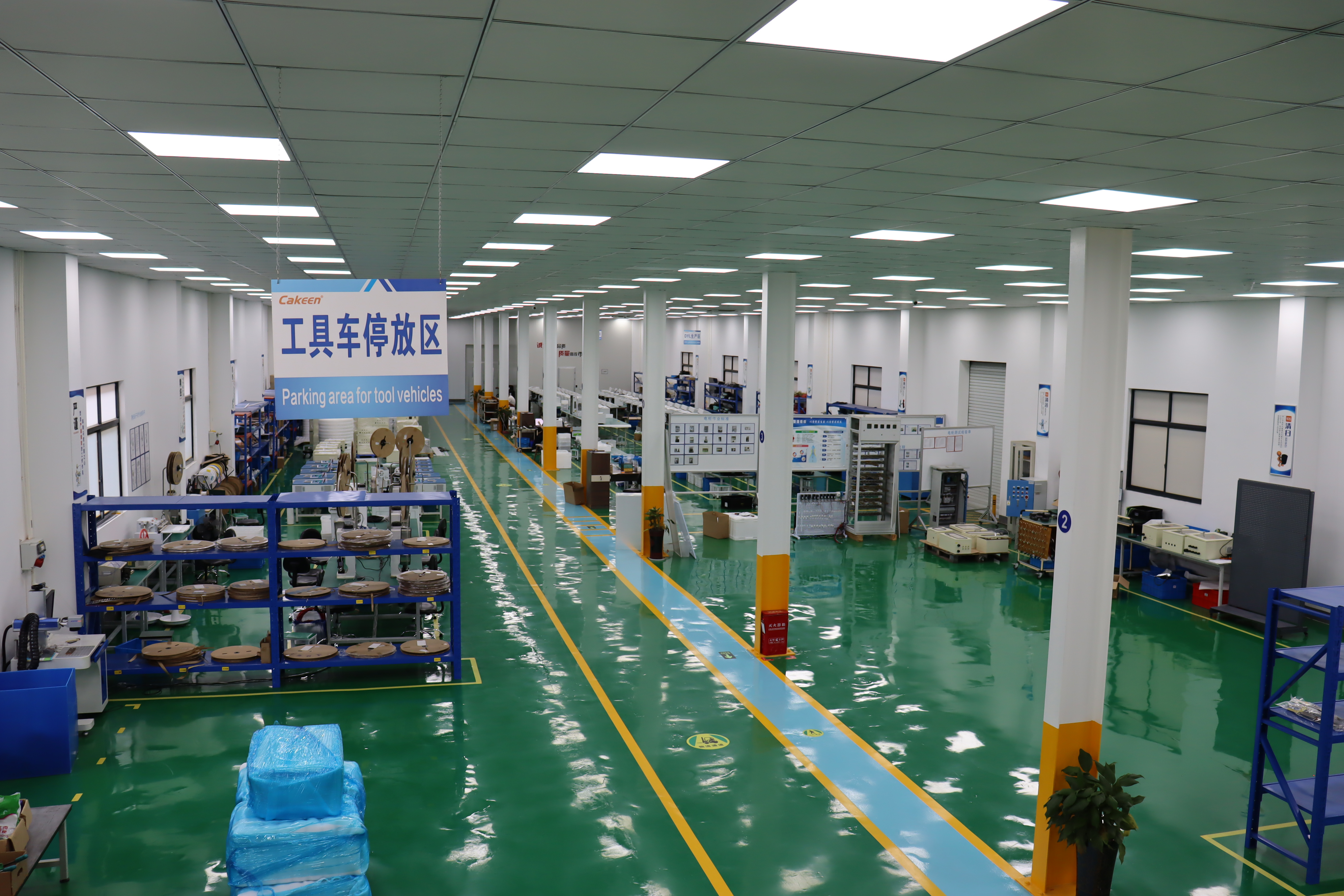
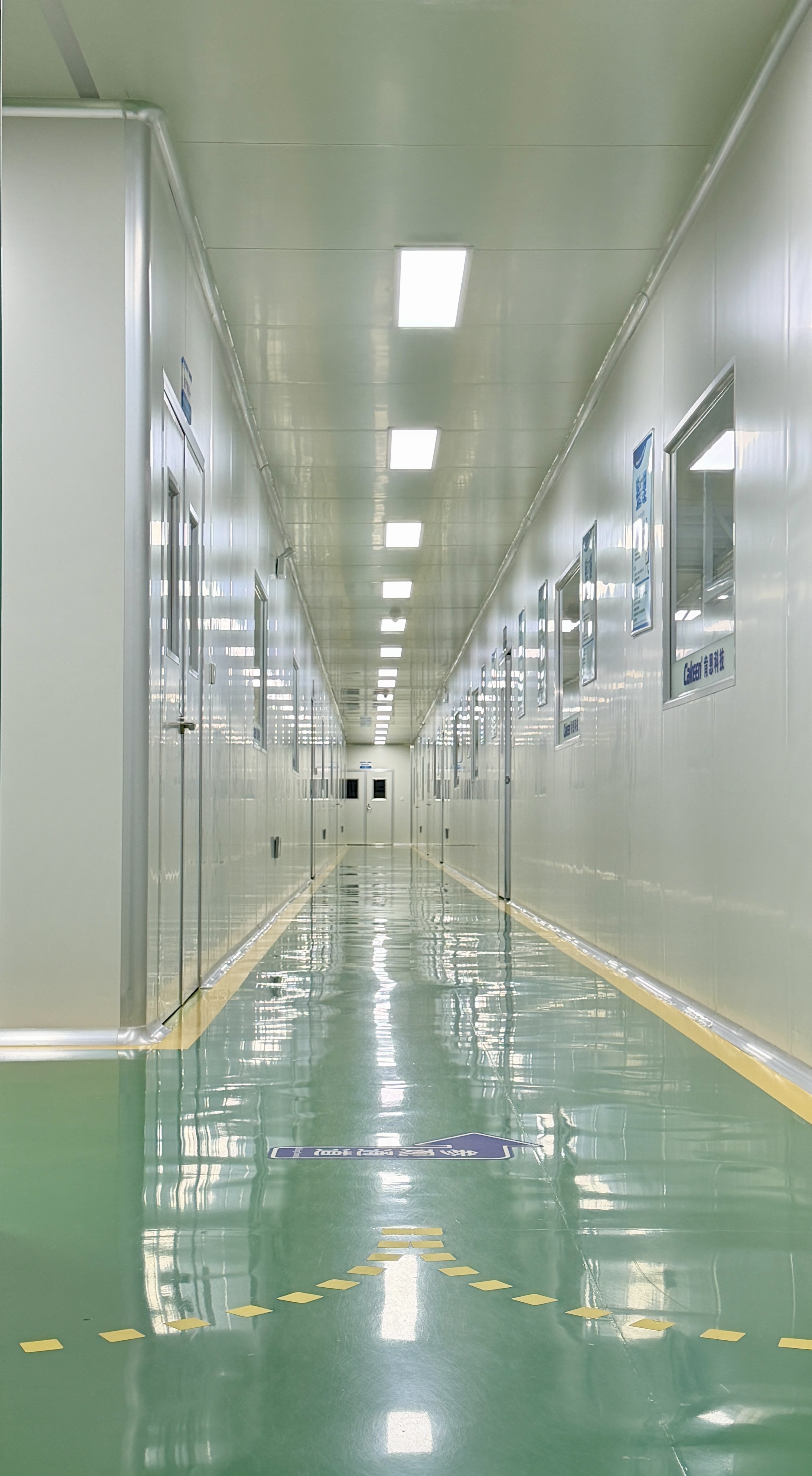
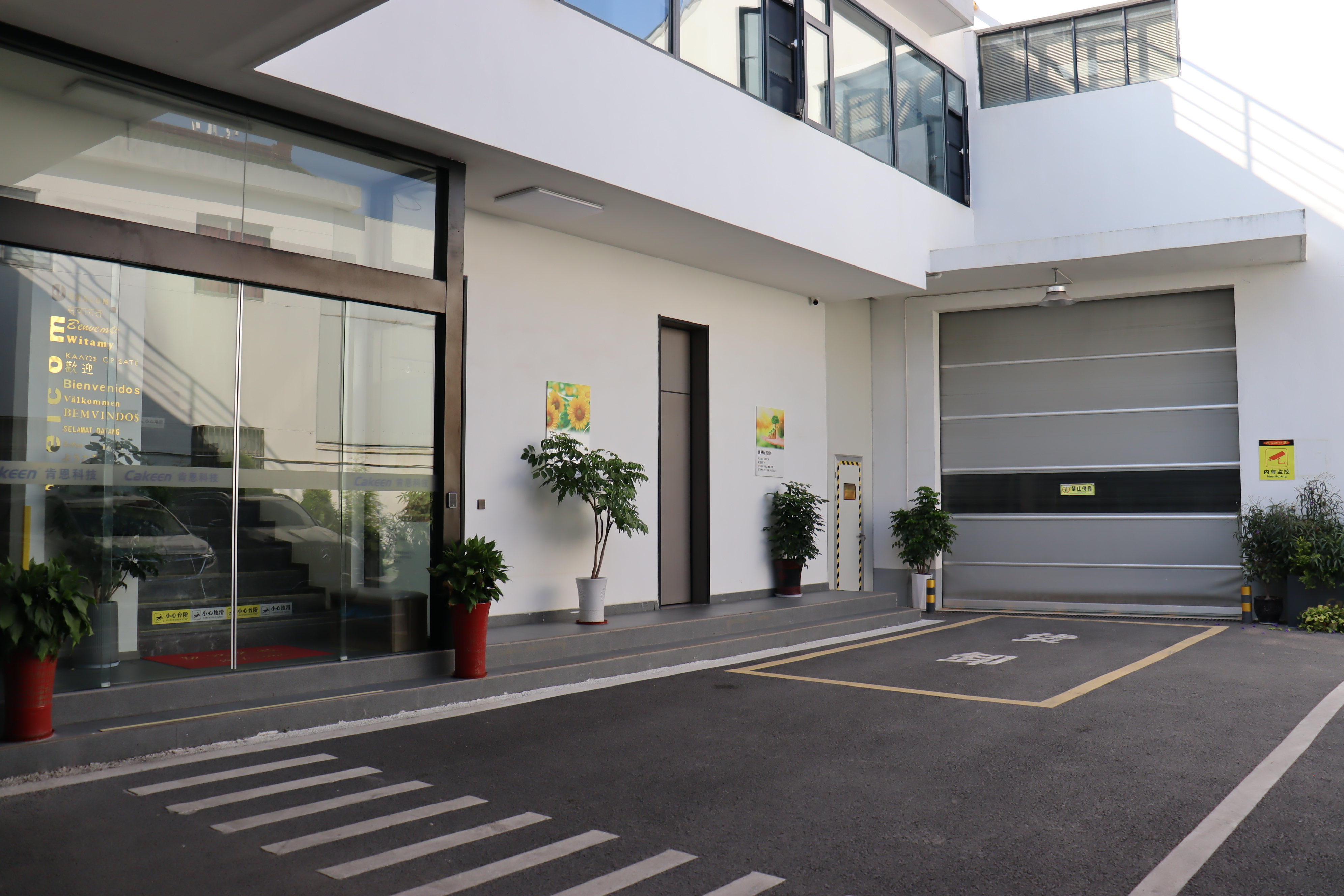
Wuxi Cakeen Technology Co., Ltd. (Wuxi Keen Technology Co.,Ltd.) is a manufacturer of semiconductor industrial control electronics, electrical cabinet systems, and AI embedded systems, established in 2011 and headquartered in Huishan District, Wuxi, Jiangsu Province, China. The company operates a 2,019 m² facility with 50 employees, including a 20-engineer R&D team, and reports an annual output of 500,000 units with a 40% export ratio across markets in Spain, Southeast Asia, the EU, and the USA.
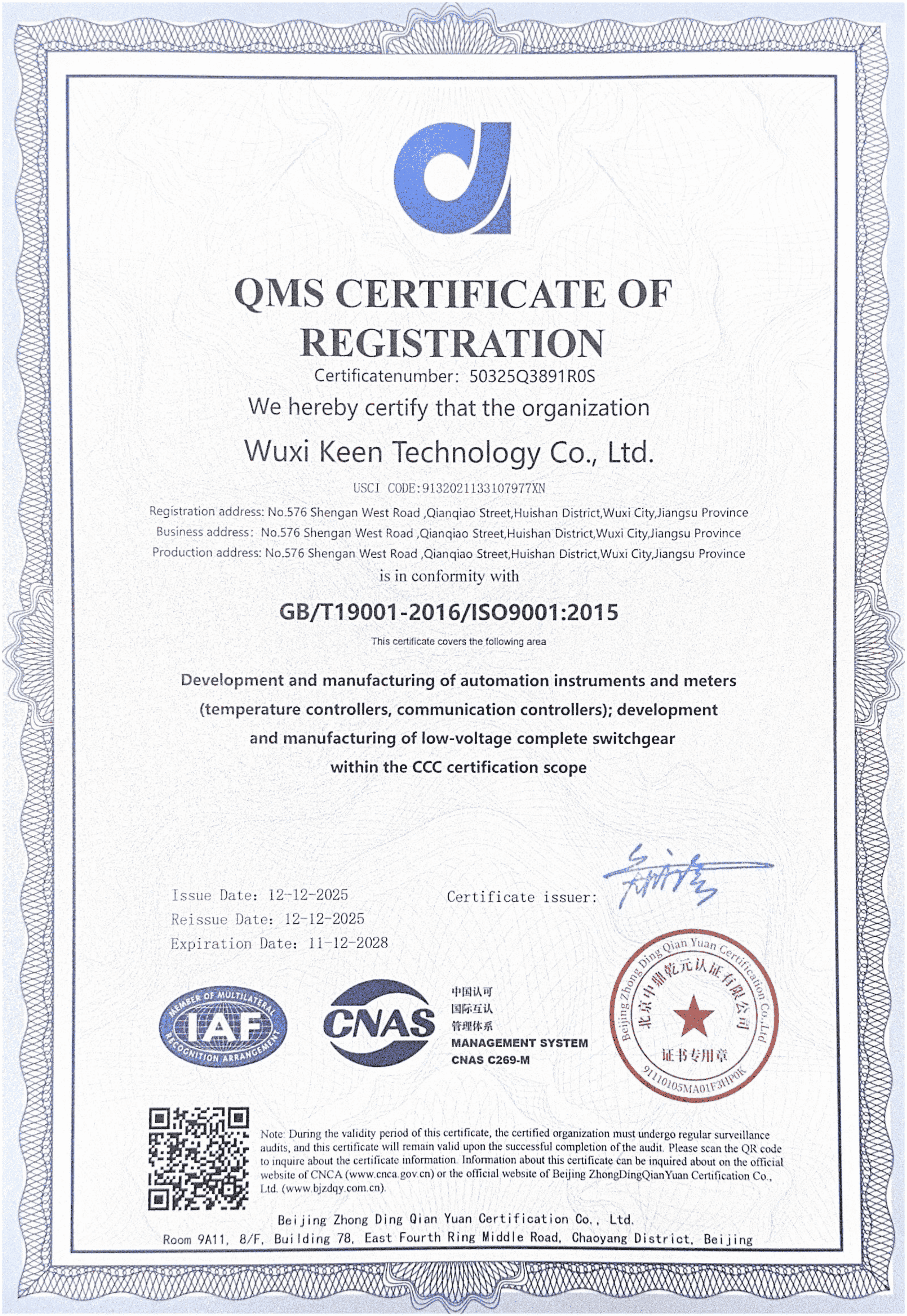
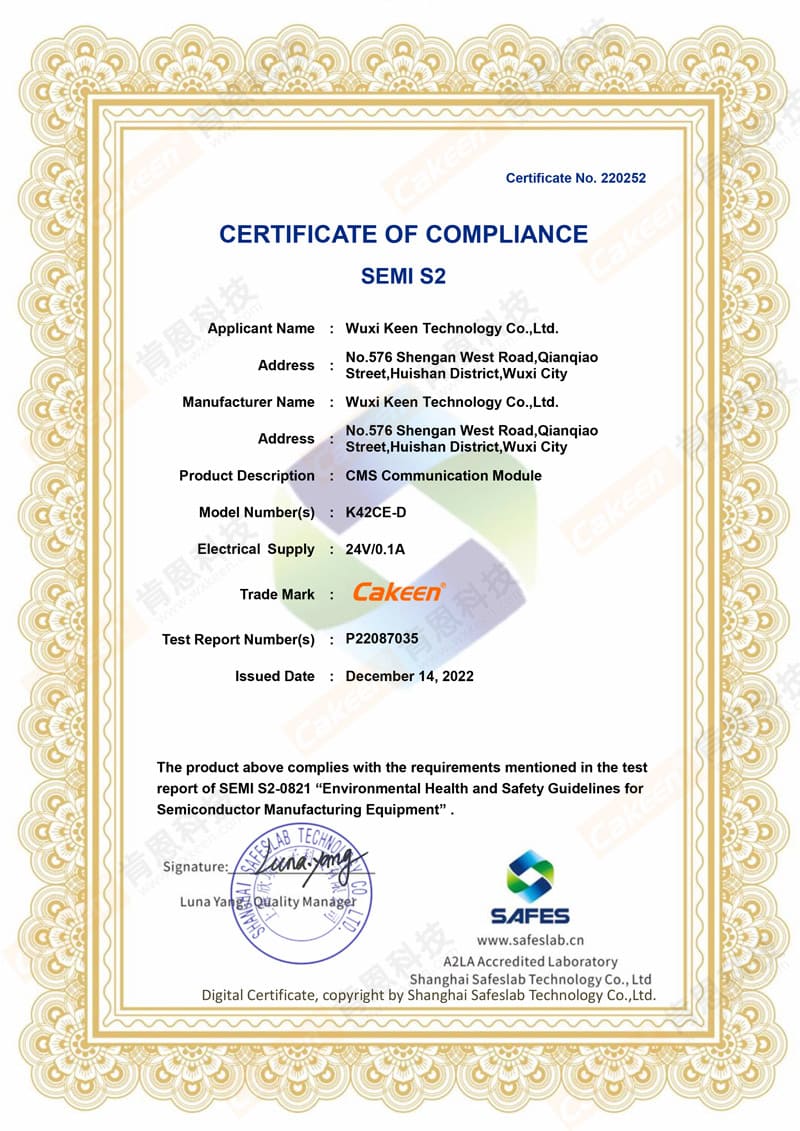
The point that matters for buyers is that the controller is manufactured under the same quality system as the rest of the product line. Cakeen holds ISO 9001 (certificate 50325Q3891R0S), ISO 14001 (50325E3892R0S), and ISO 45001 (50325S3893R0S) registrations issued by Beijing Zhong Ding Qian Yuan Certification Co., Ltd., valid from 12 December 2025 to 11 December 2028. The ISO 9001 scope explicitly covers the development and manufacturing of automation instruments and meters including temperature controllers and communication controllers. The company also holds SEMI S2 certification (certificate 220252, issued by SAFES for the EU market) covering the safety requirements of SEMI S2-0821 for semiconductor manufacturing equipment, plus CE and ROHS certifications.
Alongside hardware, Cakeen provides the control design services that normally sit around a controller inside a finished machine:
- Electrical drawing design compliant with IEC and UL508A standards, delivered as DWG, PDF, and BOM Excel files within a 2-4 week design cycle, with Chinese and English language support.
- PLC control program design for Siemens S7-1200/1500, Mitsubishi Q/L series, and Omron NJ/NX controllers, using Modbus TCP and Modbus RTU protocols and Python programming, delivered with documentation and executable files.
- PCB circuit board design from schematic to layout and routing, carrying UL and EMC certification.
- Embedded system software development covering IoT connectivity, edge computing, and AI analytics, delivered from hardware to application layer.
For OEM and ODM programs, all product parameters, logos, and appearance functions can be customized. Cakeen quotes a production lead time of 30-45 days, a monthly capacity of 40,000 units, 100% testing, and remote after-sales support. Minimum order quantity depends on the product line and configuration: standard production runs are quoted from 500 units, while some product lines support minimums from 5 units for evaluation and pilot builds.
FAQ: PID Temperature Controllers for Industrial Buyers
What certifications should a PID temperature controller manufacturer hold?
At minimum, buyers should look for an ISO 9001 quality management system registration whose scope covers temperature controller manufacturing, plus market access certification such as CE for the European Union. Where controllers are installed inside semiconductor manufacturing equipment, SEMI S2 is commonly required — Cakeen holds SEMI S2-0821 certification under certificate 220252. Cakeen also holds ISO 9001 (50325Q3891R0S), ISO 14001 (50325E3892R0S), and ISO 45001 (50325S3893R0S) registrations valid from 12 December 2025 to 11 December 2028, together with CE and ROHS certifications. Separately, if the controller is delivered inside an industrial control panel, the panel itself may need to comply with UL 508A for North American safety listing or IEC 60947 for international markets.
Can Cakeen customize PID temperature controllers for OEM equipment, and does the company provide control design services?
Yes on both counts. Cakeen operates an OEM / ODM production model in which all product parameters, logos, and appearance functions can be customized, supported by a 20-engineer R&D team. Beyond the controller itself, Cakeen provides electrical drawing design compliant with IEC and UL508A, PLC control program development for Siemens S7-1200/1500, Mitsubishi Q/L series, and Omron NJ/NX platforms, PCB circuit board design with UL and EMC certification, and embedded system software development covering IoT connectivity, edge computing, and AI analytics. For buyers integrating a controller into a larger control system, this means the controller, the cabinet drawing, and the control program can come from a single supplier.
What drives the cost of a PID temperature controller project?
Cost is driven by configuration rather than by the controller alone. The main variables are mounting format (panel mount, DIN rail, or inline heating tape), number of control channels, required accuracy class, output type (built-in SSR, external SSR, or analog 0-20 mA / 4-20 mA / 0-10 V), whether RS485 / Modbus RTU communication and supervisory monitoring are needed, the certification path the product must satisfy, the scope of OEM customization, and order volume against the manufacturer's minimum order quantity. Because these variables interact, buyers should specify the process window first and request a quotation against that specification rather than comparing list prices for nominally similar controllers. Cakeen quotes standard production runs from 500 units and supports minimums from 5 units on some product lines.
Can buyers validate a PID temperature controller with a sample before mass production?
Sample validation is the normal route, and Cakeen supports it through low minimum order quantities on selected product lines — from 5 units — so a controller can be tested on the actual load before a production commitment. Validation should mirror the real application: same sensor type (the Cakeen range accepts PT / K / J / R / S / T / B / E / N / L inputs), same setpoint and ramp profile, same actuator, and the same power supply (100-265V AC or 12-24VDC depending on model). Every unit is 100% tested before shipment, so the sample run is about confirming process fit rather than incoming quality.
What lead time and production capacity should buyers expect from Cakeen?
Cakeen quotes a production lead time of 30-45 days and a monthly capacity of 40,000 units, with 100% testing before shipment and remote after-sales support. Products are exported to Spain, Southeast Asia, the EU, and the USA. Buyers planning a build schedule should confirm lead time against the specific model and customization scope at the quotation stage, because appearance and parameter customization extends the front end of the order. To start a specification review, sample request, or quotation, contact the Cakeen team at jwy@wxkeen.com or via WhatsApp at +86 18921139517.
Conclusion: Start From the Process Window, Then Choose the Controller
A PID temperature controller is not a commodity part picked from a catalogue. It is the component that decides whether a thermal process holds its setpoint, and the right choice follows from the process window — the setpoint, the acceptable band, the sensor type, the actuator, and the mounting space available in the equipment. Panel mount controllers such as the 48×48 mm KE-48 suit operator-facing control, DIN rail controllers such as the four-channel KE-2104 suit cabinet integration, and inline controllers such as the KE-H10, H6625, and ASH suit pipe, vessel, and gas line heating.
Accuracy follows the same logic. A ±1°C band is appropriate where the goal is line stability and condensation prevention, as with the HOT-GUN pipeline nitrogen gas heater. A ±0.1°C band is appropriate where temperature determines the process result, as in the CVD, etching, and diffusion furnace applications where Cakeen controllers are installed.
Next Step: Specify Your Controller With Cakeen
Cakeen supplies PID temperature controllers in panel mount, DIN rail, and inline formats, backed by electrical drawing, PLC, PCB, and embedded software design services. Share your process window, sensor type, channel count, and mounting constraints, and the team will recommend a configuration and quote a sample.
Contact: Wendy | Email: jwy@wxkeen.com | Tel: +86-0510-85161878 / +86-18921139517 | WhatsApp: +86 18921139517 | Website: www.wxkeen.com
Wuxi Cakeen Technology Co., Ltd., No.576 Shengan West Road, Qianqiao Street, Huishan District, Wuxi City, Jiangsu Province, China.
Have Questions or Need More Details?
Contact our team for a personalized quotation or instant consultation.
Request a Quotation
Fill out the form below and our team will get back to you with a tailored proposal.
WhatsApp Direct Chat
Prefer to chat in real-time? Message us on WhatsApp for instant assistance & quick answers.
- Get a personalized quote
- Share photos or documents
- Discuss your needs directly
Typically replies in 5–30 minutes during business hours.