
Verifying PID Controller Manufacturer Capability & Delivery Assurance
Verifying PID Controller Manufacturer Capability & Delivery Assurance
The Quotation Answers Four Questions. None of Them Is Delivery Assurance.
A PID temperature controller quotation normally answers four questions: what one unit costs, how many units you must order, when the goods will ship, and how you will pay. For a buyer in the research-to-evaluation stage, none of those answers reveals whether the manufacturer can still deliver in month nine — after the pilot has passed, after the control cabinet has been wired, and after your own customer has fixed a production date.
Delivery assurance is not a promise written in an email. It is the visible output of production depth and supplier-side control. The practical way to verify it is to look one layer outside the product being quoted: at the expansion modules, the communication hardware, the adjacent thermal products, and the engineering services that a genuine manufacturer builds for the same customer base. A supplier that assembles controllers while outsourcing everything around them is returning that risk to the buyer.
This article sets out that verification model and applies it to Cakeen, the temperature control brand of Wuxi Cakeen Technology Co., Ltd. (Wuxi Keen Technology Co., Ltd.), a manufacturer founded in 2011 and headquartered in Huishan District, Wuxi, Jiangsu Province, that develops semiconductor industrial control electronics, electrical cabinet systems, and AI embedded systems.
Problem Definition: Three Gaps That Open After the Purchase Order
Delivery failures in temperature control procurement rarely look dramatic. They appear as three specific gaps, and all three are invisible in a price list.
- The component gap. The controller arrives, but the additional I/O points and the network interface were never part of the offer. The buyer then sources an expansion module and a communication module from a second and third vendor, and owns the compatibility risk, the extra freight, and the extra qualification work.
- The engineering gap. The hardware is correct, but no one on the supplier side can produce the electrical drawings, the bill of materials, or the PLC program. Commissioning slows down while the buyer's own engineers rebuild what a capable manufacturer would have supplied as a document deliverable.
- The scale and quality gap. The pilot performs well, then series delivery slips because the supplier's monthly capacity, test regime, and component supply were never sized for the order.
These gaps produce recognisable red flags during supplier evaluation. A catalogue that stops at the controller itself. Lead-time answers given without any capacity figure. No stated test regime. No document deliverables. Compliance described in adjectives instead of certificate names. The rest of this article converts those flags into a checklist that can be applied in a single supplier conversation.
Industry Background: Controllers Have Become Nodes, Not Instruments
The market context explains why evaluation criteria have shifted. The global PID controller market was valued at USD 1.60 billion in 2024 and is projected to reach USD 2.24 billion by 2032, according to SNS Insider. Strategic Market Research expects the industrial temperature controller market to grow at a CAGR of 7.1% from 2024 to 2030, driven largely by Industry 4.0 adoption. Dataintelo reported that Asia-Pacific dominated the temperature controller market in 2023 with a revenue share of 38.2%, with China as a key manufacturing hub.
Growth of that scale increases the number of manufacturers a buyer can find, and simultaneously makes them harder to separate. The decisive change is architectural rather than commercial: a temperature controller is no longer a stand-alone instrument with a display. It is a node inside a cabinet, on a Modbus network, reporting into monitoring software. The global semiconductor temperature control equipment market was valued at USD 663 million in 2024, per Market Research Reports, and Grand View Research notes that high-precision PID controllers can achieve temperature stability within ±0.1°C — a critical requirement for semiconductor lithography and etching.
Demand is also spread across very different verticals. SNS Insider reported that the oil & gas sector held the largest end-user share for PID controllers in 2024 at approximately 31.4%, while semiconductor, panel, chemical, and general industrial users operate under different precision, insulation, and documentation requirements. A manufacturer whose portfolio only fits one of those scenarios is a narrow supplier, not necessarily a weak one — but the buyer should know which scenario they are actually buying into.
Detailed Solution: The Five-Layer Ecosystem Test
The ecosystem test asks a single question: how much of the delivery does the manufacturer build itself? Five layers provide the evidence.
Layer 1 — Controller Portfolio Depth
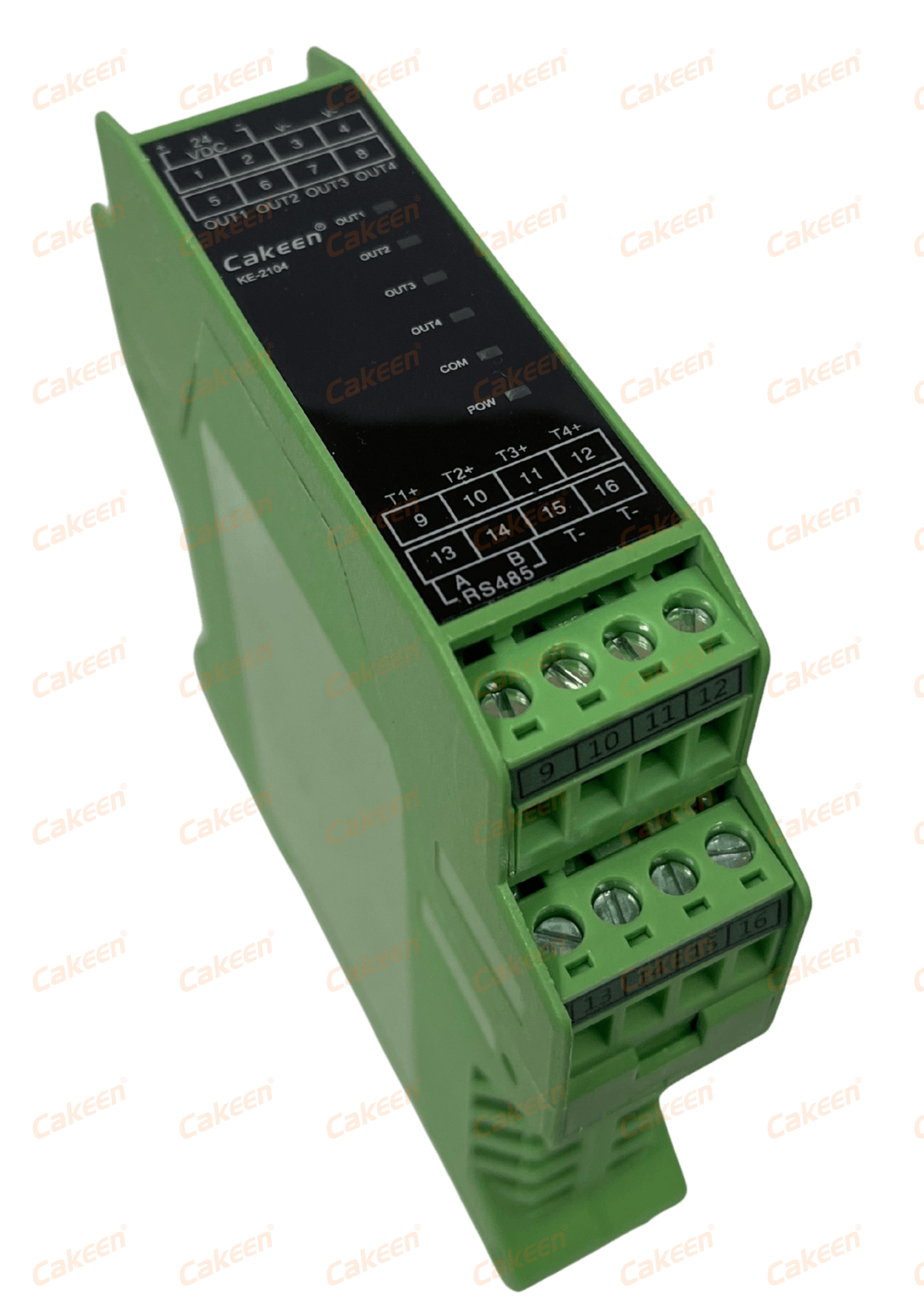
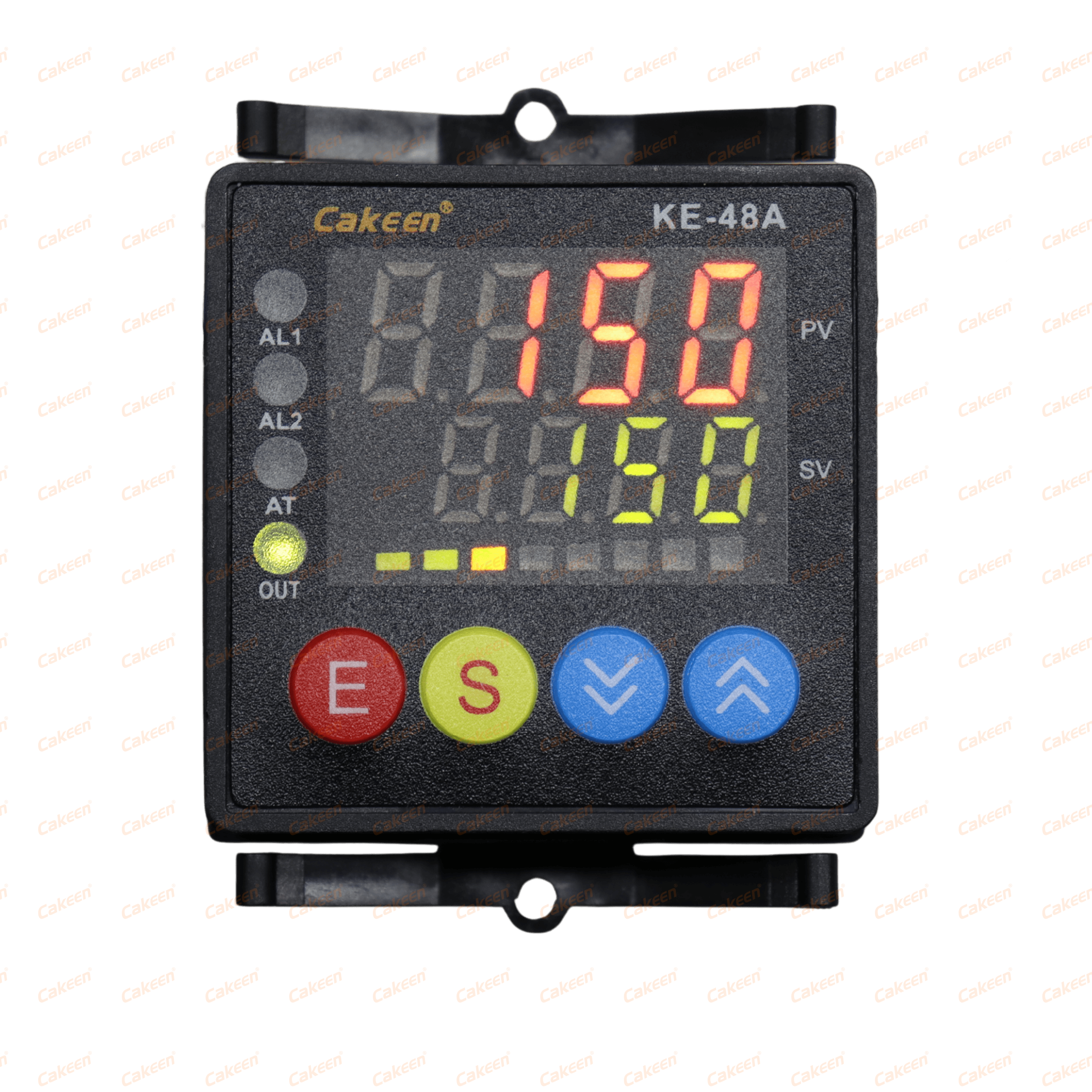
A manufacturer that fields multi-channel, panel-mount, and heating-tape controllers from the same engineering base signals that the control algorithm, sensor interface, and output stage are developed in-house rather than licensed per model. Cakeen's controller line includes the KE-2104 DIN rail mount 4-channel PID controller with ±0.1°C control accuracy, PT/K/J/R/S/T/B/E/N/L input types, external SSR output, 12–24 VDC power, and DIN35 rail mounting; the KE-48 48×48 mm panel-mount controller with ±0.1°C accuracy, SSR / 0-20 mA / 4-20 mA / 0-10 V output, one RS485 port, and 100–265 V AC power; and the single-channel heating tape family — ASH, H6625, and KE-H10 — all rated at ±0.1°C with RS485/Modbus RTU communication and built-in SSR output at maximum 3 A, 3 A, and 6 A respectively.
That spread matters for two practical reasons. A multi-channel PID controller and a compact panel-mount unit solve different cabinet-space problems, and a high-current heating tape controller covers pipe and vessel insulation duty — the same duty class as heating jacket and heating mantle temperature control in process and laboratory environments. When one supplier covers all three, the buyer does not have to re-qualify a second control platform for the second half of the project.
Layer 2 — I/O Expansion Modules
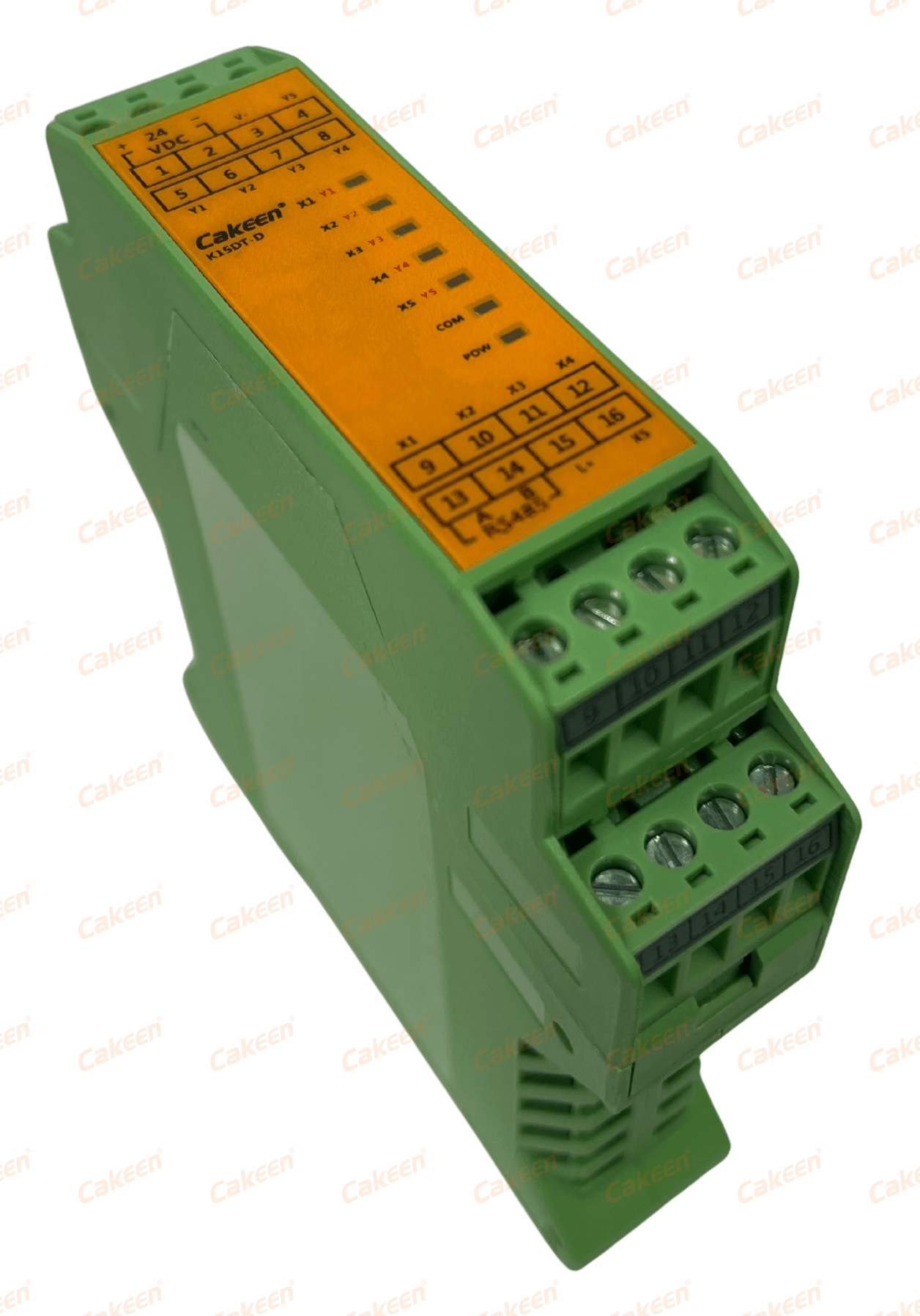
Expansion modules are the first place where a supplier's real integration depth becomes visible. The Cakeen K15DT-D I/O expansion module provides five NPN I/O points over Modbus RTU, with 12–24 VDC power and DIN35 rail mounting in a flame-retardant engineering plastic housing. It is used for switching control and remote I/O expansion — the point in the project where a controller's built-in I/O has been fully allocated and the buyer would otherwise have to bolt on a third-party device.
If a manufacturer cannot supply this layer, the delivery model is essentially: sell the controller, let the buyer solve the I/O. That is a legitimate business model, but it must be priced and scheduled as such.
Layer 3 — Communication Modules
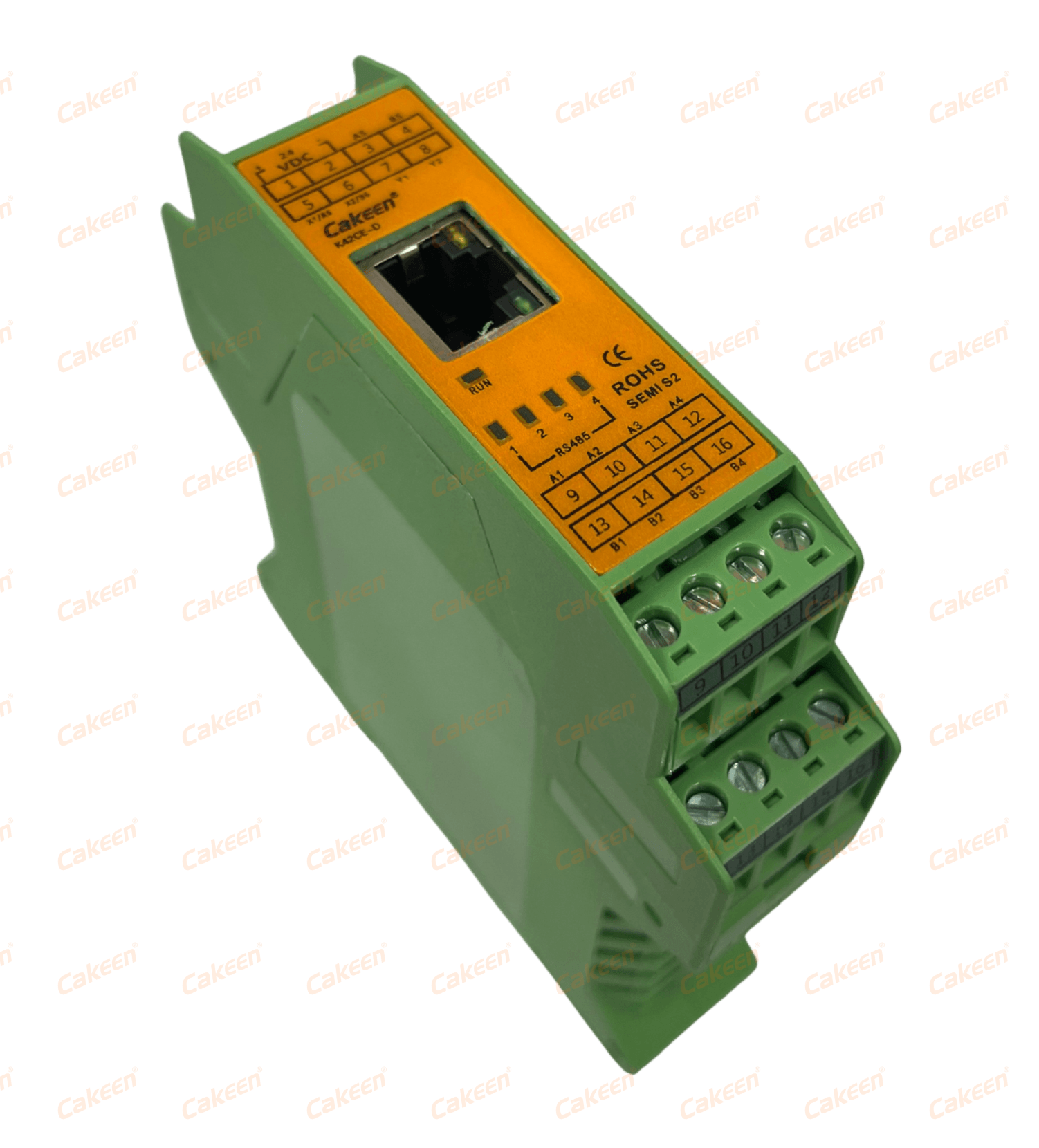
Network capability is where semiconductor and industrial buyers separate a temperature control supplier from a full control partner. The Cakeen K42CE-D communication module carries six RS485 ports and one Ethernet port with Modbus TCP/RTU protocol support, plus two NPN I/O points, 12–24 VDC power, and DIN35 rail mounting. Its documented application scope covers multi-RS485 device networking, low-latency parameter setting, data acquisition and forwarding, and lightweight PLC replacement scenarios, operating continuously around the clock.
This is the layer that most often determines whether a project runs on schedule. A controller with an RS485 port can be networked; a communication module with six RS485 ports and an Ethernet uplink determines how many devices can be networked, how fast parameters can be pushed, and whether the data reaches the customer's supervisory system without a separate gateway project.
Layer 4 — Adjacent Thermal and Gas Engineering
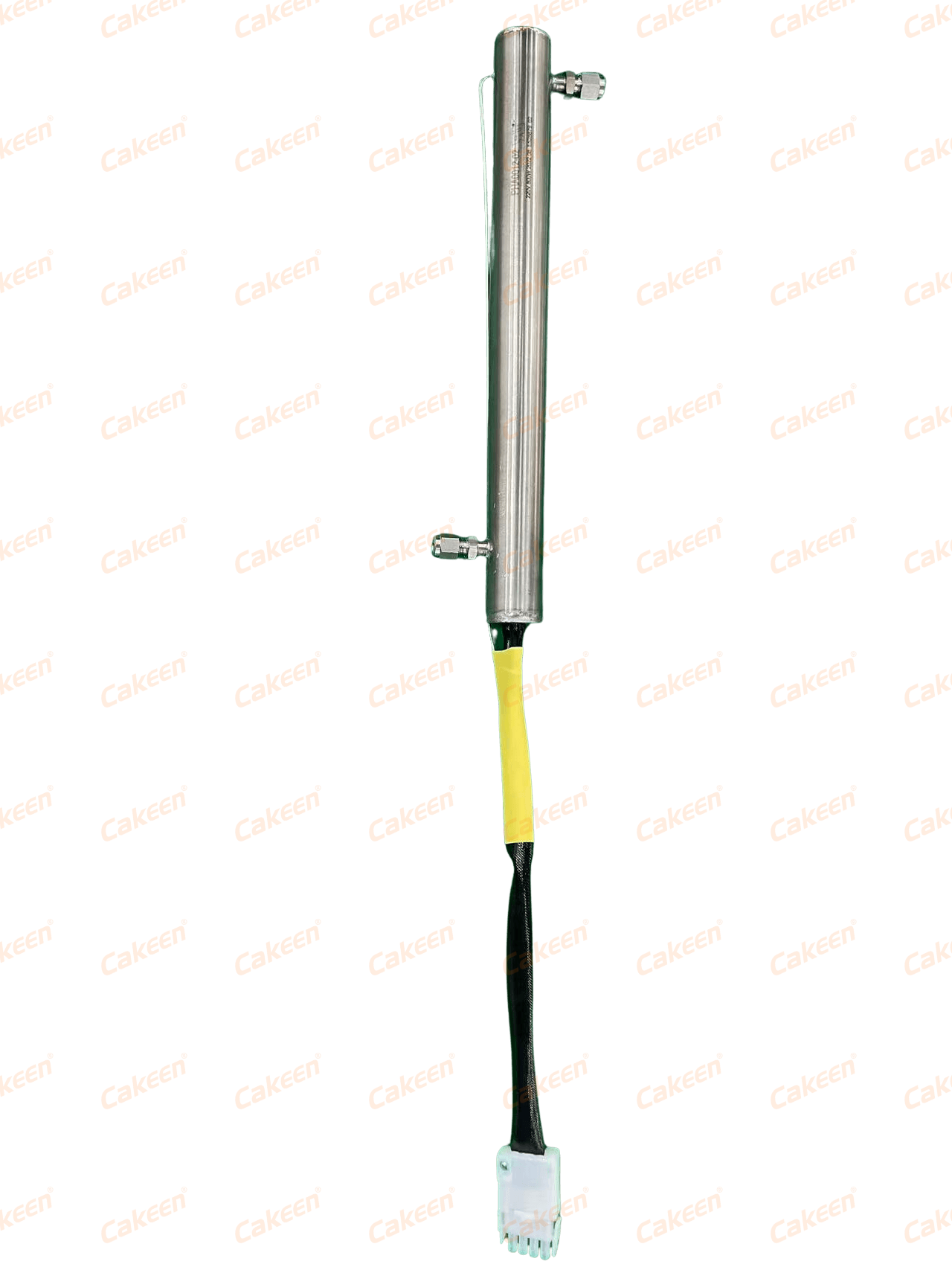
Products adjacent to the controller reveal whether the engineering team understands the process or only the loop. Two examples from the Cakeen portfolio make the difference concrete. The Pipeline Nitrogen Gas Heater (HOT-GUN) delivers ±1°C control accuracy across a 0–250°C temperature range at AC 220 V with 800 W–1600 W heating power, built in stainless steel and high-temperature alloy for anti-condensation duty on semiconductor nitrogen pipelines. The MFC Gas Flow Controller (HOT N2) holds ±1% F.S. flow accuracy across a 1–100 SLM range in stainless steel for semiconductor process gas delivery, where high-purity conditions and precise flow control are mandatory; it is CE certified.
Buyers should read these as competence evidence rather than as catalogue filler. A manufacturer that can hold ±1°C on a flowing nitrogen line has already dealt with sensor lag, heater response, and condensation behaviour — the same variables that decide whether a ±0.1°C controller performs as specified once it is installed inside a real thermal system.
Layer 5 — Design, Programming, and Production Control
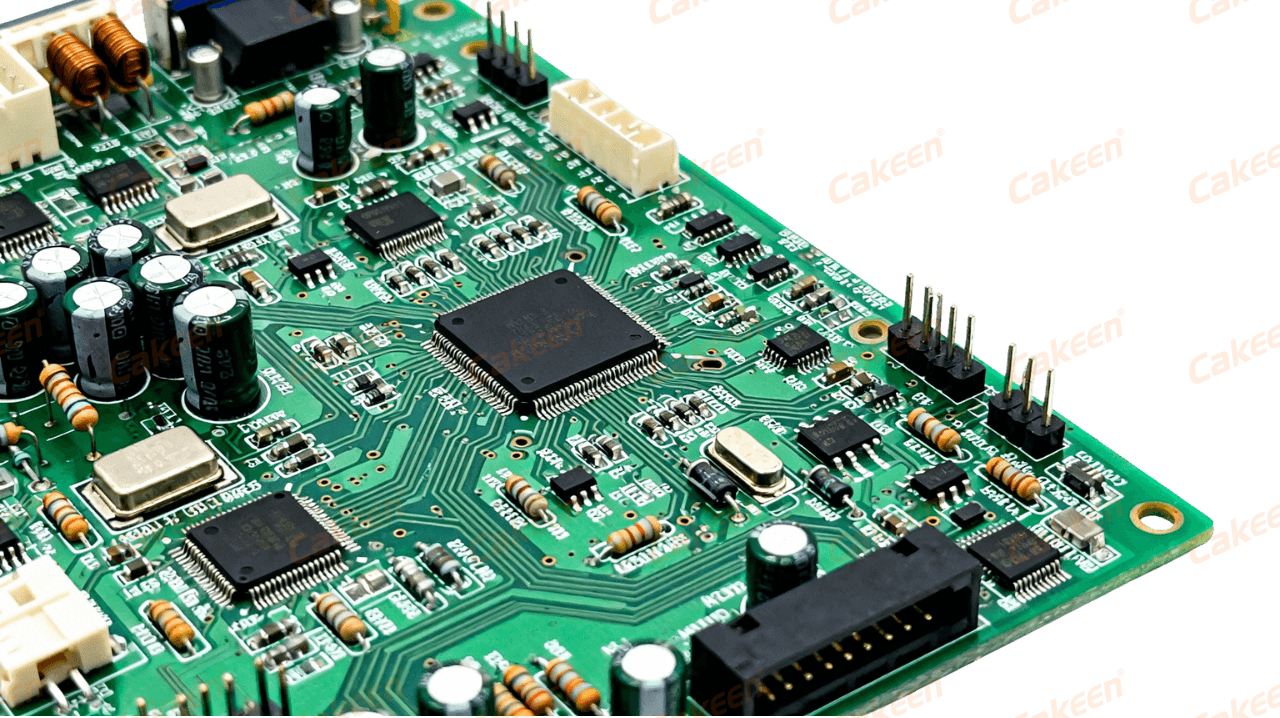
The final layer is documentable engineering work, which is the most reliable predictor of delivery assurance because it leaves a paper trail.
- PLC control program design. Support for Siemens S7-1200/1500, Mitsubishi Q/L series, and Omron NJ/NX platforms, with Modbus TCP and Modbus RTU protocols, Python as the programming language, and documentation plus executable files as deliverables.
- PCB circuit board design. Schematic to PCB layout and routing, certified to UL and EMC, aimed at industrial control motherboard design.
- Electrical drawing design. IEC and UL508A design standards, DWG, PDF, and BOM Excel delivery formats, a 2–4 week design cycle, and Chinese/English language support for semiconductor equipment retrofit, new equipment electrical design, and factory electrical system upgrades.
- Embedded system software development. IoT connectivity, edge computing, and AI analytics delivered as a full-stack solution from hardware to application layer.
Behind those services sit production facts that can be audited: OEM/ODM production with customization of parameters, logo, and appearance functions; a monthly capacity of 40,000 units on the controller line with a 30–45 day lead time, a 500-unit minimum order quantity, and 100% testing; a second, project-oriented line running at 80 units per month with a minimum of 5 units; export markets across Spain, Southeast Asia, the EU, and the USA; and remote after-sales support. The company reports an annual output of 500,000 units from a 2,019 m² facility with 50 employees and a 20-engineer R&D team, an export ratio of 40%, and certifications spanning ISO 9001, ISO 14001, ISO 45001, UL, SEMI S2, CE, and ROHS.
Step-by-Step Breakdown: A Six-Step Verification Workflow
- Map the thermal architecture before contacting suppliers. Count control channels, list sensor types in use, define whether the network is RS485, Ethernet, or both, and note cabinet space. A jacketed vessel, a heated transfer line, a laboratory heating mantle, and a nitrogen pipeline each change the required form factor.
- Ask for the accessory layer in writing. Request the I/O expansion and communication modules by model — for example the K15DT-D expansion module and the K42CE-D communication module — and confirm they are supplied by the same manufacturer as the controller.
- Separate capacity claims from capacity evidence. Ask for monthly capacity, lead time, minimum order quantity, and the test regime. Cakeen's stated figures are 40,000 units per month, 30–45 days, 500 units, and 100% testing on the controller line.
- Request a document deliverable rather than a drawing sample. Electrical drawings to IEC and UL508A with a BOM in DWG, PDF, and Excel formats carry a stated 2–4 week design cycle; a PLC program deliverable includes documentation and executable files.
- Match the compliance scope to the destination market. UL 508A is the reference for North American industrial control panel safety listing and IEC 60947 for international markets, per UL Solutions. Cakeen's European Standard Electrical Cabinet is CE certified and TÜV Rheinland certified with IP54/IP65 protection, the Japanese Standard Electrical Cabinet is JIS-compliant, and PCB design is executed under UL and EMC compliance.
- Plan the monitoring and support path. The Industrial Device Central Monitoring System (CMS) supports 10,000+ Modbus TCP devices with a 10-second polling interval, monitors PV/SV temperature and AL1/AL2 thresholds plus TC BK sensors, and retains 365 days of time-series history in InfluxDB — a useful check that the supplier can support the system after delivery, not only the component.
Use Cases: Where the Framework Changes the Decision
Semiconductor nitrogen pipeline heating. Anti-condensation on pipe walls requires stable heat across a medium-high temperature range. The Pipeline Nitrogen Gas Heater holds ±1°C from 0–250°C at AC 220 V, 800 W–1600 W, in 24/7 continuous or on-demand-per-process operation. Buyers evaluating this scenario should verify the heater and the controlling PID device come from the same engineering base.
Heating tape on pipes, vessels, and jacketed lines. The ASH, H6625, and KE-H10 controllers provide ±0.1°C accuracy with built-in SSR output at 3 A, 3 A, and 6 A, RS485/Modbus RTU communication, and 100–265 V AC power. The H6625 mini design targets space-constrained installation, and KE-H10 targets higher-current chemical delivery insulation — two different answers to two different installation problems.
Multi-point cabinet temperature control. A single KE-2104 DIN rail unit controls four channels at ±0.1°C with external SSR output and DIN35 mounting, which reduces the number of discrete instruments inside an electrical cabinet. A documented semiconductor equipment OEM project uses both the KE-48 48×48 mm panel mount, which fits OEM equipment design, and the KE-2104, which saves cabinet space; that relationship has run for 4+ years at 50+ units per year for embedded temperature control in CVD, etching, and diffusion furnace equipment.
Flexible cabinet and retrofit projects. A domestic equipment integrator has purchased 100+ cabinet sets per year for 5+ years across factory automation and equipment retrofit work, with multi-PLC brand support (Siemens, Mitsubishi, Omron), configurable IP40–IP65 protection, and a reported 40% shortening of the customer's delivery cycle.
Data acquisition and predictive maintenance. A platform-level industrial IoT integrator project combined custom IoT gateway hardware and edge computing software for factory data acquisition and AI-based predictive maintenance, achieving real-time collection from 1,000+ sensors with AI anomaly detection reported to reduce unplanned downtime by 25%. The hardware was delivered with UL/EMC certification, and the full-stack scope ran from PCB to cloud across the CMS software, PCB design, and embedded software services.
Comparison Table: Verified Capability Signals vs. Red Flags
| Verification dimension | Evidence to request | Verified example (Cakeen) | Red flag |
|---|---|---|---|
| Control portfolio | Multi-channel, panel-mount, and heating tape models with stated accuracy and input coverage | KE-2104 (4-channel, ±0.1°C, DIN rail); KE-48 (48×48 mm panel, ±0.1°C); ASH / H6625 / KE-H10 (heating tape, built-in SSR max 3 A / 3 A / 6 A) | Catalogue limited to a single controller type |
| I/O expansion | Module model, I/O count, protocol, power, mounting | K15DT-D: 5 NPN I/O, Modbus RTU, 12–24 VDC, DIN35 rail | No expansion layer; buyer must source third-party I/O |
| Communication | Port count, protocol, application scope, mounting | K42CE-D: 6× RS485, 1× Ethernet, 2× NPN I/O, Modbus TCP/RTU, 12–24 VDC, DIN35 rail | Only a single RS485 port; gateways added by the buyer |
| Adjacent engineering | Thermal or gas products with published accuracy figures | HOT-GUN: ±1°C, 0–250°C, AC 220 V, 800–1600 W; HOT N2 MFC: ±1% F.S., 1–100 SLM | No process-level products; accuracy unproven outside the datasheet |
| Document deliverables | Drawing standards, formats, design cycle, language support | Electrical drawing design: IEC, UL508A, DWG / PDF / BOM Excel, 2–4 weeks, Chinese and English | Refusal to commit to a document deliverable or a timeline |
| Software and integration | PLC platforms supported, protocol, language, deliverables | PLC program design: Siemens S7-1200/1500, Mitsubishi Q/L, Omron NJ/NX, Modbus TCP/RTU, Python, documentation plus executable files | Programming treated as the buyer's problem |
| Production capacity | Monthly capacity, lead time, minimum order quantity | 40,000 units per month; 30–45 days; MOQ 500 units on the volume line, 5 units on the project line | Lead time quoted with no capacity figure attached |
| Quality regime | Test coverage, facility and engineering headcount | 100% test; 2,019 m² facility; 50 employees; 20-engineer R&D team | Sampling described vaguely, no coverage percentage |
| Compliance | Named certificates and panel standards | ISO 9001, ISO 14001, ISO 45001, UL, SEMI S2, CE, ROHS; UL 508A / IEC 60947 for panel work; TÜV Rheinland certified European Standard Electrical Cabinet | Compliance claimed in adjectives only |
| Post-delivery support | Monitoring capability and support model | CMS: 10,000+ Modbus TCP devices, 10-second polling, 365-day history; remote after-sales support | No defined support path after shipment |
FAQ: Verifying a PID Temperature Controller Manufacturer
What certifications should a PID temperature controller manufacturer be able to document for industrial and semiconductor projects?
Buyers should expect two categories. The first is management-system certification: ISO 9001, ISO 14001, and ISO 45001. The second is application and market certification: CE, ROHS, UL, and SEMI S2 for semiconductor-relevant products. Cakeen holds all of these. For control cabinet and panel work, UL 508A governs North American safety listing and IEC 60947 applies internationally, according to UL Solutions; Cakeen's European Standard Electrical Cabinet is CE certified and TÜV Rheinland certified, and PCB design is executed to UL and EMC requirements. The correct test is not whether a supplier lists certificates, but whether each named certificate maps to the destination market and the end application.
How can a buyer verify capability claims that are difficult to check directly?
Verify the layers around the controller rather than the claim itself. Ask for an I/O expansion module such as the K15DT-D with five NPN I/O points over Modbus RTU, and a communication module such as the K42CE-D with six RS485 ports, one Ethernet port, and Modbus TCP/RTU support. Then ask for engineering deliverables: PLC program development across Siemens S7-1200/1500, Mitsubishi Q/L, and Omron NJ/NX platforms with Modbus TCP/RTU and Python; PCB design under UL and EMC; electrical drawing design to IEC and UL508A in DWG, PDF, and BOM Excel formats within a 2–4 week cycle; and process-level products such as the HOT-GUN pipeline nitrogen heater at ±1°C over 0–250°C or the HOT N2 mass flow controller at ±1% F.S. over 1–100 SLM. A manufacturer that can produce those artefacts has demonstrated depth that a controller sample alone cannot.
What drives the budget of a temperature control project beyond the unit price?
Five cost drivers matter more than the headline unit price. First, channel count — a 4-channel DIN rail controller such as the KE-2104 replaces four single-channel instruments, while a single-channel 48×48 mm KE-48 suits panel retrofits. Second, input type coverage: PT/K/J/R/S/T/B/E/N/L support avoids a sensor change later. Third, output type and current rating: SSR, 0-20 mA, 4-20 mA, or 0-10 V on the KE-48, and built-in SSR rated at maximum 3 A on the ASH and H6625 versus 6 A on the KE-H10. Fourth, whether expansion and communication modules are required. Fifth, engineering scope — drawings, PLC programs, PCB design, and embedded software. Consolidating these with one manufacturer reduces integration and re-qualification workload, which is a budget item as real as the hardware itself.
Can we validate a supplier before committing to volume?
Validation does not have to start at full volume. Cakeen production runs as OEM/ODM with all parameters, logo, and appearance functions customizable, and the project-oriented line operates with a minimum order quantity of 5 units, while the volume controller line runs at a 500-unit minimum with a 30–45 day lead time and 100% testing. That structure allows a buyer to validate configuration and documentation on a small batch before scaling, which is the sequence most semiconductor and industrial equipment projects require.
What lead time should buyers plan for, and what makes it slip?
Cakeen states a 30–45 day lead time on the controller line against a monthly capacity of 40,000 units, and a 2–4 week design cycle for electrical drawing work, so a project that includes documentation should plan for the engineering cycle to run alongside production rather than after it. Lead time slips most often when the I/O modules, communication modules, or engineering documents are outsourced to parties outside the supplier's control, because the buyer then depends on two or three schedules instead of one. Confirming the module list, the document deliverables, and the test regime before the purchase order removes most of that exposure. Buyers who need to confirm current lead time, minimum order quantity, or configuration options for a specific project can contact Cakeen directly at www.wxkeen.com, by email at jwy@wxkeen.com, or by phone at +86-0510-85161878 / +86-18921139517.
Move from evaluation to validation
Cakeen supplies PID temperature controllers, expansion and communication modules, electrical cabinets, and the engineering services that surround them — so capability can be checked against documents and specifications rather than adjectives.
Request a configuration review, a quotation, or a small-batch validation run: www.wxkeen.com · jwy@wxkeen.com · WhatsApp +86 18921139517
Conclusion: Capability Is a Layer Count, Not a Claim
Delivery assurance cannot be verified from a quotation, because a quotation describes one product while delivery depends on an entire system. The buyers who verify successfully count layers: a controller portfolio that covers multi-channel, panel-mount, and heating tape duty at ±0.1°C; an I/O expansion module such as the K15DT-D with Modbus RTU; a communication module such as the K42CE-D with six RS485 ports and one Ethernet port on Modbus TCP/RTU; process-level engineering proven by the ±1°C Pipeline Nitrogen Gas Heater or the ±1% F.S. HOT N2 mass flow controller; and documentable design services spanning PLC programming, PCB design with UL and EMC, electrical drawings to IEC and UL508A, and embedded software for IoT, edge computing, and AI analytics.
Each of those layers is a risk the manufacturer has already absorbed. Each is also a question a buyer can ask, with a verifiable answer. A supplier that answers all five — Wuxi Cakeen Technology Co., Ltd. among them, with its 40,000-unit monthly capacity, 100% test regime, 30–45 day lead time, and ISO 9001, ISO 14001, ISO 45001, UL, SEMI S2, CE, and ROHS certifications — has shown where its production depth ends. That boundary, made visible, is what makes a delivery commitment worth signing.
Have Questions or Need More Details?
Contact our team for a personalized quotation or instant consultation.
Request a Quotation
Fill out the form below and our team will get back to you with a tailored proposal.
WhatsApp Direct Chat
Prefer to chat in real-time? Message us on WhatsApp for instant assistance & quick answers.
- Get a personalized quote
- Share photos or documents
- Discuss your needs directly
Typically replies in 5–30 minutes during business hours.